

"In countless job postings, the salary field simply says 'subject to company policy' or 'to be discussed after interview' — leaving applicants completely in the dark."
Han Da-sri, chairperson of the International Medical Foundation labor union, made that observation at a labor policy forum hosted by President Lee Jae-myung in March, arguing that withholding such information entrenches low wages among young workers. She called for legislation requiring employers to state wages explicitly in job postings.
Lee said the point was "well taken" and expressed agreement. Four months on, however, little has changed in the job market.
Only 8 of 103 job postings disclose salary figures
A review of 103 entry-level and internship job postings active on the Jobkorea platform as of Tuesday found that only 8, or 7.8 percent, listed a specific monthly or annual salary. Seven private-sector companies — Kyobo Securities (internship), KoMiCo, Lotte Auto Care, Chosun Refractories, Eland Park, Dong-A Socio Group and PFD — disclosed monthly pay or annual salaries, while K-Water Technology, a subsidiary of Korea Water Resources Corporation, provided a salary range.
The remaining 95 postings, or 92.2 percent, gave no pay information, listing only phrases such as "subject to company policy" or "to be discussed after interview."
The public sector fared little better. A standing recruitment notice posted on Jobkorea by the Gyeonggi Province Job Foundation — a provincial youth employment agency — also listed compensation only as "subject to company policy." The practice of withholding wage information has taken root across the hiring market, extending beyond private companies to some public institutions.
As youth employment conditions worsen, frustration over opaque job postings is growing.
According to the Ministry of Statistics, the number of employed people aged 15 to 29 fell by 197,000 in June compared with a year earlier, marking 44 consecutive months of decline. The youth employment rate dropped 1.7 percentage points year on year to 43.9 percent, while the youth unemployment rate rose 0.9 percentage point to 7.0 percent. With fewer job opportunities available, critics say young workers are increasingly frustrated that they cannot even verify salary — one of the most critical factors in deciding whether to apply.
Demand for wage information during the hiring process is demonstrably high.
In a 2024 survey of 1,046 job seekers conducted by a recruitment platform, 56 percent cited "clear and detailed job postings" as the factor most likely to motivate them to apply — the top response. Starting salary and annual pay levels ranked first among the information applicants most wanted before applying, cited by 49 percent. A 2022 public survey by the Ministry of Employment and Labor on fair hiring legislation similarly found that the most common request — at 23.7 percent — was for job advertisements to include specific details such as duties and working conditions.
Some analysts also argue that disclosing wages upfront could reduce job mismatches and improve hiring efficiency, noting that early resignations are common among workers who joined without fully understanding their employment terms.
Korea Workers' Compensation and Welfare Service data show that of the 6,083,331 people who newly enrolled in employment insurance in 2023, 547,751 — or 9.0 percent — left their jobs within 30 days of starting. A separate Ministry of Employment and Labor survey on corporate hiring trends in the second half of 2023 found that 16.1 percent of new hires at the country's top 500 companies by sales left within a year, with "finding better working conditions" cited as the leading reason. Companies themselves reported that early departures cost more than 20 million won ($13,600) per person, lending weight to calls for greater transparency about working conditions at the recruitment stage as a way to reduce job mismatches.
Legislation to make wage disclosure mandatory in job postings was pursued in the National Assembly but ultimately failed.
In February last year, Democratic Party of Korea lawmaker Lee Yong-woo introduced an amendment to the Employment Security Act that would require employers to include salary information when posting job openings. The bill aimed to reduce information asymmetry in hiring by allowing job seekers to check compensation levels before deciding whether to apply.
However, when the National Assembly's climate, energy, environment and labor committee consolidated several related Employment Security Act amendments into a single substitute bill in April this year, the wage disclosure provision was left out.
The final substitute bill included measures to strengthen monitoring of false job advertisements, verify the identity and corporate information of employers, and require job postings to disclose workplaces cited in industrial accident reports — but the requirement to state salary levels was excluded. The information job seekers most want to know was, in effect, left to the discretion of employers.
Fears over fewer postings; scope and penalties also at issue
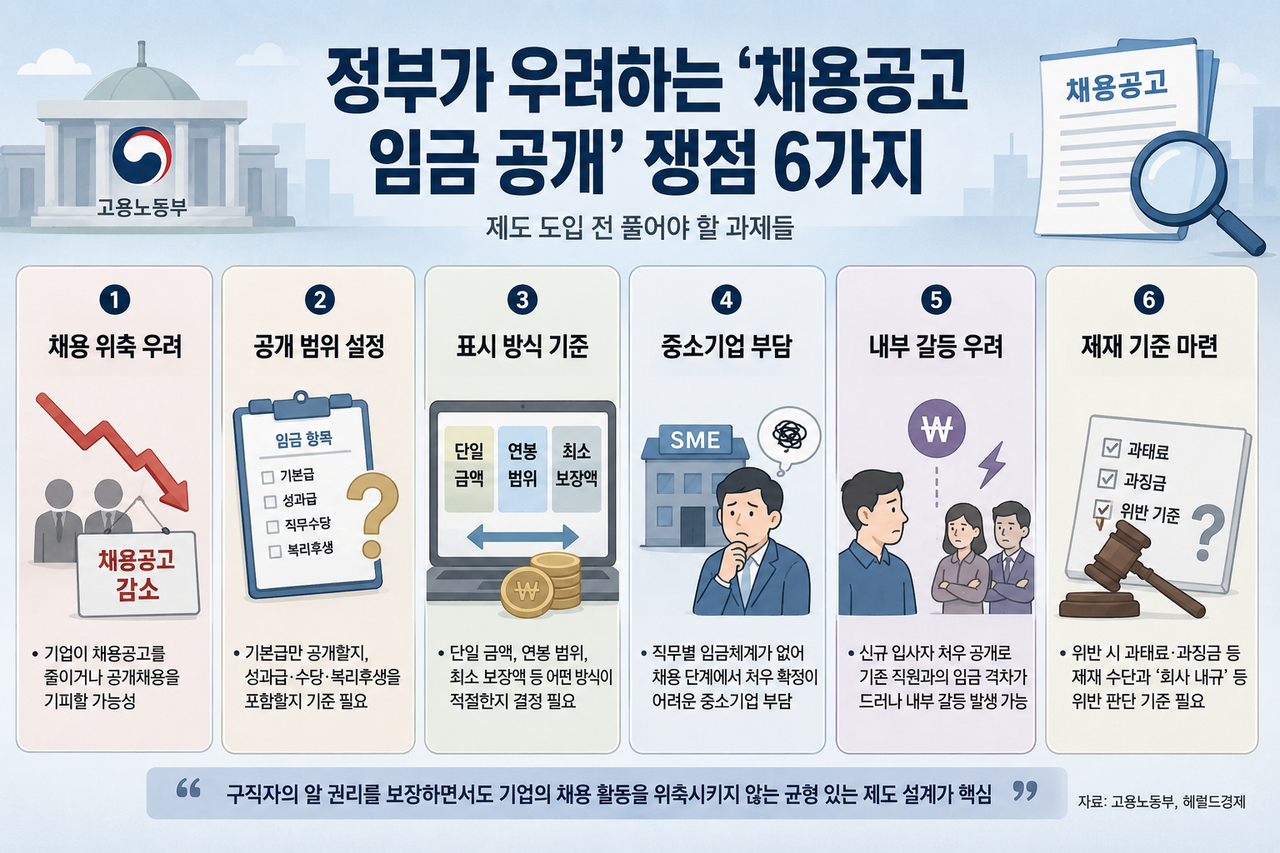
The government says it recognizes the need to expand wage disclosure, but its chief concern is that mandatory requirements could prompt companies to post fewer job openings or avoid public recruitment altogether.
"If companies find posting job advertisements burdensome, job seekers could actually end up with less information about available positions," a Ministry of Employment and Labor official said. "Finding the right balance — one that protects job seekers' right to information without discouraging companies from hiring — is the biggest challenge."
The government says the first step is defining what counts as "wages" for disclosure purposes.
Whether to require disclosure of base salary only, or total compensation including performance bonuses, job-specific allowances and benefits, would significantly affect how job seekers interpret the information. Companies where performance pay makes up a large share of total compensation say base salary alone does not accurately reflect actual earnings, but critics also note that requiring disclosure of variable performance bonuses is impractical.
How wages should be presented in job postings is another unresolved question. Even within a single posting, offered salaries often vary depending on a candidate's experience, role and qualifications. Companies warn that without clear standards on whether to list a single figure, a salary range or a minimum guaranteed amount, mandatory disclosure could generate more disputes rather than fewer.
Differences in capacity by company size also need to be considered. Large companies tend to have relatively well-defined pay structures by job function, but many small and medium-sized enterprises set compensation based on individual candidates' abilities and negotiation outcomes. Applying a uniform disclosure standard could place a disproportionate burden on smaller employers. The government is also weighing the risk that publishing new hires' pay could expose wage gaps with existing employees, potentially fueling internal conflict.
The Ministry of Employment and Labor says it also needs to think through what enforcement tools to use against employers who do not disclose wages. "We need to establish detailed criteria for determining whether phrases like 'subject to company policy' or 'to be discussed after interview' constitute a violation, and how to distinguish between simple mistakes and deliberate omissions or false postings," an official said, adding that "the level and scope of sanctions — such as fines or penalty surcharges — also need to be reviewed together."
Several countries have already made wage disclosure mandatory. Japan's Employment Security Act requires employers to list wages as a key working condition in job postings, alongside working hours, so that applicants can review essential terms before deciding whether to apply. In South Korea, the National Human Rights Commission recommended in 2018 that the Ministry of Employment and Labor consider making wage disclosure in job postings mandatory.
This article is part of a series that explains useful policy information in plain language, examining the background behind policy proposals, what changes they would bring, and who can benefit from them and how.
fact0514@heraldcorp.com





