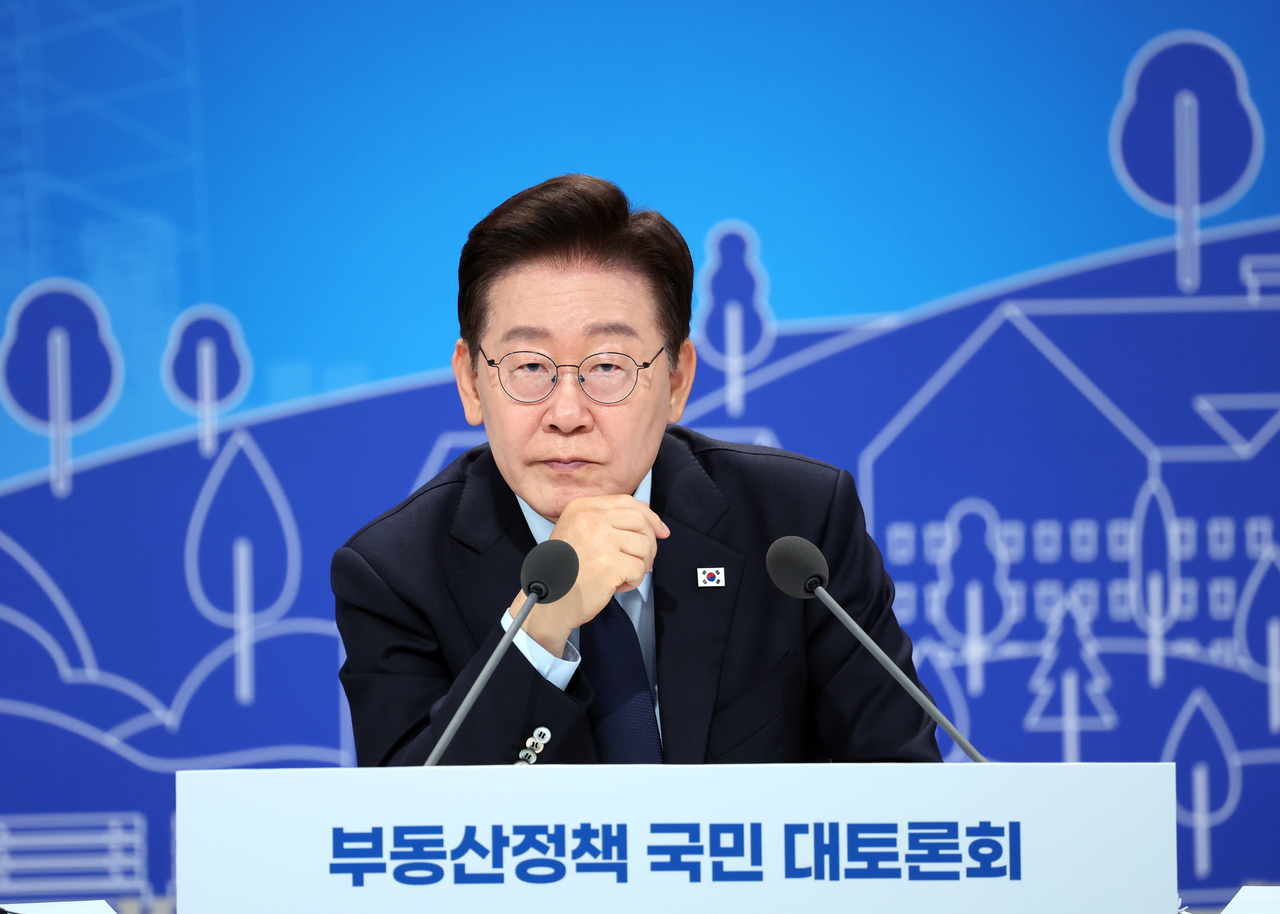
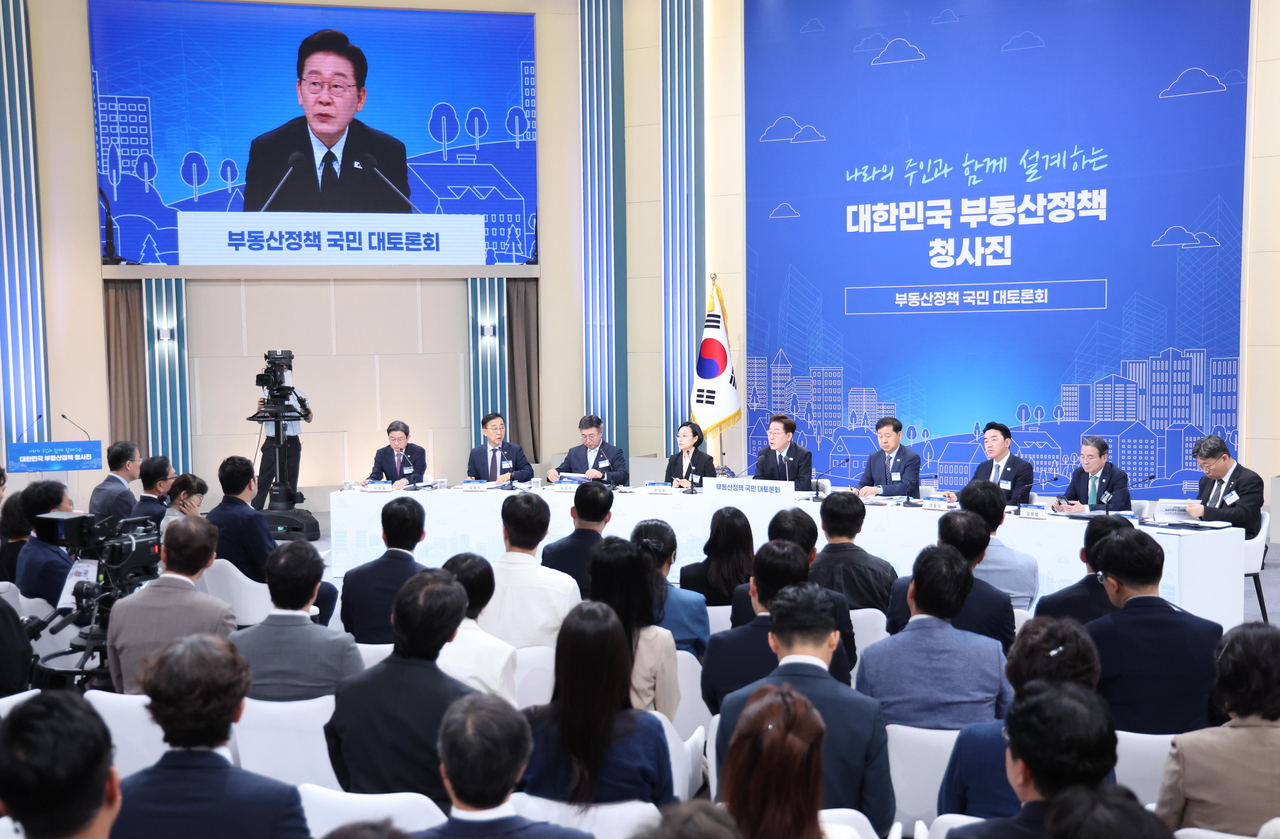
A broad consensus emerged Thursday at President Lee Jae Myung's national real estate policy forum that South Korea must accelerate housing supply. Participants put forward a range of proposals, including incentives for private construction-rental operators and deregulation of private redevelopment and reconstruction projects.
On the question of what should count as an "ultra-luxury single home" — the forum's central focus — opinions diverged sharply, with some calling for a threshold of 1 billion won in market value and others urging caution over the risk of passing higher holding taxes on to tenants. Lee reaffirmed his intent to strengthen holding taxes on high-value properties, saying "owners of expensive homes should bear a greater social burden."
The forum, held at the KBS annex in Yeouido, drew a wide range of proposals on how to expand housing supply.
Chae Sang-wook, chief executive of Connected Ground, argued that boosting private supply requires "a system that collectively nurtures developers who build and operate private long-term rental housing, along with strong incentives such as supplier financing." He added that keeping private rental separate from other housing categories would prevent various regulations and tax measures from bleeding into the private rental market.
Others called for easing relocation loans to unblock the supply pipeline from redevelopment projects. Yang Ji-young, a senior adviser at Shinhan Premier Pathfinder, said "looking at recently completed Gangnam-area complexes, the time from management and disposal plan approval to move-in and completion has stretched to eight to ten years — about three years longer than before." She said construction cost burdens, relocation loan availability and the ability to secure additional relocation financing all determine the pace of supply, and called for policy attention to those issues.
Jin Mi-yun, a professor at Myongji University's Graduate School of Real Estate, said in a keynote presentation that "what worries me is not a temporary dip in housing supply but the breaking of the supply chain itself," and called for expanded financial and tax support to revive new construction.
She also said accelerating supply at key sites and carefully designing what types of homes are built would be critical. She noted that overlapping regulatory zones — including adjustment target areas, speculative overheating districts and land transaction permit zones — should be streamlined, even though they were designed to stabilize the market and curb speculation.
Calls also came for speeding up large-scale supply projects such as the third-generation new towns. Ko Jong-wan, head of the Korea Asset Management Research Institute, said "the pace of third-generation new towns and similar projects must be raised," and added that the central and local governments should form a regular policy consultative body to coordinate plans for sites such as the Taereung Golf Course, the Yongsan railyard and the Gwacheon racetrack.
With the government signaling a tougher holding tax burden on ultra-luxury homes, participants were divided over where to draw the line. Jeong Se-eun, an economics professor at Chungnam National University, said that if owner-occupiers are to be protected, properties priced at roughly twice the national average — above 1 billion won ($675,000) — should be classified as ultra-luxury, and called for "a strong measure with no exceptions" in any tax reform.
Some argued that heavier taxes on premium "one prized home" holdings were needed, while others warned that the burden could be passed on to tenants and destabilize the rental market. Lee Hyeong-il, first vice minister of the Ministry of Economy and Finance, relayed pre-forum survey findings, saying participants had expressed the view that "excessive tax benefits for owners of a single ultra-luxury home should be restricted," with suggested thresholds ranging from 3 billion won to 5 billion won. Participants also called for revising the current tax system, which is centered on the number of homes owned.
Kim In-man, head of the Kim In-man Real Estate Economics Research Institute, said "it is doubtful that raising the holding tax on ultra-luxury homes would stabilize prices for apartments below 1.5 billion won, which is where the real problem lies," adding that he was uncertain whether any such link would produce results within a few years.
Lee acknowledged that setting a uniform threshold for ultra-luxury homes would not be easy. "Even for a home valued at 3 billion won, people in the regions and those living in Seoul and the greater metropolitan area may see it very differently," he said. "There could be enormous tax resistance, and the threshold is hard to set because the impact varies by region and circumstance."
Even so, Lee signaled that heavier taxes on high-value "one prized home" holdings were warranted. He said "there may be people who would want to buy a Han River-view apartment no matter the price," and added that "if someone can afford the taxes, that choice should be respected."
hss@heraldcorp.com
hwshin@heraldcorp.com
quq@heraldcorp.com