![A villa neighborhood in Seoul. [Herald Business DB]](https://wimg.heraldcorp.com/news/cms/2026/07/24/news-p.v1.20260306.2764f90170204a60aca34e1199b29619_P1.jpg)
As the government puts forward expanded non-apartment housing supply — including row houses, multi-family homes and officetels — along with accelerated redevelopment and faster third-generation new town construction as solutions to the housing shortage, calls are growing from the field to address structural problems such as permit bottlenecks and financial regulations. President Lee Jae Myung has distanced himself from reconstruction and redevelopment as supply drivers, while signaling his intent to ease supply bottlenecks by speeding up administrative procedures.
Non-apartment permits down two-thirds — experts say exit routes for sellers must also be created
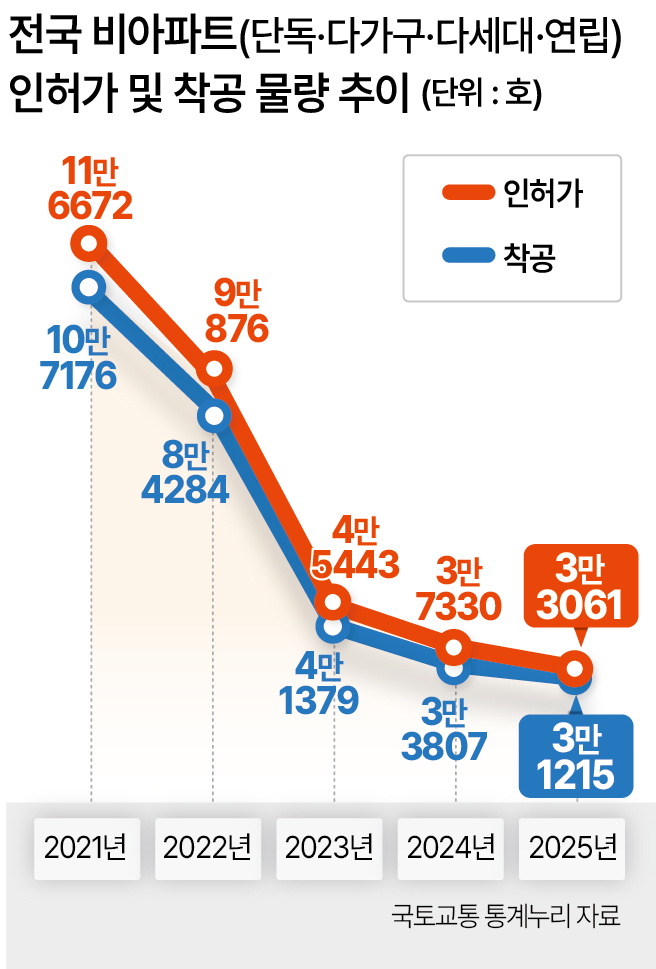
According to Ministry of Land, Infrastructure and Transport statistics, the number of non-apartment housing units permitted nationwide fell from 116,672 in 2021 to 33,061 in 2025. Ground-breakings also dropped from 107,176 units in 2021 to 31,215 units last year — a contraction to roughly one-third of supply levels in just four years.
As permits and ground-breakings declined, a national public forum on real estate policy chaired by President Lee on Thursday drew calls from multiple directions for targeted financial and tax support to revive new non-apartment construction.
Jin Mi-yun, a professor at Myongji University's Graduate School of Real Estate, said "permitting and ground-breakings both fell simultaneously from 2022, and new non-apartment construction dropped sharply after tenant confidence collapsed in the wake of jeonse fraud." She added that a shrinking pool of housing options for young single-person households and newlyweds "could translate into a heavier housing-cost burden for working- and middle-class families."
The supply contraction has pushed prices for row houses and multi-family homes higher. In Seoul, where apartment prices have risen sharply, residential demand has been shifting toward the relatively cheaper non-apartment market, pulling those prices up as well.
Korea Real Estate Board data on average monthly transaction prices for row houses and multi-family homes by region show that the average price per square meter for such properties in Seoul hit 10.04 million won ($6,830) in June last year — just before the June 27 mortgage lending restrictions took effect — crossing the 10 million won threshold for the first time. The figure climbed to 10.45 million won in January before pulling back, then returned to 10 million won in May.
Transaction volumes have also risen consistently this year. Korea Real Estate Board data on housing sales by type show that non-apartment transactions in Seoul increased by 1,570 cases, from 3,629 in January to 5,199 in May.
At Thursday's forum, participants also raised the idea of excluding certain non-apartment types — such as detached and multi-unit houses — from the total property count used for tax purposes, and of creating exit routes for non-apartment multi-property owners looking to sell. Chae Sang-wook, chief executive of Connected Ground, said "the collapse in non-apartment ground-breakings happened because financing collapsed along with it," and proposed cultivating long-term private rental housing developers and introducing dedicated supplier financing. He said financial support is needed for a broad range of non-apartment supply, including not only multi-unit houses but also residential officetels.
![The site of the Changneung third-generation new town in Goyang, Gyeonggi Province. [Yonhap]](https://wimg.heraldcorp.com/news/cms/2026/07/24/news-p.v1.20250523.295eb7536df84ad897c6335eb9b1a5b0_P1.jpg)
Experts urge easing of relocation loan rules and faster third-generation new town delivery
Whether restrictions on relocation loans — a key cause of delays in redevelopment projects — will be eased is another critical question. Metropolitan-area mortgage loans are capped at 600 million won, and a loan-to-value ratio of 40 percent applies in adjustment target zones and speculative overheating districts, making it increasingly difficult for residents at many project sites to secure rental housing using basic relocation funds alone.
According to the Seoul Metropolitan Government, 14 of the 35 redevelopment zones scheduled to relocate residents this year face uncertain financing. Even when guarantees are secured, borrowers must bear interest rates of 4 to 7 percent annually. The Seoul Metropolitan Government has asked the central government to raise the loan-to-value ratio on relocation loans to 70 percent and ease restrictions on transferring union membership. It has also called for relaxing the legal floor-area ratio cap for private redevelopment projects by 1.2 times.
Accelerating the third-generation new towns, where large-scale supply is planned, is another major challenge. The third-generation new towns — Wangsuk and Wangsuk 2 in Namyangju, Gyosan in Hanam, Gyeyang in Incheon, Changneung in Goyang and Daejang in Bucheon — are planned to deliver a combined 176,000 units. Announced in 2018 and 2019, the projects have taken years to break ground as land compensation, district planning, and environmental and traffic impact assessments have proceeded sequentially.
Gyeyang in Incheon, the first project to advance, did not begin construction until November 2022, more than three years after its district designation in 2019. Wangsuk in Namyangju, the largest site at 66,000 units, broke ground in October 2023 — about four years after its 2019 designation.
Changneung in Goyang, Gyosan in Hanam and Daejang in Bucheon have all seen construction schedules pushed back due to prolonged compensation processes, demolition of obstacles and negotiations over infrastructure. Concerns have also persisted that separate consultations required for wide-area transport projects — including rail and road links — could create a gap between move-in dates and the opening of transit networks. Gyeyang in Incheon is set to become the first third-generation new town to receive residents, with 1,285 units scheduled for move-in by the end of this year.
Experts said non-apartment housing, which can deliver supply effects most quickly, should be the first priority. Ham Young-jin, head of the real estate research lab at Woori Bank, said "the housing type that can realistically produce supply effects the fastest is non-apartments," explaining that "while apartments typically take five to six or more years to deliver, officetels and row and multi-family houses have relatively shorter construction periods, making it easier to accelerate supply."

quq@heraldcorp.com