![[123rf]](https://wimg.heraldcorp.com/news/cms/2026/07/27/news-p.v1.20241119.ae515bcd0dd74819ba47d08c51ca3ca7_P1.jpg)
South Korea's state-run think tank warned Monday that the government's push to reach 100 gigawatts of renewable energy capacity by 2030 is unlikely to succeed at the current pace of deployment.
While renewable energy subsidies were found to be economically justified — with social benefits exceeding costs — the Korea Development Institute said expanding deployment and improving policy efficiency will both remain out of reach unless structural bottlenecks in the power grid and project financing are resolved.
In a report released Monday titled "Policy Tasks for Effective Expansion of Renewable Energy Deployment," KDI said expanding renewable energy has become an urgent priority for national competitiveness and economic security, but that increasing subsidies alone has its limits.
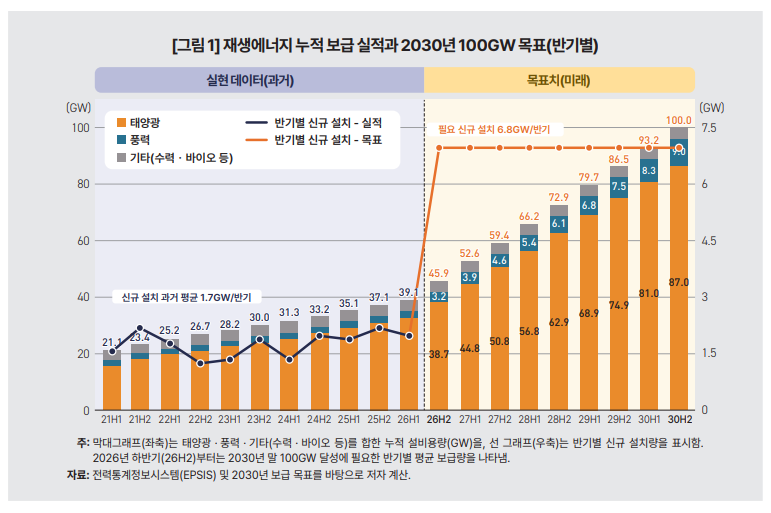
As of the first half of this year, South Korea's cumulative installed renewable energy capacity stood at 39.1GW. To reach the government's 100GW target by 2030, the country would need to add an average of 6.8GW of new capacity every six months — roughly four times the actual pace of 1.7GW per half-year recorded over the past five years. Solar installation would need to accelerate about 3.6 times, while wind power would require nearly 10 times the current rate.
KDI also assessed the economic viability of the Renewable Portfolio Standard and Renewable Energy Certificate regime that has underpinned renewable energy expansion. The analysis found that for every 1 won in subsidies, social benefits amounted to 1.33 won for solar and 1.18 won for onshore wind, confirming a minimum level of economic justification. However, the institute noted that benefit levels remain low compared with countries such as the United States — "barely exceeding costs" — and called for improvements to the system.
KDI also identified the power grid and project financing as the two biggest obstacles to expanding renewable energy.
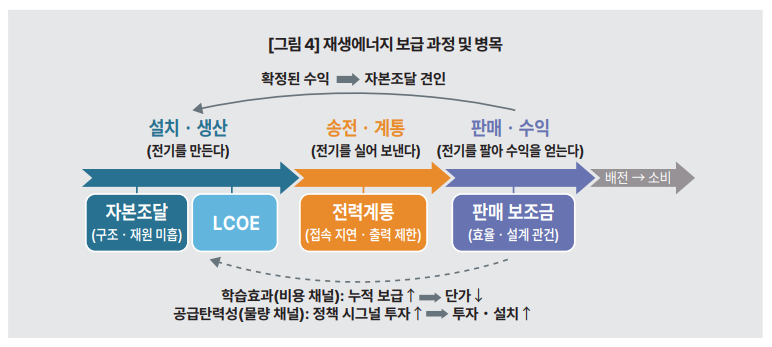
Transmission grid expansion has failed to keep pace with the growth in generation capacity. From 2003 to 2023, installed generation capacity grew 154 percent while the transmission network expanded by only 26 percent. As a result, new grid connections have been restricted in renewable energy-dense regions such as Honam and Jeju due to system saturation, and output curtailment has recurred repeatedly. KDI also noted that the regulatory frameworks needed to improve grid flexibility — including energy storage systems, distributed energy and demand-response markets — remain insufficiently developed.
The financing environment was also found to be inadequate. Renewable energy developers' revenues are heavily exposed to fluctuations in the wholesale electricity price and Renewable Energy Certificate prices, yet long-term fixed-price contracts and private power purchase agreement markets that could buffer such volatility have yet to take off. The financial market infrastructure needed to support project financing for large-scale offshore wind and energy storage system projects has similarly not matured enough.
KDI warned that the two problems are feeding each other in a vicious cycle. When output curtailment occurs due to grid shortfalls, developers struggle to forecast revenues, prompting financial institutions to raise the cost of capital to reflect the added risk. This in turn discourages new investment and slows renewable energy deployment. The institute warned that if the bottlenecks are left unaddressed and subsidies are simply increased, the cost-effectiveness of those subsidies could deteriorate further.
To accelerate renewable energy deployment, KDI recommended pursuing three measures together: expanding the transmission grid and power system, improving access to capital through long-term contracts and policy finance, and reforming the subsidy regime to make it more predictable. The institute particularly stressed that "the power grid is the physical prerequisite for other policies to take effect," identifying transmission network expansion and flexibility resource development as the most urgent priorities.
fact0514@heraldcorp.com