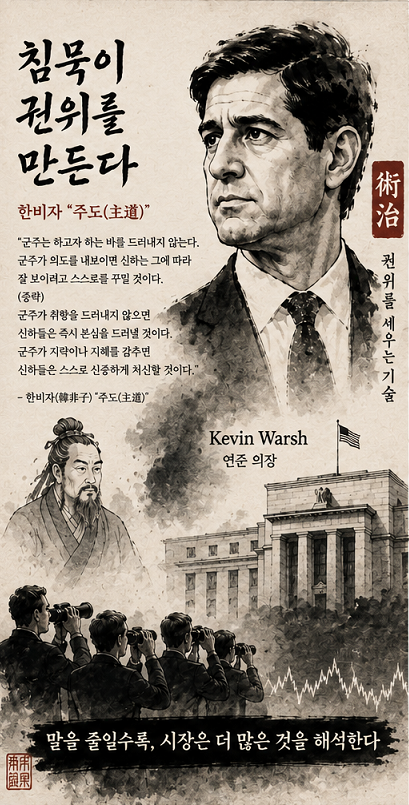
"A ruler does not reveal what he desires. If he shows his intentions, his ministers will dress themselves up accordingly … If the ruler conceals his preferences, his ministers will immediately reveal their true minds. If the ruler hides his stratagems and wisdom, his ministers will conduct themselves with care." — Han Feizi, "The Way of the Ruler"
The end of the 'helpful' Fed
The first notable change since Kevin Warsh took office as the new Federal Reserve chair has been his announcement that the Fed will scale back so-called forward guidance — the practice of signaling the direction of monetary policy in advance. The stated rationale is that when markets know where the Fed is headed, distortions from one-sided positioning can follow. Warsh is a former hedge fund professional who knows better than most how macro and arbitrage strategies are built around interest rate directionality.
But the deeper motivation is the restoration of the Fed's authority. Working at Morgan Stanley and the White House, Warsh watched Alan Greenspan move markets through deliberate ambiguity rather than open communication. Then, as the youngest Fed governor in history, he encountered Ben Bernanke, who responded to the financial crisis by emphasizing transparency and rolling out quantitative easing. At odds with that philosophy, Warsh resigned his governorship in 2011. In the years that followed, the Fed conducted monetary policy based on widely available economic indicators — with its hand visible to all, outside interference intensified. The running battle between President Donald Trump and former Chair Jerome Powell is the most prominent example.
When Warsh returned to the Fed as chair last May — 15 years after his departure — his inaugural address cited Greenspan as his role model and did not mention Bernanke, his five-year colleague, by name. Since then, Warsh has kept his mouth shut and his cards close, working to rebuild the Fed's institutional authority. The task force he established last month to drive Fed reform is the clearest expression of that effort.
'Reform the Fed' — five working groups take shape
When a new leader sets out to reshape an organization, legitimacy is everything. Soliciting the views of respected outside experts is a highly persuasive way to build it. The TF comprises 15 heavyweights — including former central bank governors of the United Kingdom, India and Brazil, a Nobel laureate in economics, and corporate CEOs — divided into five working groups: Data, Inflation Frameworks, Communication, Balance Sheet Policy, and Productivity & Jobs. Together they will chart the direction of Fed reform.
These are outside experts in name, but if the leader chose them and set the agenda, the broad direction is already decided. Given how prominent these figures are, their likely positions are also fairly predictable. A brief forecast of where each of the five working groups is headed:
First, read the economy through data that reflects the present, not the past.
Second, reduce interest rate volatility through policy credibility.
Third, let markets function rationally by saying less.
Fourth, use quantitative tightening rather than rate hikes to deflate asset bubbles and encourage fiscal discipline.
Fifth, build confidence in productivity gains driven by AI and other technological innovation as a counterforce to inflation.
The overarching message: keep the Fed's hand as hidden as possible while pursuing the optimal policy for economic conditions.
Keeping rate hikes to a minimum to tame inflation
Under this framework, the Fed's authority would be strengthened relative to today, and the tendency of markets to pile into one direction would diminish — reducing the need for sharp rate moves in either direction. Add quantitative tightening and technological innovation to the mix, and Warsh's direction points toward a clear inference: tame inflation with the smallest possible rate increases. The message is that the big knife should not be swung too often or too wide. Recklessness and authority are incompatible.
Trump nominated Warsh as chair with the expectation that he would cut rates. Instead, Warsh appears to be engineering a Fed that is harder for the government to meddle with. Why?
Warsh comes from money. He is the son of a wealthy family and the son-in-law of the Estée Lauder dynasty. He served as the youngest Fed governor on record and spent years in investment banking. He has little reason to chase a paycheck or a title. Power and legacy are more likely what drive him. Successfully installing what might be called the Warsh system at the Fed would be a considerable honor and a source of lasting authority. Greenspan became chair at 61 and served for 18 years. Warsh is 56 this year — young enough to think in decades.
'Kevin is ambitious' — comparing past Fed chairs
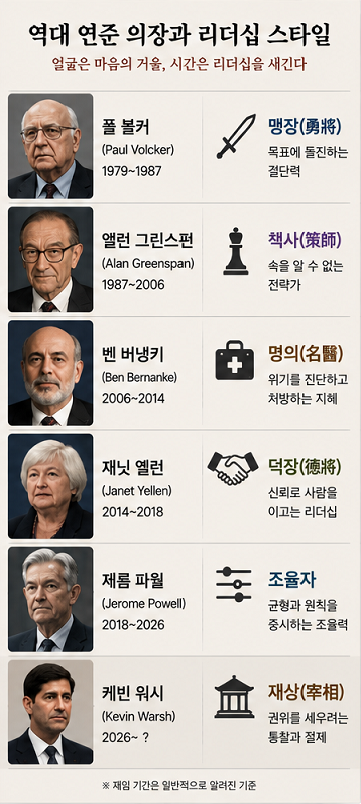
There is even academic research analyzing the relationship between the height of past Fed chairs and their monetary policy stances. But what about reading their faces? Physiognomy is not science. Yet there is a saying that the face is the mirror of the mind. One should never judge a person by appearance alone. Still, the faces of those who have held power for a long time bear the imprint of habit and responsibility, etched by time. The face does not determine destiny — it is the life lived that shapes the face. So what monetary philosophy might be written in the faces of past Fed chairs?
First, Paul Volcker (1979–1987), who carried out extreme tightening: the type who charges straight at the objective — a general of raw courage.
Second, Alan Greenspan (1987–2006), the longest-serving chair: the inscrutable strategist whose true intentions are never known.
Third, Ben Bernanke (2006–2014), who used quantitative easing to navigate the financial crisis: the skilled physician.
Fourth, Janet Yellen (2014–2018), who began winding down QE but managed the pace carefully: the virtuous commander.
Fifth, Jerome Powell (2018–2026), gentle but committed to balance and principle: the mediator.
Read through the lens of physiognomy, Warsh's face can be summed up in a phrase: a prime minister type bent on restoring authority. His gaze is focused, the space between his brows is clear, his lips are firmly set, and his jaw is strong. He has a large sense of ambition and the bearing of someone destined for high office — though the moment of full ripening has not yet arrived.
Yet there is visible tension in Warsh's bearing. It may stem from the weight of the role, but it may also reflect his awareness of the wide gap between the wishes of Trump, who appointed him, and the demands of the market. Known as a hawk, Warsh secured the chairmanship by arguing for the need to cut rates. But in his first rate decision after taking office, he showed a decidedly hawkish hand — a signal that friction with both the market and Trump may lie ahead.
'Success is what counts' — the stakes of reform for the global economy
The era of low interest rates that took hold after the global financial crisis appears to be drawing to a close. The balance between central banking and fiscal policy has never mattered more. AI is becoming a variable capable of shaking the financial system to its roots. The Fed, too, seems overdue for change. Whether Warsh will succeed in his reform effort, however, remains to be seen.
Concern about the fallout from quantitative tightening remains substantial. Former Chair Powell, breaking with convention, has stayed on as a governor, and governors appointed under Democratic administrations still hold a majority. How much of the outside experts' advice the conservative Fed bureaucracy will absorb is also an open question.
Above all, what matters most is whether the Fed can earn the market's trust through accurate diagnosis and sound policy. How faithfully new data sources reflect economic reality will require rigorous verification. Silence can amplify market misreading and push up risk premiums. Conversely, forward guidance can serve as a stabilizer that reduces uncertainty in medium- and long-term interest rates. The price the United States — and the world — would pay for a Fed misstep is too high.
A central bank's authority does not come from words — it comes from getting the call right. Silence, ambiguity and forward guidance are all ultimately just tools in the pursuit of credibility. Markets will not trust the Fed on authority alone, at least not for a while. Warsh's success or failure will be determined not by his silence, but by the accuracy of the judgment that lay behind it.
Han Feizi's art of statecraft builds a ruler's authority. But the moment the market — as the ruler's subject — reads that silence not as depth but as anxiety, the hidden hand becomes not authority but risk. Whether Warsh's silence proves to be one or the other, the Fed's results will ultimately provide the answer.
[Appendix] The five working groups of the TF Kevin Warsh established at the Fed, and their members
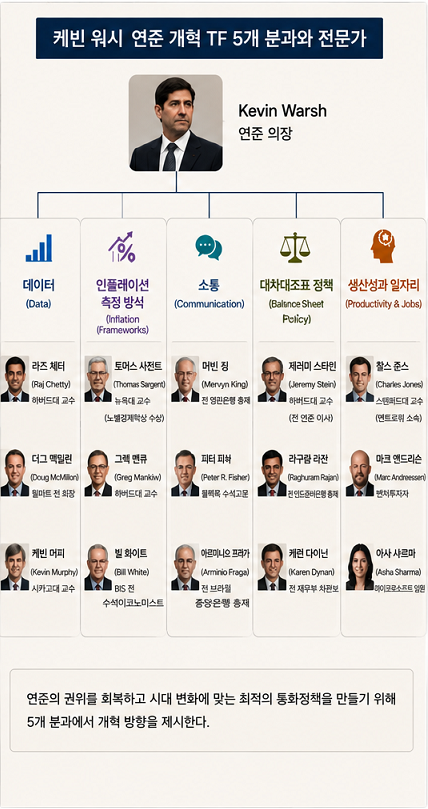
▶ Data
Most of the economic indicators the Fed uses in its decisions are figures that are at least a month old. Warsh wants data that reflects the present.
Harvard economist Raj Chetty built a system during the COVID-19 pandemic that combined credit card transactions, private payroll records and small-business revenue data to track economic conditions by neighborhood and income bracket — weeks ahead of government statistics.
Doug McMillon, former CEO of Walmart, is someone with deep firsthand knowledge of the real economy.
Kevin Murphy, a professor at the University of Chicago, is a leading authority on price theory and an expert at identifying data and determining what it actually means.
▶ Inflation Frameworks
Trump wants rate cuts. Bringing inflation down requires raising rates, which puts a heavy burden on the economy and public finances. Thomas Sargent, a Nobel laureate in economics and professor at New York University, has researched how coordination between a central bank and fiscal authorities alone can break inflation — the key being a government that stops adding to its deficit and a central bank that holds a firm line to win market confidence.
Harvard economics professor Greg Mankiw is also expected to provide the theoretical grounding for the argument that managing public expectations makes taming inflation considerably easier.
Bill White, an economist who spent his career at the Bank for International Settlements (BIS), predicted the 2008 financial crisis by focusing on debt and asset bubbles. He is expected to offer a framework for reading inflation not just from price indexes but from debt levels and asset prices.
▶ Communication
Mervyn King, former governor of the Bank of England, focused during his tenure on earning market trust without signaling the path of interest rates — exactly the Warsh style.
Peter R. Fisher ran trading operations at the New York Fed and led the fixed-income division at BlackRock, the world's largest asset manager. He is an expert on how markets react when the Fed signals its intentions in advance, and what effect that has on the broader economy.
Arminio Fraga, former governor of the Central Bank of Brazil, also earned market credibility during his tenure by taming inflation through action rather than words — having already traveled the road Warsh wants to take.
▶ Balance Sheet Policy
Warsh resigned as Fed governor in protest at the expansion of QE during the financial crisis response. Shrinking the balance sheet — selling into the market the government bonds the Fed accumulated through QE — is unfinished business for Warsh, but it is also the policy markets fear most, since it effectively tightens financial conditions by draining liquidity. Looked at another way, it is also a means of fighting inflation without raising interest rates.
Jeremy Stein, a Harvard economics professor and former Fed governor, holds that prolonged monetary easing causes markets to chase higher returns, building up risk in the system.
Raghuram Rajan, former governor of the Reserve Bank of India, has long warned of the dangers of the liquidity expansion that QE produces.
Karen Dynan, former assistant secretary for economic policy at the Treasury Department, is positioned to offer views on how QE has affected households.
▶ Productivity & Jobs
Warsh believes that productivity gains driven by AI have the power to hold inflation in check.
Charles Jones, a former Stanford economics professor now working at Anthropic, is researching the impact AI will have on economic growth.
Marc Andreessen is a Silicon Valley venture investor and specialist in digital assets, and one of the most plugged-in observers of the latest developments in technology.
Asha Sharma, a Microsoft executive, is among the experts best positioned to read how companies are actually deploying AI.
kyhong@heraldcorp.com