Mayor urges metropolitan transport chief to address key infrastructure needs
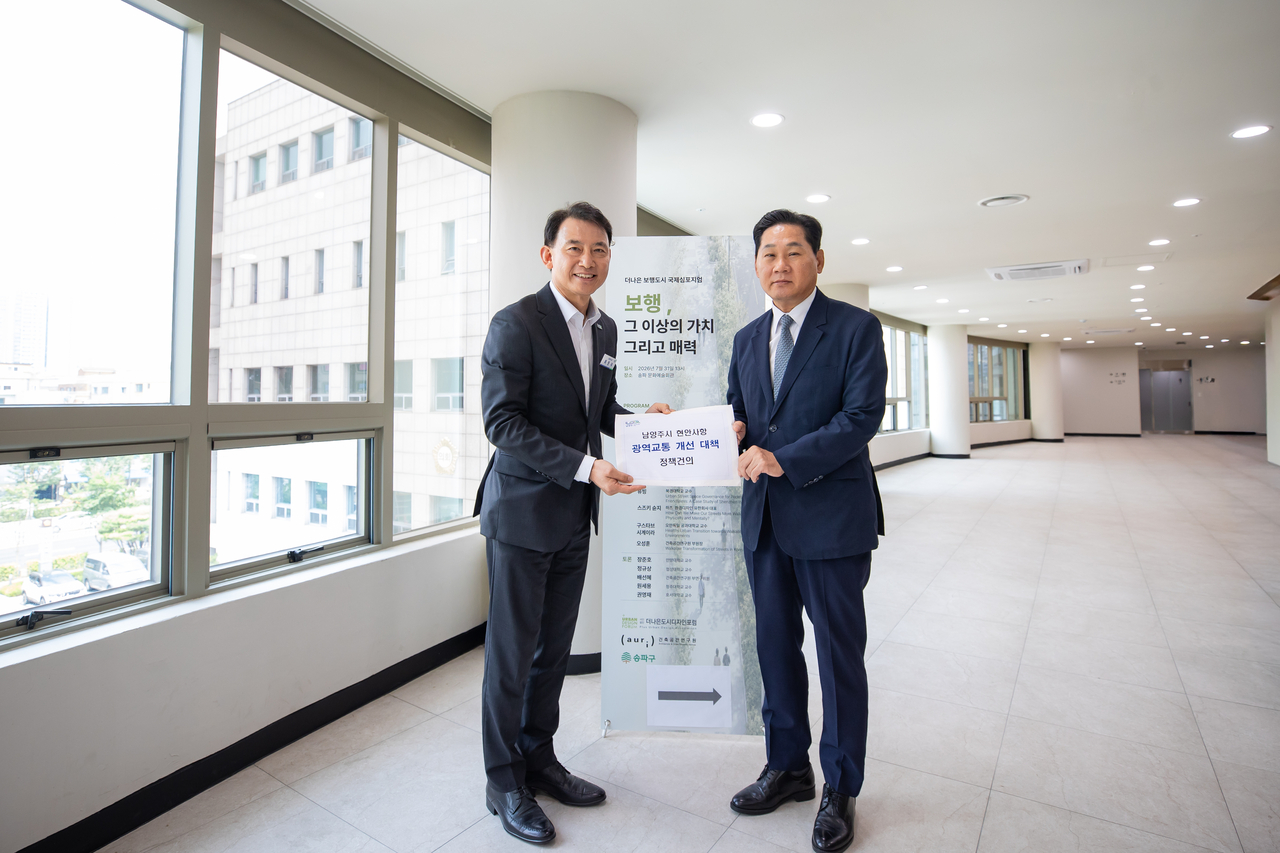
Namyangju Mayor Choi Hyeon-deok met with Kim Yong-seok, chairman of the Metropolitan Area Transport Commission, on Friday at the Better Walking City International Symposium held at Songpa Culture and Arts Center, urging the expansion of Namyangju's metropolitan transport network and improvements to the city's overall traffic conditions.
The symposium, co-hosted by the Better City Design Forum and the Architecture and Urban Research Institute, brought together domestic and international experts in urban planning and architecture to discuss ways to create cities where public transit and pedestrian movement are organically connected, under the theme "Walking: Beyond Its Value and Appeal."
Mayor Choi briefed Kim on Namyangju's metropolitan transport conditions and key pending issues, explaining that the city's transportation demand is growing rapidly due to large-scale urban development and population growth. He then called on the government to actively support the expansion of the metropolitan transport network to ease commuting difficulties for residents and improve mobility within living zones.
The mayor's proposals covered four areas: selecting the Byeollae Line (Line 8) extension as a subject for a preliminary feasibility study; rerouting the Gangdong-Hanam-Namyangju Line (Line 9) extension to pass through the Jingeon district's Wangseok incorporation area and adding new stations; reflecting the Line 3, 6 and 8 extension projects in the Fifth Metropolitan Transport Implementation Plan; and advancing a metropolitan road project linking Nowon and Namyangju.
The city said these projects are essential infrastructure needed to meet the transportation demand of large-scale development zones, including the Wangseok new town, and to improve access to Seoul and inter-regional mobility.
To organically connect the metropolitan transport network with residential living zones and create pedestrian-centered urban spaces, the city is pursuing a "Namyangju-style 15-minute neighborhood" policy — developed with input from a residents' planning committee as part of the process of drawing up the Namyangju 2040 Urban Master Plan.
In addition, the city plans to improve access to metropolitan rail stations and transit hubs and to upgrade pedestrian environments within living zones, with the goal of creating neighborhoods where residents can conveniently use nearby education, cultural, welfare and commercial facilities and services.
"The metropolitan transport network is the city's core foundation — it supports not only residents' daily commutes but their overall mobility in everyday life," Mayor Choi said. "We will work closely with relevant agencies to ensure that key rail and road projects proceed without delay."
He added that the city would "build a resident-centered city where metropolitan transport and walkability go hand in hand, based on a living-zone plan that reflects the opinions of the residents' planning committee."
The city said it plans to continue strengthening cooperation with the central government and relevant agencies, focusing its administrative efforts on creating a resident-centered city where the metropolitan transport network and living zones are organically connected.
pjh@heraldcorp.com