
![Tourists visit Bukchon Hanok Village. [Korea Tourism Organization]](https://wimg.heraldcorp.com/news/cms/2026/08/03/news-p.v1.20260803.20c94f83b490482dbaaa0afb5fe4d050_P1.jpg)
A new professional guide offering sustainable strategies for leveraging the unique assets of local communities, including tourism, has been published. The book provides a practitioner-focused analysis of local competitiveness and structural transformation from a public relations perspective.
Publisher Saeroun Saramdeul has released "Local Shift," co-written by eight PR professionals. The book goes beyond asking how to promote a region, focusing instead on how to build structures that allow communities to tell their own stories and forge their own relationships.
The authors — Jeong Gi-yun, Jeon Ye-ji, Park Ji-young, Seo Su-hyeon, Jeon Min-cheol, Jo Cheol-je, Yun Han-deuk and Kim Yun-mi — all hold the Korea Accredited Public Relations (KAPR) certification issued by the Korea Public Relations Association. Drawing on experience across a range of industries, the eight spent roughly a year writing the book, which covers local branding and storytelling, tourism, local food, transportation, IT, climate and community.
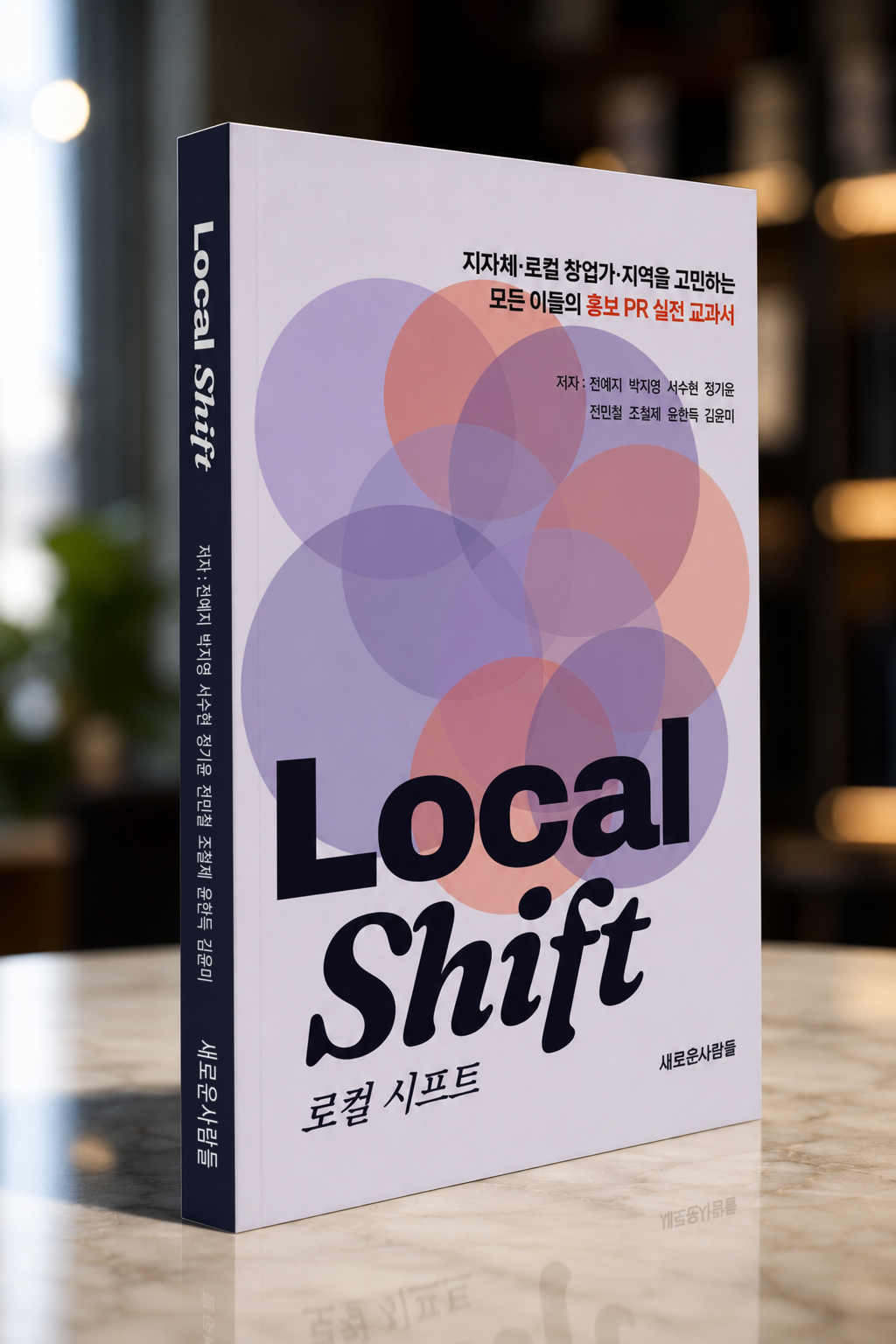
The book frames local communities not as victims of population decline or recipients of government support, but as "media assets" — spaces where distinct culture and lifestyle have accumulated — and as sites of creative potential. As global interest shifts from K-culture to K-lifestyle, the authors argue that a region's distinctly Korean character can become a competitive advantage that is difficult to replicate.
The authors also said local competitiveness comes not from large-scale development or facility expansion, but from reinterpreting existing assets — alleyways, markets, food, local dialects and residents' memories. They call for a shift away from one-way promotional campaigns toward a two-way communication structure in which residents, merchants, visitors and local government all participate.
The book is organized into eight chapters, each addressing local strategy in a specific field — local branding and storytelling, local food, tourism, transportation, IT, climate response and community — all examined through a PR lens. The tourism chapter particularly stresses the need to move away from policies centered on attracting tourists and toward structures in which residents play an active role.
Beyond emphasizing the importance of local communities, the book draws on case studies from Gangneung, Jeonju, Seongsu, Bukchon and Mangwon-dong, weaving in theories such as place branding, the experience economy, framing, diffusion of innovation, relationship management, social capital and two-way symmetrical communication to offer directions applicable to both policy and practice.
Jo Yeong-seok, chairman of the Korea Public Relations Association, said the book shows "what kind of innovation emerges when PR expertise built in the field meets the uniqueness of a local community," adding that "helping a region find its own voice — that is what PR is."
The authors will hold a book talk to mark the publication. The first event is scheduled for Aug. 26 at Joseon Salon in Jongno, Seoul.
terry@heraldcorp.com





