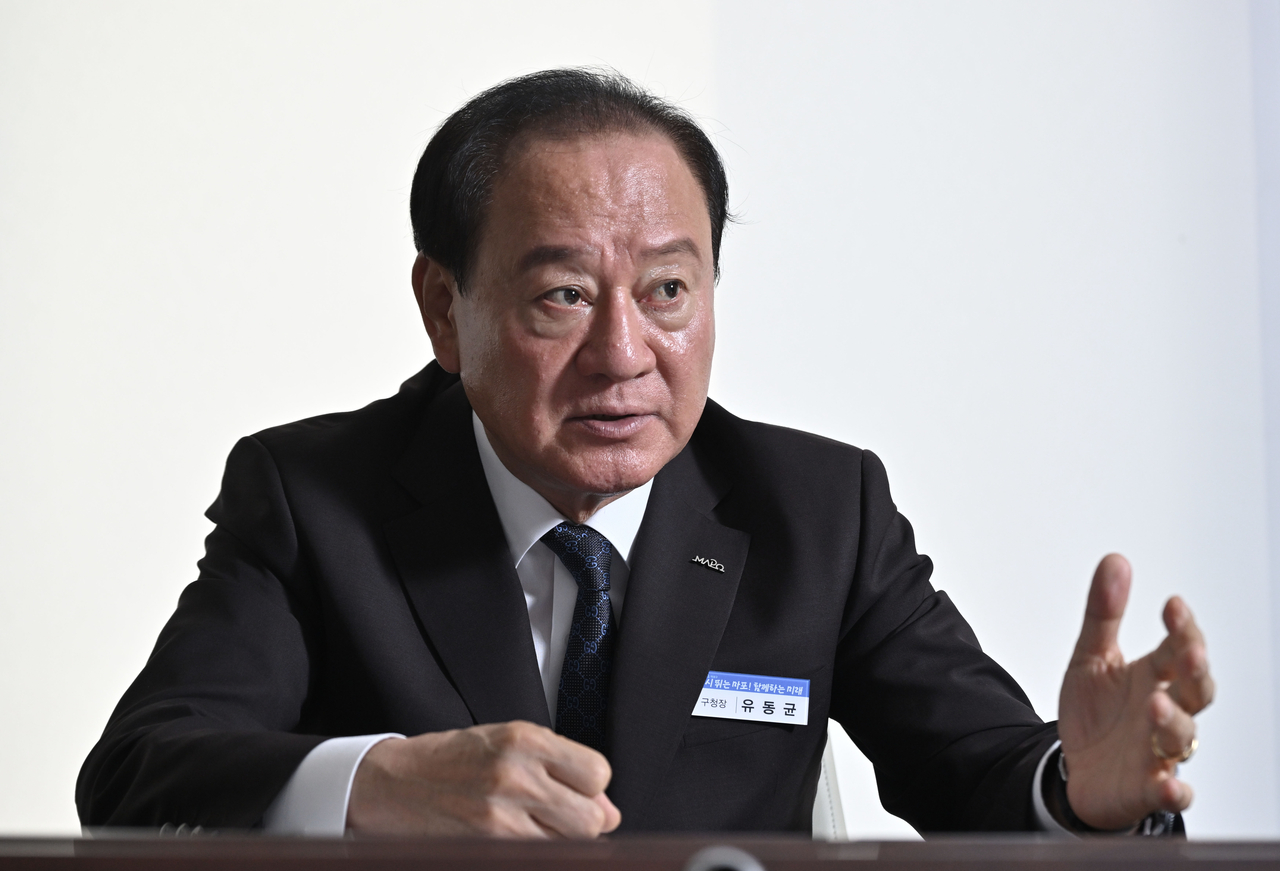
Yu Dong-gyun, who has served Mapo-gu as a district council member twice, a Seoul Metropolitan Council member and district mayor, has returned to lead the district for a third elected term. First elected district mayor in 2018, Yu guided Mapo-gu for four years before losing the next election and spending four years out of office — a period during which he continued to walk the streets of the district and stay in touch with residents. He won back the post by defeating his predecessor, Park Gang-su, in what amounted to a rematch. His return has revived momentum for projects that had stalled during the intervening term. Speaking in an interview on June 28, Yu said he would make his new term "a time when all the efforts so far bear fruit, through constant communication with residents."
The following is an edited transcript of the interview.
— What are your feelings on returning as district mayor for this term?
▶ Returning to this office after four years, I feel an immense sense of responsibility and deep gratitude. I believe it is because residents trusted my promise to work solely on Mapo's behalf and to do better than before. If the years past were about sowing seeds of hope together with Mapo residents, the time has now come to make those seeds bloom and bear fruit — and to share that harvest. As an administrator raised by Mapo, who has laughed and cried alongside residents, I will pour all of my experience and ability into the district's development and open a better era for its people.
— What is the role of the redevelopment and reconstruction rapid-implementation task force, the first measure you approved after taking office?
▶ Demand from residents for redevelopment and reconstruction is growing, but the pace of projects has not kept up with their expectations. There are currently 61 improvement projects under way in Mapo-gu, and a significant number are still in early stages — drawing up improvement plans, forming promotion committees, establishing associations — meaning it will be quite some time before residents can actually move in. Many residents are going through redevelopment or reconstruction for the first time and do not have much knowledge or information about the process, so the district office intends to go directly to them and provide guidance. The task force was set up so that I can personally monitor the progress of improvement projects and quickly remove obstacles at each stage. The plan is to consolidate what had been a fragmented management structure, oversee the entire process in an integrated way, and actively resolve difficulties and conflicts that arise on the ground. I will also chair a monthly meeting to communicate directly with association heads and other project stakeholders, and to discuss a wide range of issues including permit-related requests, ways to resolve resident disputes and matters requiring coordination with the Seoul Metropolitan Government.

— Which projects from your first term that were discontinued would you most like to revive?
▶ There were policies from my first term that I was disappointed to see not carried forward. One was using education subsidies to create an environment where every student who graduates from a school in Mapo-gu has the ability to do survival swimming and rowing, practice at least one sport, and play at least one musical instrument. At present, education subsidies are drawn on whenever money is needed for other purposes. Costs for managing school facilities should be covered by the education office; education subsidies should be used solely for students. So in this term, I plan to reform and direct those subsidies so that every child who graduates from a school in Mapo-gu can do rowing, a sport of their choice, and play a musical instrument.
The other signature initiative of my first term was the 5-million-tree planting project. Mapo-gu had already launched that project before the government declared its 2050 carbon neutrality goal. It began in 2018 with a drive to plant about 1 million trees to create clean-air forests, and in 2019 the district became the first autonomous district in Seoul to formally announce a 5-million-tree planting project, expanding the effort from there. I plan to pursue a "5 million trees again" campaign in this term as well.
I also consistently pushed during my first term to increase parking and community sports facilities — particularly a complex cultural and sports center at Saetteo Mountain (Saetteo Neighborhood Park) that would include an international-standard 50-meter, eight-lane swimming pool, so residents could enjoy sports and cultural activities close to home. That project was halted during the previous term, but I intend to resume it as quickly as possible now that this term has begun.
— What is your position on the Mapo Resource Recovery Facility?
▶ The Seoul Metropolitan Government lost a lawsuit brought by residents and, in March, dropped its appeal and scrapped plans to build a new incinerator. It then announced it would instead pursue efficient use of the existing resource recovery facility — which has been in operation for more than 20 years — by modernizing it rather than building a new one. Residents are expressing concern about that modernization because distrust has built up over the years due to what they see as a lack of adequate information and community consultation in the way the city has pursued its policies.
As district mayor of Mapo-gu, I make three promises to residents on the incinerator issue. First, I will demand that the Seoul Metropolitan Government, in the process of replacing aging equipment under the banner of modernization, limit the work strictly to improvements in safety and environmental performance and exclude any expansion of incineration capacity. Second, I will work with the city to ensure that a proper procedure is established for fully disclosing modernization plans, environmental impact assessments and processing capacity figures to residents, and for collecting their opinions. Third, I will urge the city to strengthen waste-reduction policies at the metropolitan level and reinforce the principle of each autonomous district taking responsibility for its own waste, so that the burden of waste disposal does not become concentrated in Mapo-gu.
Most importantly: not a single additional ton of waste will be allowed into this facility, and the health and living environment of Mapo-gu residents come first. If that is not upheld, I will respond forcefully alongside residents. I will participate actively in consultations with the Seoul Metropolitan Government aimed at improving the facility's safety and environmental standards, but I will respond firmly — using every administrative and legal means available — to any attempt to increase the burden on Mapo-gu residents.
ikson@heraldcorp.com