
With the government's "2026 Tax Reform Plan" laying out tighter taxation on multi-home owners, non-resident single-home owners and ultra-luxury properties, attention is turning to whether the shift toward an owner-occupier-focused tax system will actually push more listings onto the market. Analysts say some properties could come to market — particularly from retired elderly owners with no cash income who can no longer absorb the rising holding-tax burden, given that high-value single-home owners have been included as a targeted tax group for the first time.
The reform also opens exit windows — including a temporary easing of the heavy tax rate on multi-home owners in regulated areas and a one-year delay in implementing the revamped long-term holding deduction — which analysts say could prompt homeowners who had been weighing a sale to finally act. However, experts note that strong pent-up demand in key Seoul neighborhoods makes a prolonged inventory buildup unlikely, and that robust buying interest in relatively affordable mid-range areas could, over the medium to long term, fuel a growing preference for what the market calls a "less premium single home."
Listings expected in Gangnam, Han River belt as tax pressure mounts alongside exit options
Under the "2026 Tax Reform Plan" announced by the Ministry of Economy and Finance on Monday, the government will broadly tighten comprehensive real estate tax and capital gains tax on owners of ultra-luxury single homes and multiple properties, while pairing those measures with temporary relief to push the tax system toward favoring owner-occupiers. Experts say the plan reflects the policy vision that President Lee Jae-myung and other officials have repeatedly emphasized — protecting genuine end-users while curbing speculative demand.
The reform package includes four key changes: raising the tax-exempt threshold for owner-occupied single homes from a publicly assessed value of 1.2 billion won ($863,000) to 1.4 billion won; lowering the threshold for non-resident single homes and multi-home owners (from 1.2 billion won to 900 million won, and from 900 million won to 400 million won plus a portion of 500 million won based on the share of owner-occupied housing); raising the fair market value ratio from 60 percent to 70 percent; and gradually phasing out the tiered tax rates based on the number of homes owned. Together, the measures significantly increase the holding-tax burden not only on multi-home owners but also on high-value single-home owners and non-resident single-home owners.
According to the government's estimates, owners of homes valued at between 2 billion and 3 billion won will see their comprehensive real estate tax fall, those with homes in the 3 billion to 4 billion won range will see little change, and the tax burden will rise for homes valued above 4 billion to 5 billion won.
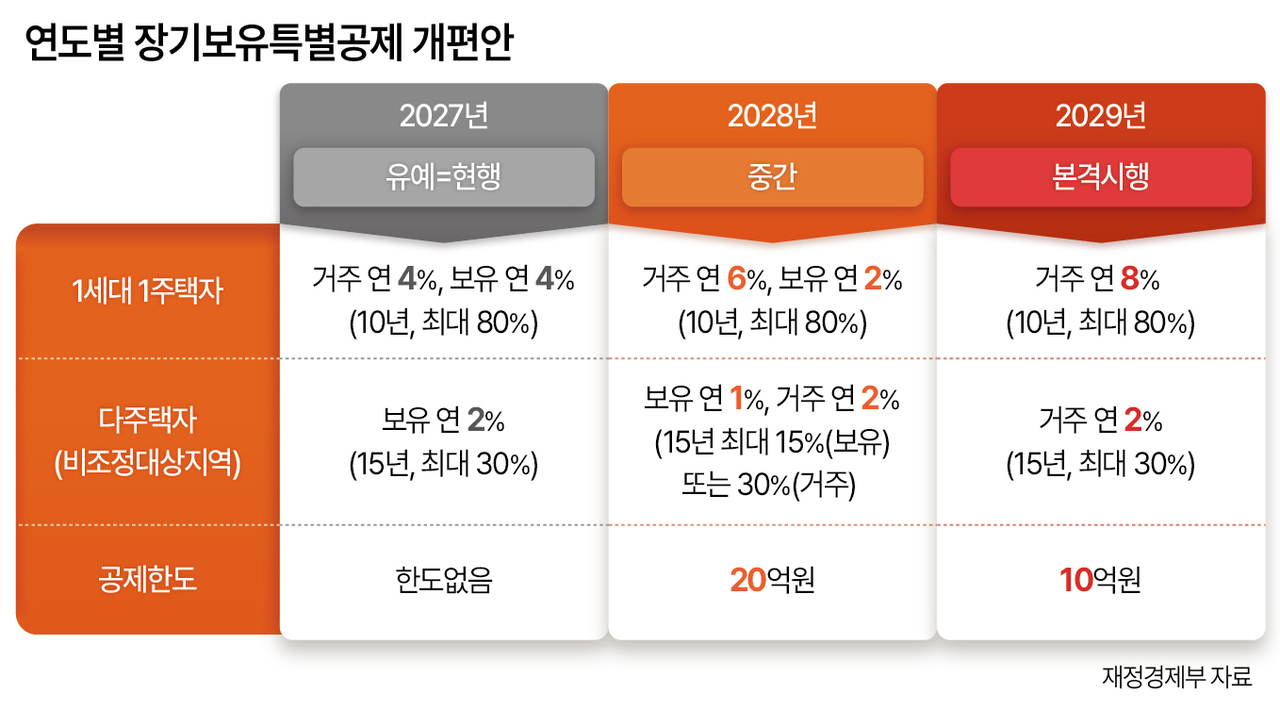
The reform also overhauls the capital gains tax deduction system, converting the existing long-term holding special deduction into a long-term residency income deduction — eliminating the ownership requirement from 2029 onward and capping the residency-based deduction at 80 percent — while introducing new deduction ceilings of 2 billion won in 2028 and 1 billion won from 2029. Because tax savings under the old system grew with higher home prices and larger capital gains, these changes are also seen as squarely targeting luxury properties.
Experts predict that the tax overhaul will trigger a short-term wave of listings, concentrated in major complexes in the Gangnam area and the Han River belt where homes valued at 4 billion won or more are clustered.
Kim Hak-ryeol, director of the Smart Tube Real Estate Research Institute, said that as the holding-tax burden on luxury homes increases, "a limited number of listings from elderly owners and others could come out over the course of August." Nam Hyeok-woo, a real estate researcher at Woori Bank, said that in the past many elderly single-home owners had held on to their properties — paying holding taxes while waiting to pass them on through gifts or inheritance — but added that "with this reform also increasing the holding-tax burden on elderly single-home owners, some degree of selling activity appears unavoidable."
Such expectations stem from the government's decision to raise the comprehensive real estate tax and capital gains tax burden while simultaneously opening exit windows for high-value, non-resident and multi-home owners to offload properties. The comprehensive real estate tax will be phased in over two years, while the capital gains tax changes come with a one-year grace period. The temporary easing of the heavy capital gains tax rate on multi-home owners' properties in regulated areas — set for 2027 and 2028 — is widely interpreted as an incentive to bring listings to market before the full tax burden kicks in.
Ham Yeong-jin, head of Woori Bank's Real Estate Research Lab, described the measures as "a signal saying, 'sell now.'" He added that the inclusion of a special exemption reducing capital gains tax for elderly single-home owners who sell their Greater Seoul properties and relocate to the regions "also appears designed to encourage regional migration and increase the supply of homes in the metropolitan area."
Mid-range areas seen sustaining price gains; luxury home turnover cycle may shorten
Even so, experts broadly agree that any increase in listings is unlikely to reverse Seoul's sharp upward price trend. The city's housing supply shortage remains unresolved, and the volume of new listings is not expected to be large enough to drag down prices across the luxury market as a whole.
Yang Ji-young, a senior adviser at Shinhan Premier Pathfinder, said that "key Seoul areas still face a supply shortage and abundant pent-up demand, and cash liquidity from investment gains in the recently buoyant stock market and performance bonuses could flow into parts of the real estate market — making it unlikely that the added supply will pile up for long." She added that "this reform is less a policy aimed directly at lowering home prices and more a restructuring of the tax system around owner-occupiers, with the goal of normalizing transactions."
Nam also said that with exit windows now open, "not only mid-to-lower-tier areas of Seoul where inventory has been persistently tight, but also unregulated areas in the Greater Seoul metropolitan area are expected to get some breathing room overall." He cautioned, however, that "even if listings increase, pent-up demand remains ample and the timing of new supply will be spread out, so whether inventory actually accumulates remains to be seen." He added that "in those areas, renters are actively converting to buyers due to a shortage of jeonse and monthly rent listings, and price and loan accessibility are favorable, so genuine end-user demand tends to be steady."
![A view of the Sanggye-dong area in Nowon-gu, Seoul. [Herald DB]](https://wimg.heraldcorp.com/news/cms/2026/08/03/news-p.v1.20260127.09e5b03bf521410cb044f82fcf7100d7_P1.png)
Analysts expect buying interest to concentrate even more heavily in existing mid-to-lower-priced areas less affected by the tax reform, sustaining price gains in those neighborhoods. They also note that as the ownership-based benefits of the long-term holding deduction disappear, the turnover cycle for luxury homes could shorten as well.
Lee Eun-hyeong, a research fellow at the Korea Construction Policy Research Institute, said that "high-asset households are likely to maintain the status quo, while others will cluster around the tier of a single quality home that falls within the new long-term deduction ceiling." Nam also said "there is a possibility that demand for a 'less premium single home' will grow over the medium to long term," explaining that properties where the tax base falls below 600 million won — roughly equivalent to a market price of around 3.1 billion won — would be subject to the same tax rate as before and could come to be seen as a new category of tax-efficient quality home, drawing upgrade-driven buyers.
He added that "in the luxury home market, the new cap on the long-term residency income deduction sets an upper limit on tax savings, which could reduce the incentive to hold properties for the long term and shorten the cycle of listings coming to market, depending on circumstances."
hwshin@heraldcorp.com
lucky@heraldcorp.com