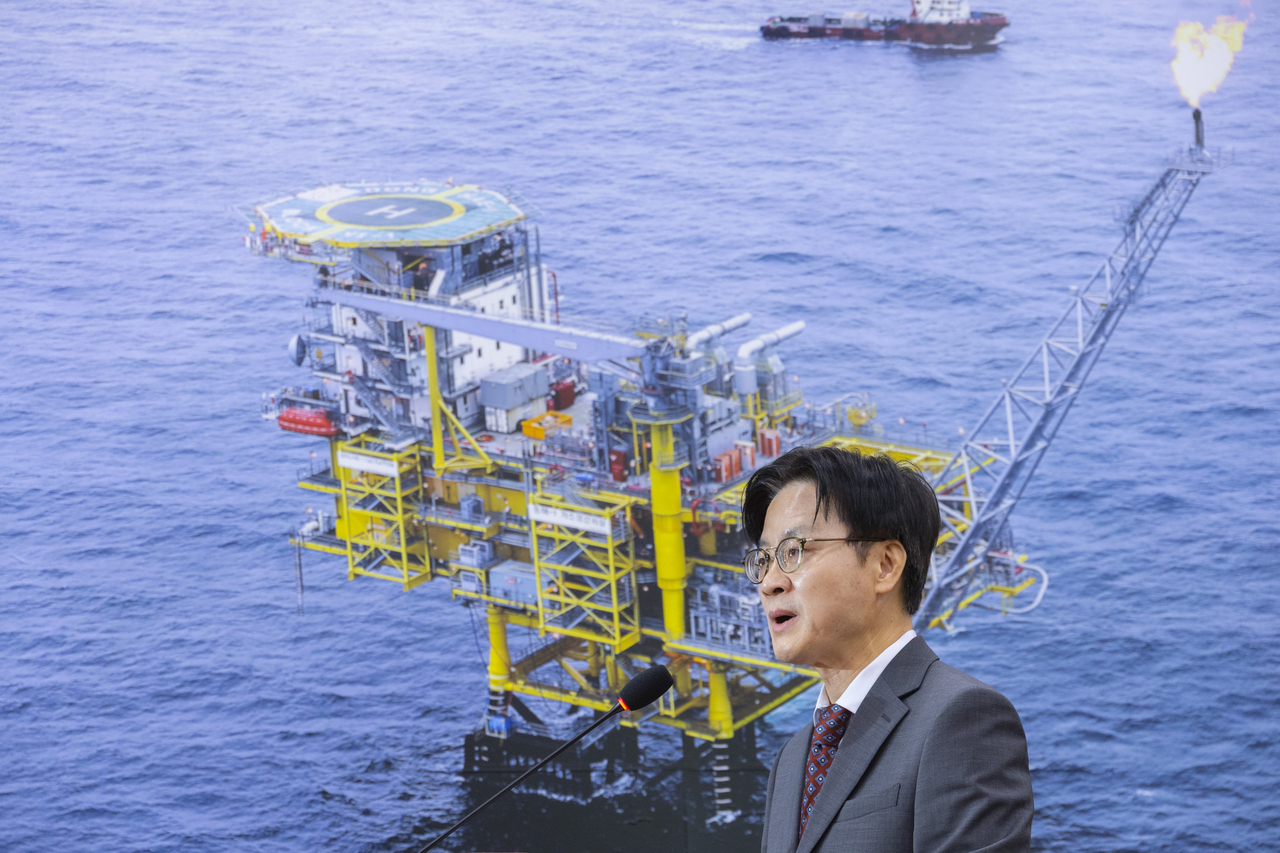
![Kim Sung-hwan, minister of Climate, Environment and Energy [Yonhap]](https://wimg.heraldcorp.com/news/cms/2026/08/04/rcv.YNA.20260730.PYH2026073007780001300_P1.jpg)
South Korea will divide the country into four broad regional tiers and apply differentiated industrial electricity rates starting in the fourth quarter of this year (October–December), a move expected to produce an effective reduction in industrial power costs.
Discussions on whether to build additional nuclear power plants will begin next week.
The Ministry of Climate, Environment and Energy said Tuesday, in a presidential briefing, that it would "reform the rate structure to reflect regional power supply-and-demand conditions."
The ministry also said it would overhaul the rate framework to accommodate the construction of large-scale AI data centers.
The two measures involve introducing a regional differential rate system for industrial electricity and a dedicated rate plan for AI data centers.
Climate Minister Kim Sung-hwan said at a pre-briefing and a roundtable marking his first anniversary in office Monday that the regional differential rate plan would be finalized after a public hearing in the third week of this month, and that the dedicated AI data center rate would be introduced before the end of the year.
On the regional differential rate system, Kim said the government is reviewing a plan to divide the country into four broad tiers and then further subdivide them — taking into account areas designated as population-decline zones by the Ministry of Interior and Safety — to apply varying rates.
The government had previously said it would design the regional differential rate system by weighing each area's energy self-sufficiency, transmission costs and balanced national development. The number of regional zones had been a key open question; the ministry disclosed the broad framework Tuesday.
Kim said the differentiated industrial electricity rates would amount to a "reduction."
"The steel and petrochemical industries, which compete head-to-head with China, say they can barely afford current electricity rates," Kim said. "We intend to cut rates on a differentiated basis so that these industries — whose factories are far from Greater Seoul — can regain their competitiveness."
He also argued that during the final year of the Yoon Suk Yeol administration, it would have been appropriate to raise both residential and industrial electricity rates in tandem, but that industrial rates alone were raised sharply, possibly because of the proximity to the general election.
There are concerns that cutting industrial electricity rates could widen Korea Electric Power Corporation's deficit. KEPCO raised its internal financial risk management level in June to Alert — the second highest of four stages.
"Ideally I would like to bring industrial electricity rates down to China's level, but because that could pile up deficits at KEPCO, we intend to set the size of the cut at a level KEPCO can absorb," Kim said, without offering specifics.
China's average industrial electricity rate is about 120 won per kilowatt-hour, compared with about 180 won in South Korea, according to the ministry.
Kim had long maintained that expanding renewable energy was not a factor driving up electricity rates, but recently shifted to saying rates could rise sharply if coal phase-out relied on renewables alone. He insisted Tuesday he had "never changed his position."
"Unlike other countries, South Korea has the lowest power generation cost from nuclear energy," he said. "If we want renewables as the primary power source, we also need energy storage systems and pumped-storage hydropower to compensate for volatility — and if all those costs are passed into electricity rates, problems could arise."
He added that "if nuclear and renewable energy are not properly mixed, electricity rates could become extremely expensive."
On the government's review of whether to build more nuclear plants beyond the two large reactors and one small modular reactor whose sites were recently decided, Kim said the government would determine this week how and how many times to hold public hearings on the 12th Basic Plan for Electricity Supply and Demand, and would "pick up speed starting next week."
He had appeared on a radio program in early July, saying the 12th basic plan needed to be finalized "roughly around the regular National Assembly session" and that "not much time is left."
Because the government has said it will incorporate any decision on additional nuclear plant construction into the 12th basic plan, there are concerns that deliberations conducted in the short window Kim described could be rushed.
"The regular Assembly session runs from September through December," Kim said. "We plan to submit the government draft of the 12th basic plan in September or October, report it to the National Council on Climate Crisis Response and the Assembly, and finalize it — and we intend to hold time for public discussion before that."
On the scale-up of the Dong Seoul converter station in Hanam, Gyeonggi Province — a project widely seen as a gauge of the government's capacity and will to expand the power grid — Kim said he had heard that at a public hearing recently organized by ruling party lawmakers, residents' committee representatives and KEPCO agreed to work out the issue through roughly two months of consultations. "I understand they also agreed that if the issue is not resolved within two months, the government will proceed with the project as planned," he said.
The Dong Seoul converter station is the terminus of a 280-kilometer ultra-high-voltage direct-current transmission line carrying power from the East Sea coast to Greater Seoul. The facility is also closely linked to the electricity supply for the semiconductor industrial complex in Yongin, Gyeonggi Province.
Residents in the area, centered on the nearby Gamil new town, oppose the scale-up of the Dong Seoul converter station, citing concerns about electromagnetic waves and noise. Local authorities have withheld permits in response, pushing back the project's completion date by about eight years.
oskymoon@heraldcorp.com