Investors are watching closely to see whether South Korea's three major battery makers are entering a sustained rebound. All three returned to profitability in the second quarter, breaking through the electric vehicle market's "chasm" — a period of temporary growth slowdown — and growing expectations for a Korean version of the US Inflation Reduction Act are adding to the positive sentiment in the securities industry.
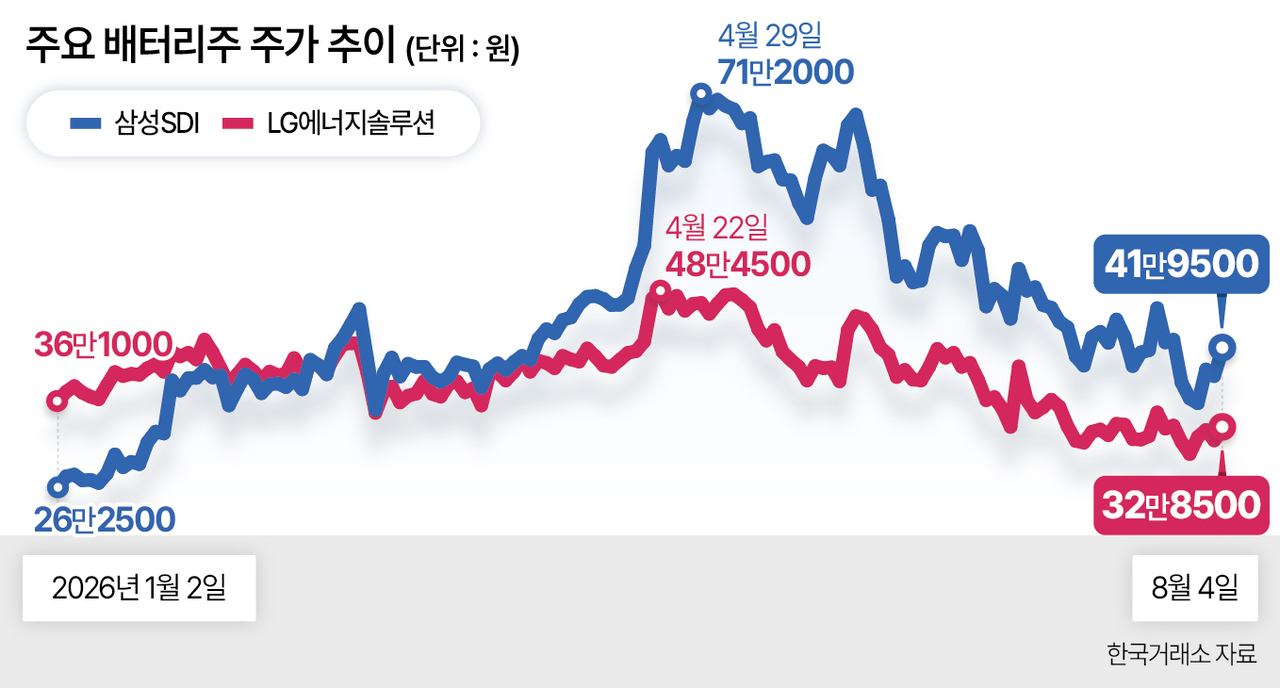
According to Korea Exchange, shares of Samsung SDI, LG Energy Solution and SK Innovation — the parent of SK On — closed Tuesday up 7.7 percent, 3.96 percent and 3.06 percent, respectively. Samsung SDI reclaimed the 400,000 won ($280) threshold on a closing-price basis for the first time in six trading sessions. All three stocks extended their gains from the opening bell on Wednesday as well.
The rally reflects growing optimism about an earnings recovery after all three companies posted a return to profit in the second quarter.
Samsung SDI recorded an operating profit of 203.8 billion won in the second quarter, swinging back to the black for the first time in seven quarters. LG Energy Solution also turned profitable, posting an operating profit of 113.3 billion won, reversing a loss from the previous quarter.
SK On delivered a record quarterly operating profit of 821.8 billion won — the highest in its history. Higher product sales drove the result, along with a compensation payment received from the dissolution of its joint venture with US automaker Ford.
Market analysts note that battery-related stocks have been relatively left behind during this year's sharp Kospi rally, and expect the shares to gain momentum if earnings continue to improve.
Measured against their closing prices at the end of last year, Samsung SDI shares were up 55.65 percent as of Tuesday's close, while SK Innovation had risen just 9.98 percent. LG Energy Solution shares were actually down 10.85 percent over the same period. Given that the Kospi rose 50.89 percent during the same stretch, both SK Innovation and LG Energy Solution lagged the broader index — Samsung SDI being the sole exception.
Adding to the positive backdrop, the government recently announced plans to introduce a domestic production incentive tax scheme — dubbed a Korean-style IRA — that would offer tax cuts proportional to output across six strategic industries, including secondary batteries, semiconductors and AI. Analysts expect the measure to benefit the battery sector going forward.
The rapid growth of the energy storage system (ESS) market, which domestic battery makers are actively cultivating as a new growth engine, is also a tailwind. According to market research firm SNE Research, global shipments of lithium-ion battery ESS in the first half of this year reached 461.3 gigawatt-hours (GWh), up 71 percent from 269.7 GWh in the same period last year.
Securities analysts are raising their targets accordingly. An Hoe-su of DB Securities maintained a buy rating and a target price of 570,000 won for LG Energy Solution, saying ESS order momentum is expected to concentrate in the second half of the year, driven by a proactive expansion of US ESS capacity. "US Ultium Cells will begin to narrow its losses as it resumes operations, and the European plant is expected to turn profitable in 2027," An said.
Choi Tae-yong of DS Investment Securities maintained a buy rating and a target price of 840,000 won for Samsung SDI, forecasting that ESS revenue would rise 30 to 40 percent in the third quarter with double-digit profitability. On Samsung SDI's next-generation all-solid-state battery, Choi said the company is currently supplying samples in the second half of the year, with mass production targeted for the second half of next year. "Humanoid robots are the most likely candidate for the first commercial application," he said.
Baek Young-chan of Sangsangin Investment & Securities said SK On is expected to improve its battery business earnings through aggressive cost cuts and expanded ESS orders "from the bottom of weak EV demand," setting a target price of 140,000 won for the stock. IBK Investment Securities and Hana Securities each set higher targets of 200,000 won.
jiyun@heraldcorp.com