
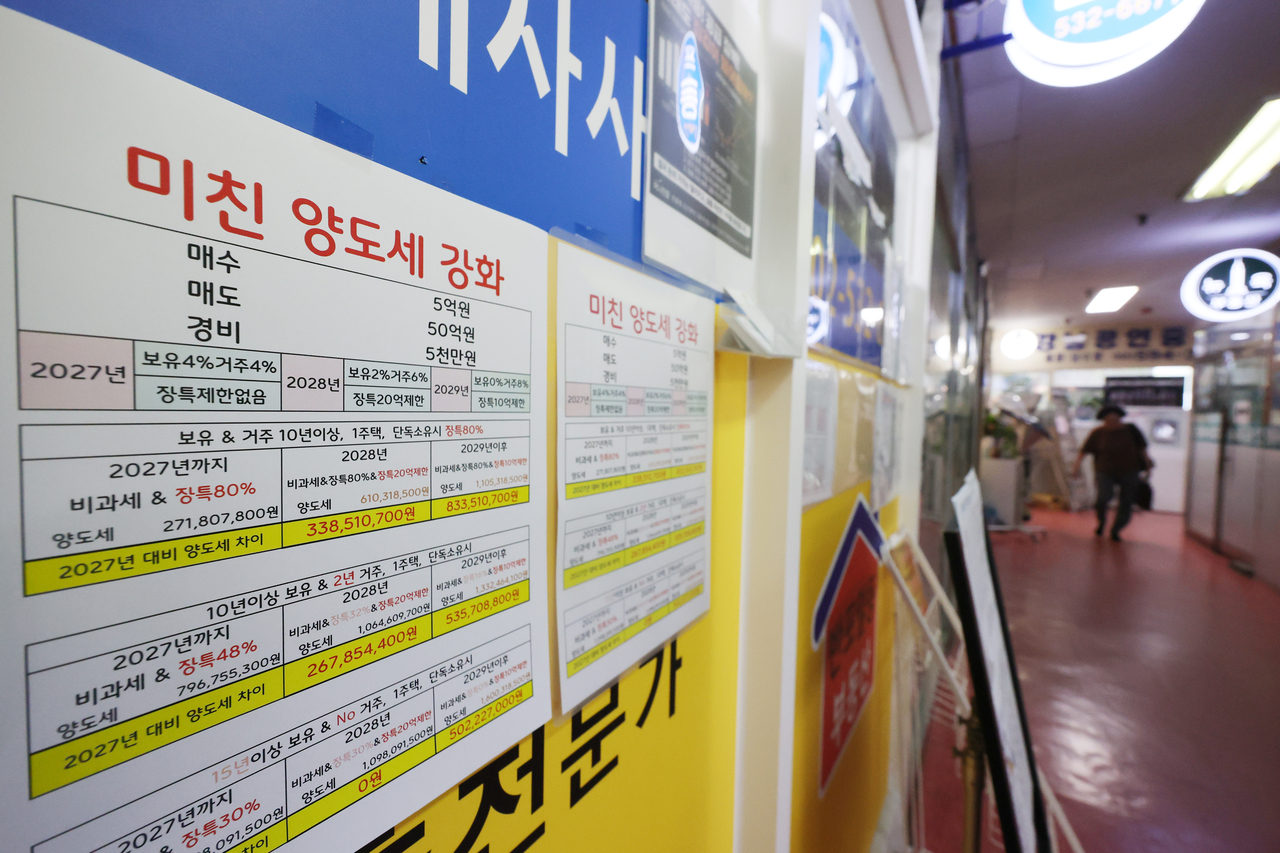
As the government moves to overhaul the long-term holding special deduction for single-homeowners — replacing it with a residence-based deduction that eliminates the ownership-period requirement — capital gains tax burdens on ultra-high-priced homes valued at 3 billion won ($2.1 million) or more are set to surge two to fivefold. Owners who bought aging apartment complexes in Yeouido, Gangnam and other prime areas 20 to 30 years ago stand to face particularly sharp increases, as reconstruction prospects have driven up property values and the reform eliminates the ownership deduction while introducing a new cap on total deductions.
According to the Ministry of Economy and Finance and the real estate industry, the long-term holding special deduction — which currently allows single-homeowners to deduct up to 40% of capital gains for meeting the ownership requirement and another 40% for meeting the residency requirement, for a combined maximum of 80% — will be replaced starting in 2029 by a long-term residency income deduction capped at 80% for residency only, with the ownership component eliminated entirely. Under a phased transition, the reform will be partially applied in 2028, with a residency deduction of up to 60% and an ownership deduction of up to 20% still available that year. From 2029, the ownership deduction disappears completely. In addition, a new ceiling on the total deduction amount will take effect — 2 billion won in 2028, falling to 1 billion won from 2029 onward.
Yeouido Hanyang owner faces 100 million to 210 million won rise after 20 years; Sinbanpo 2-cha jumps from 470 million to 2.14 billion won
With a new deduction ceiling taking effect and the ownership requirement being phased out, capital gains tax burdens on ultra-high-priced homes in Seoul's three Gangnam-area districts — Gangnam-gu, Seocho-gu and Songpa-gu — as well as Yongsan-gu are expected to rise sharply. Owners who purchased at low acquisition prices are particularly exposed: even if they meet the residency requirement and have held the property for many years, their accumulated capital gains are large enough that the reform will significantly increase their tax liability.
A simulation of capital gains tax changes on ultra-high-priced Seoul homes — commissioned from Woo Byung-tak, a specialist adviser at Shinhan Premier Pathfinder, and broken down by market price brackets of 2 billion, 3 billion, 5 billion and 7 billion won — shows that tax burdens on homes priced at 3 billion won or more will jump by hundreds of millions to tens of billions of won.
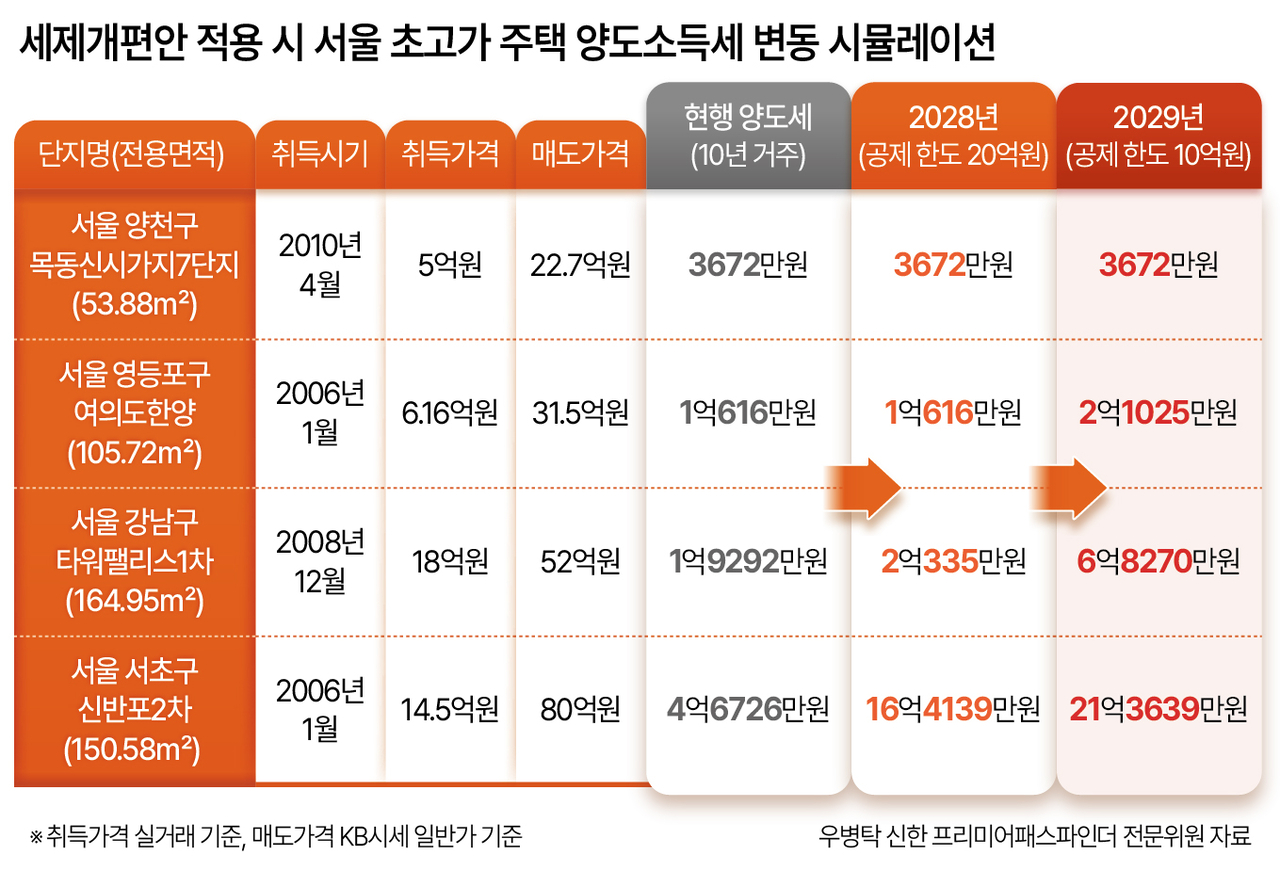
A single-homeowner who bought a 105-square-meter unit at Hanyang Apartment in Yeouido-dong, Yeongdeungpo-gu for 616 million won in January 2006 and has lived there for 20 years would currently owe 106.16 million won in capital gains tax upon selling at 3.15 billion won — the KB general market price — after receiving the full 80% combined ownership-and-residency deduction. In 2028, the tax bill would remain the same, as the deduction amount stays within the 2 billion won cap and the 20% ownership plus 60% residency rates still apply. From 2029, however, the liability rises to 210.25 million won.
A single-homeowner who bought a 164-square-meter unit at Tower Palace 1 in Dogok-dong, Gangnam-gu for 1.8 billion won in December 2008 and has lived there since would face a capital gains tax of 192.92 million won under current rules if selling at the current market price of 5.2 billion won. That figure rises to 203.35 million won in 2028 and jumps to 682.7 million won in 2029 — a 253% increase once the full transition to the residency-only deduction takes effect.
For a single-homeowner who bought a 150-square-meter unit at Sinbanpo 2-cha Apartment in Jamwon-dong, Seocho-gu for 1.45 billion won in January 2006 — a complex where home prices have surged in recent years on the back of Han River-adjacent reconstruction prospects — and sells at 8 billion won, the capital gains tax bill would exceed current levels by more than 1 billion won. The liability climbs from 467.26 million won today to 1.64 billion won in 2028 and 2.14 billion won in 2029.
However, an owner who bought a 53-square-meter unit at Mok-dong Sinsiganji 7 Danji in Yangcheon-gu — currently priced at 2.27 billion won — for 500 million won in April 2010 and has lived there since would see no change in their tax bill after the reform, which remains at 36.72 million won. The deductible amount on the capital gain falls within the 1 billion won cap, and the owner satisfies the residency requirement, leaving the tax burden unchanged.
Government says reform improves tax equity through 'rationalized deductions'; experts warn it undermines the policy's original purpose
The government's push to restructure the capital gains tax system around residency reflects its view that correcting excessive deduction benefits for long-term holders of high-priced homes who do not actually live in them — and improving tax equity — is the right way to normalize the tax regime.
But by lowering the deduction ceiling to 1 billion won, the reform will increase the capital gains tax burden even for owners who do live in their homes.

President Lee Jae Myung invoked the equity gap between wage income tax and capital gains tax at a Cabinet meeting on Tuesday to defend the reform's rationale. "The top rate on earned income, with various surcharges, goes up to 49.5%, yet even when real estate capital gains reach the tens of billions of won, the tax paid is only a few hundred million," he said. "If someone happened to end up that way just by living their life, a deduction makes sense — but if you bought property as an investment and made tens of billions of won while paying almost no tax, that's simply not fair to workers paying tax on their wages."
He added: "On earned income above 1 billion won, you pay nearly half in taxes — but on real estate income, even when it reaches tens of billions of won, the current system means you pay almost nothing. That's the problem."
Among experts, however, there is criticism that the government has overlooked both the original rationale behind the long-term holding special deduction and the structural differences between wage income tax and capital gains tax. The deduction was formally introduced in 1989 to normalize capital gains taxation by stripping out the "bunching effect" — the distortion caused by taxing in a single year gains that accumulated over many years — as well as inflation. It has also served as a tool to discourage short-term speculative selling and encourage long-term ownership. The Moon Jae-in administration later added a residency requirement in the 2020s.
With the ownership requirement eliminated entirely, critics argue the reform could undermine the deduction's original purpose of easing the bunching effect — the concentration of high-rate taxation on income that built up over many years.
A tax industry expert who asked not to be named said: "With wage income, if you earn 100 million won a year, you're taxed on roughly 100 million won each year. But with capital gains tax, if you earn the same 1 billion won over 10 years, you're taxed on all of it in a single year. The long-term holding special deduction exists precisely to address that structural difference — the bunching effect — because wage income and capital gains tax work completely differently. If the ownership requirement disappears and a cap is introduced, taxpayer resistance is inevitable."
hwshin@heraldcorp.com





