"The problem is not Japan. The question is which market lies beyond Japan."
— 'Abenomics hunter Scott Bessent … transformed into Takaichi's shield after 13 years?' (Jan. 26, 2026, this column)
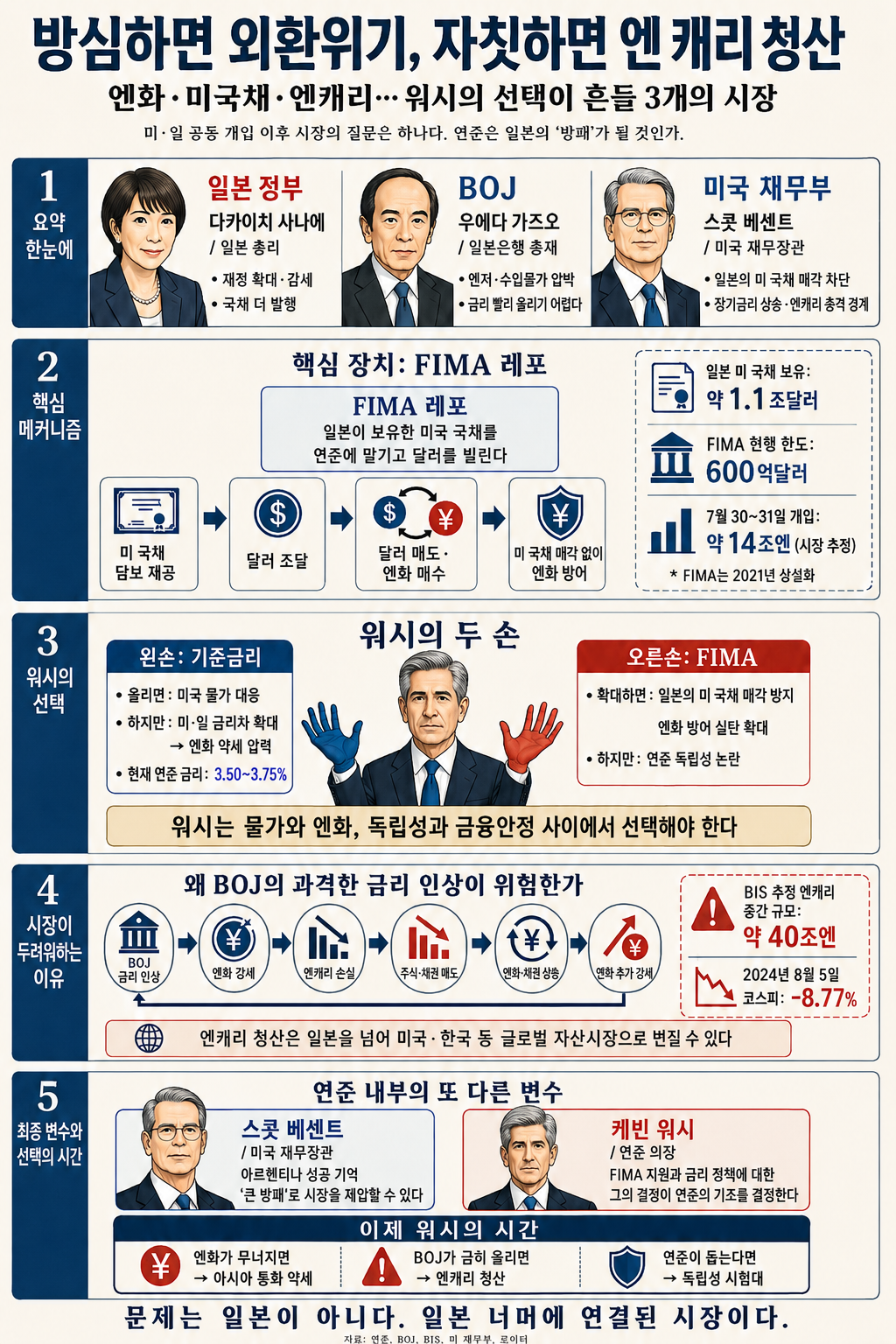
A joint US-Japan defense of the yen has emerged as the defining issue in global financial markets. What began as Japan's problem alone could send shockwaves through the United States and the broader global financial system. To understand what is at stake, it helps to map out where the Bank of Japan, the Japanese government and the US Treasury each stand.
The BOJ faces growing pressure to raise interest rates as a weaker yen pushes up import prices — but it cannot move easily. Higher rates would undercut the government's stimulus drive and swell the interest burden on government bonds. The Japanese government, for its part, wants to stimulate the economy: it is pushing to expand fiscal spending while cutting taxes, particularly the consumption tax, even if that means issuing more government bonds on top of a public debt already exceeding twice GDP. The US government, meanwhile, is wary of Japan selling its US Treasury holdings to defend the yen. If Japanese selling drives up long-term US interest rates, Washington's own debt-servicing costs rise — and a weaker yen, by lowering the dollar price of Japanese goods, could erode US tariff barriers and widen the trade deficit.
One misstep could trigger an Asian financial crisis — and the US would not be spared
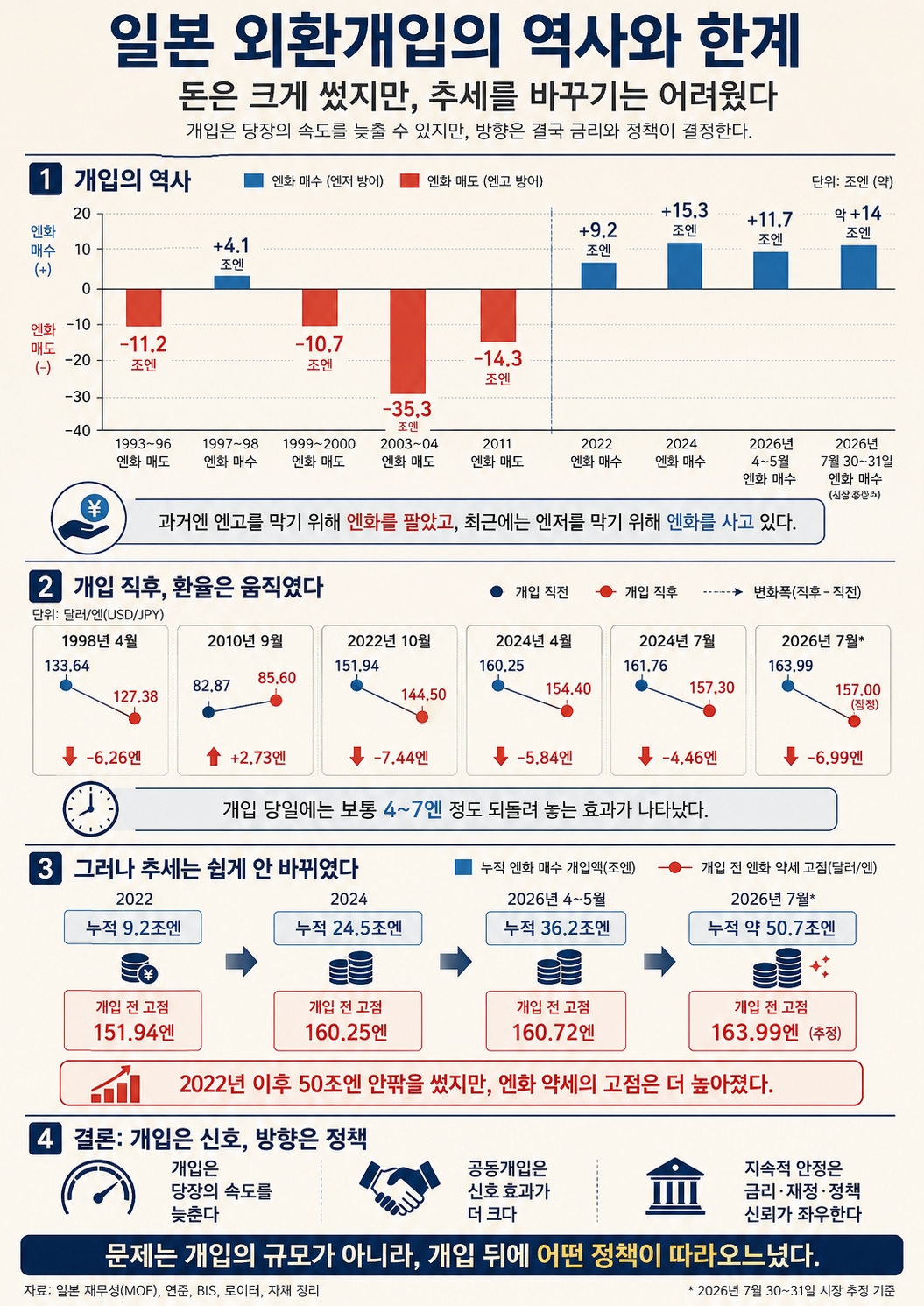
Markets estimate that the Japanese government injected roughly 14 trillion yen ($88.7 billion) into currency markets on Thursday and Friday of last week, buying yen. The US Treasury also sold euro holdings to purchase yen. On Friday, Treasury Secretary Scott Bessent appeared to deliberately expose a note reading "yen purchases of $5 billion to $10 billion" to news cameras at a Cabinet meeting — the first joint US-Japan yen-buying intervention in 28 years, since 1998.
Bessent went a step further. He publicly called for Japan to use the Federal Reserve's Foreign and International Monetary Authorities Repo Facility — the FIMA repo※ — as a funding source for currency market intervention, and said the current per-counterparty limit of $60 billion should be raised if necessary.
The mechanics work like this: Japan pledges its US Treasury holdings with the Fed as collateral, borrows dollars, then sells those dollars in the market to buy yen. Japan defends its currency without having to sell Treasuries outright, and the United States avoids the risk of Japanese selling pushing up long-term interest rates. The "shield" Bessent described for Japan back in January is now clear — a shield for Japan and a shield for the US Treasury market alike.
※ The FIMA repo facility allows foreign central banks and similar institutions to temporarily borrow dollars from the Federal Reserve by pledging US Treasury securities held at the New York Fed as collateral — without having to sell those Treasuries in the open market. The facility was created as a temporary measure during the COVID-19 shock in 2020 and made permanent in 2021. The current per-counterparty limit is $60 billion per day; a related foreign exchange subcommittee may approve changes to the limit, maturity and interest rate terms.
Bessent — a former macro hedge fund manager who once bet against the British pound in 1992 and the yen in 2012 — publicly demanding an expansion of the FIMA limit signals that he believes joint US-Japan intervention alone cannot fully subdue the market. In other words, the situation is that serious.
Bessent has warned that allowing yen weakness to persist could trigger a synchronized depreciation of Asian currencies and competitive devaluations across the region. He has also said yen movements could ripple through the won, the yuan and other Asian currencies. The 1997 Asian financial crisis was itself set off by a combination of high US interest rates, a strong dollar, fragile external debt structures in emerging economies and falling exchange rates. After that crisis, emerging-market countries rebuilt their reserves with US Treasuries. If even the yen — long considered a safe-haven currency — collapses, a surging dollar could spread pressure to the won and other Asian currencies. Should emerging economies begin liquidating their Treasury-heavy reserves to defend their own currencies, the United States would feel the pain too.
Intervention is a stopgap — without Fed support, yen carry trades could unwind
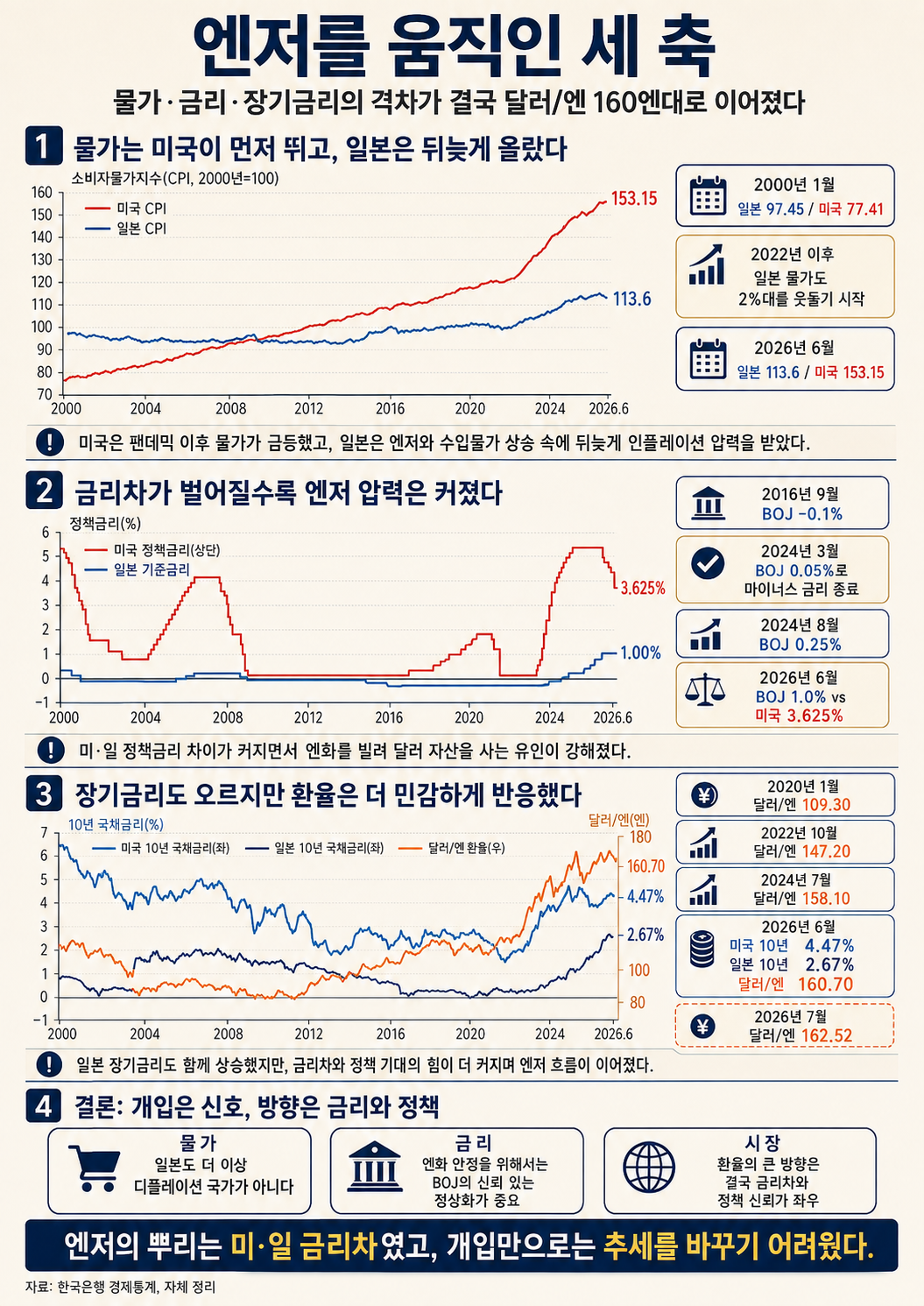
The joint intervention has lifted the yen from a low of 164 per dollar to around 157, where it has since traded sideways. Markets remain skeptical that stability will hold. The root cause of yen weakness is the interest rate gap between Japan and the United States. As long as Japan tightens more slowly than other major economies, the incentive to borrow yen and buy dollar assets remains strong. Ultimately, some argue, the BOJ must accelerate its benchmark interest rate increases to put the yen on a genuinely stable footing.
The problem is that BOJ rate hikes would do more than strain Japan's public finances. They would also raise the probability of an unwinding of yen carry trades, which are deeply embedded in global asset markets. The yen carry trade involves borrowing low-rate yen and investing the proceeds in US equities and bonds, emerging-market currencies and other higher-yielding assets. The wider the US-Japan rate gap, the greater the profit. Conversely, BOJ rate increases raise funding costs and compress the spread. A strengthening yen adds currency losses on top. For leveraged positions, the shock is far larger.
Consider an investor with 100 million won ($70,000) in equity who borrows in yen to build a 500 million won position in overseas assets. If the yen rises 5 percent, exchange-rate moves alone wipe out 25 percent of the investor's equity even if the underlying assets hold their value. To limit losses, the investor sells US and Korean stocks and bonds, buys yen and begins repaying the debt — which in turn inflates losses for other yen carry investors. The feedback loop runs: BOJ rate hike → stronger yen → carry-trade losses → foreign asset sales → yen borrowing repaid → yen strengthens further → more unwinding.
The closest precedent is exactly two years ago — Aug. 5, 2024. Fears of a US economic slowdown lit the fuse, but BOJ tightening, a surging yen and a partial carry-trade unwind amplified the selloff. The Bank for International Settlements estimated the yen carry trade at roughly 40 trillion yen at the time, concluding that deleveraging and margin calls drove a brief but extreme spike in global market volatility. The shock that began in Japan spread rapidly to US and Asian markets.
If the BOJ raises rates aggressively, it can rescue the yen — but a carry-trade unwind could batter global asset markets in the process. If it holds back, yen weakness and rising import prices continue unchecked.
Help sets a precedent, inaction makes things worse — the Fed's dilemma
What Tokyo and Washington want is not a surging yen. They want orderly stability — neither a sharp fall nor a sharp rise. Achieving that without forcing the BOJ into aggressive rate hikes, and doing so quickly, would exceed even Japan's foreign reserves of more than $1 trillion. The United States — specifically the Fed — needs to signal that Japan's intervention firepower has no effective ceiling. Bessent, more than anyone, knows that macro funds fear nothing more than coordinated action among reserve-currency central banks. Whether the Fed will join the fight, however, remains an open question. Fed Chair Kevin Warsh has not made his position clear.
Before taking office, Warsh told Congress that "the Fed is most independent when setting interest rates, and holds no special advantage over the administration or Congress in other areas, including international finance." After taking office, however, he told lawmakers that dollar liquidity facilities between central banks constitute part of monetary policy.
The FIMA repo facility already exists as a standing arrangement. Substantially raising the $60 billion limit to fund Japan's yen defense is a separate matter. The line between a financial-stability measure to protect the functioning of the US Treasury market and support for the Trump administration's fiscal policy is blurry.
Bessent's public demand for a higher FIMA limit also puts Warsh in a difficult spot. If Warsh refuses, Japan may sell Treasuries or the BOJ may feel compelled to raise rates faster to defend the yen. If the Fed immediately complies, it risks looking as though it has yielded to executive pressure — and compliance is no guarantee the crisis ends there.
Both Bessent and former Fed Chair Jerome Powell remember the Trump administration's intervention in Argentina's currency market. In 2025, the Treasury used the Exchange Stabilization Fund to provide Argentina's central bank with a currency-swap backstop of up to $20 billion. Actual drawdowns reached only $2.5 billion, and Argentina repaid the full amount by December of that year. The mere display of overwhelming standby firepower calmed the market; only a fraction of the committed funds was ever used.
Bessent's takeaway from that episode may be this:
"You don't need to spend all your ammunition. Show the market that America is behind you, and you can break a one-way bet."
But Powell's takeaway may be different:
"The Argentina support was led by the Treasury's ESF. The Fed's System Open Market Account did not participate in foreign exchange intervention. The Treasury achieved its currency-policy objectives using its own tools, without deploying the Fed's balance sheet."
In short, the same episode gives Bessent grounds to demand greater Fed involvement and gives Powell grounds to argue that the Treasury should solve this with its own tools.
The differences between Argentina and Japan are also stark. Argentina's support came alongside a policy shift — austerity, reform and political backing. Japan is moving in the opposite direction: looser fiscal policy, a slow-moving BOJ and a Fed that is itself weighing rate increases. Japan's economic scale and the yen's place in global markets make it far harder to change the trajectory with Treasury firepower alone.
September rate decision in the crosshairs — FOMC dissent could surface
The fact that Powell has remained on the Fed board after his term as chair ended — to preserve the institution's independence — carries weight in this episode. Powell is a former chair, but he is still an active FOMC voting member. Throughout his tenure he held firm to the principle that exchange-rate policy belongs to the Treasury and that the Fed should keep its distance from foreign governments' currency targets. Even if Warsh leans toward supporting Japan, Powell could serve as an institutional check, pressing the question of how far the Fed can go in accommodating the administration's currency policy.
Warsh's sway over the FOMC is also uncertain. At the July meeting, the committee voted 9-3 to hold the benchmark interest rate at 3.50 to 3.75 percent. Cleveland Fed President Beth Hammack, Minneapolis Fed President Neel Kashkari and Dallas Fed President Lorie Logan all called for a 25-basis-point increase to bring down inflation. Warsh described the split as "a family argument."
Logan in particular deserves close attention. She previously oversaw the open-market desk and the System Open Market Account at the New York Fed, making her arguably the most knowledgeable person inside the Fed on the mechanics, effects and risks of FIMA repo, currency intervention and central-bank liquidity provision. She is the key figure who will scrutinize any decision on technical grounds.
Warsh drew market criticism immediately after the July FOMC meeting for appearing ambiguous about rate increases despite recent inflation concerns. That frustration showed up as a sharp rise in long-term Treasury yields — which widened the US-Japan rate gap and put further downward pressure on the yen.
The situation now intersects directly with the September rate decision. If the Fed raises rates, the US-Japan rate gap widens, intensifying yen weakness, increasing Japan's intervention burden and potentially swelling the dollars it needs to borrow through FIMA. A Fed that lends dollars to Japan through one window while raising rates through another — reinforcing the very cause of yen weakness — would be working at cross-purposes.
Even if each transaction is short-term, repeated use and a sharply higher limit could fuel a growing debate over whether the Fed's balance sheet is being conscripted for the Treasury's currency policy rather than serving as a temporary market-stabilization tool.
Yet if the Fed freezes rates out of concern for the yen, US inflation and the Fed's credibility come into question. Doubts about the Fed's resolve to fight inflation could push long-term Treasury yields higher — creating the paradox of yields rising precisely because the Fed held rates steady to prevent Japan from selling Treasuries.
There is another concern. Substantially expanding FIMA might break the momentum of yen short-sellers, but it would set a precedent of deploying the Fed to defend another country's currency. With US Treasuries no longer commanding the unquestioned status they once did, the Fed could find itself drawn into currency markets more and more often. But if the limit is not raised — or the decision is delayed — markets may read that as a lack of US commitment and test the yen again. A yen collapse could destabilize Asian currencies and the US Treasury market. A rushed BOJ rate hike could trigger a carry-trade unwind that rattles global asset markets.
Jackson Hole will be the turning point — August belongs to Kevin Warsh
The cards held by the Japanese government, the BOJ and the US Treasury are now on the table. Tokyo wants to stimulate the economy through fiscal expansion. The BOJ wants to raise rates gradually, watching inflation. Bessent wants to buy time through joint intervention and the FIMA repo. He has the Argentina success story behind him. For that hand to work, Warsh must persuade Powell and the rest of the FOMC to lend the Fed's credibility and balance sheet to the effort. If the Fed steps back, the situation returns to square one.
This has grown into a global issue that transcends the US-Japan relationship. As it happens, the Jackson Hole Economic Policy Symposium runs from Aug. 27 to Aug. 29. The official theme this year is "The Impact of Financial Innovation on Payments and Policy." Regardless of the agenda, with central bankers from around the world gathered in one place, it will be hard to avoid discussing the yen, FIMA, central-bank cooperation and Fed independence. For Warsh, it will be his first major international stage since taking office. He is expected to hold as many bilateral meetings as possible. From now until late August, the spotlight belongs to Warsh.
kyhong@heraldcorp.com