
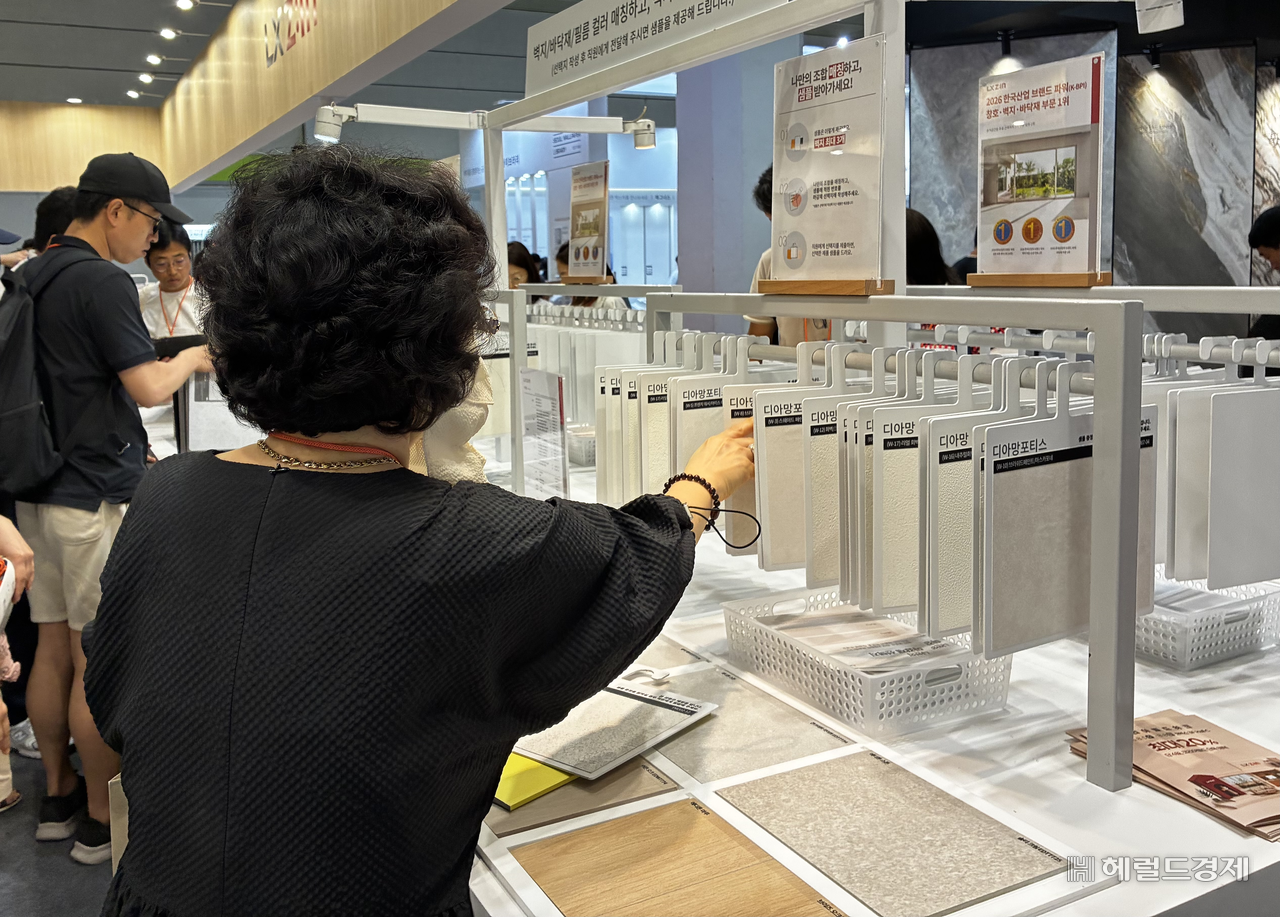
Every consultation table at the interior design hall of the 2026 Korea Build Week was packed Wednesday afternoon at COEX in Gangnam-gu, Seoul. Despite it being a weekday, visitors preparing for the fall moving season filled nearly every seat.
This year's interior design hall was dominated by "one-tone" design — coordinating walls and floors in soft whites, light grays and beiges to create a unified look. Hyundai Livart showcased a dedicated one-tone kitchen line that matches cabinet doors, ceilings, moldings and interior doors in a single color scheme.
"Many customers now prefer an integrated design that unifies walls, floors and furniture in calm, muted tones to make a space feel larger and more organized," an LX Hausys official said. Yun Se-yeon, 34, who is preparing to move into her first home as a newlywed, said the approach addressed a practical concern. "My new place is about 59 square meters, so I was worried it would feel cramped," she said. "Matching the walls and floors in similar colors seems like it would make it feel less stuffy."
Picking finishes by hand, like shopping for clothes
Beyond simply viewing finished interiors, visitors were invited to mix and match materials themselves throughout the exhibition floor. At booths run by LX Hausys, Hyundai Livart and Hanssem, wallpaper samples hung on racks like clothing; visitors pulled them one by one and laid them over flooring swatches to compare color combinations. A compact kitchen mock-up the size of a storage box let visitors slot in different flooring panels, cabinet doors and countertop surfaces to see how combinations worked together.
At window display stands, visitors repeatedly opened and closed frames by hand to test their weight and the sense of openness they created. LX Hausys highlighted its ViewFrame window series, which carries a top energy-efficiency rating and features a "bezel-less design" that minimizes the border between the frame and the glass. "The frame is barely visible, so it feels almost like a full-pane window — it really opens up the room," one visitor said.
Marble alternatives that replicate the texture and veining of natural stone were also popular. Visitors ran their hands over large upright display panels and held two or three palm-sized tile samples side by side to compare them. LX Hausys presented its Editon line — a flooring and wall cladding product that applies marble and tile patterns over a high-strength base made from crushed stone. "Demand for alternatives that are easier to maintain, come in more designs and cost less than natural marble has clearly grown," a company official said.
Exhibition spaces targeting the built-in furniture trend that has taken hold in residential design also drew attention. LX Hausys dressed up a kitchen and walk-in closet display with built-in wardrobes and interior partition doors to resemble an actual home. Hanssem expanded its interior door lineup as well, adding a new fabric-style glass panel to its Unit Wood Sliding series, which features a wood-embossed finish and a 16-millimeter frame. Visitors touched the glass directly to feel how light passed through it and how much privacy it provided.
Decorating your home in VR — and a first look at second-half launches

Virtual reality and augmented reality featured widely across the show floor, from interior design consultations to building inspections. At the Hyundai Livart booth, visitors put on VR headsets and walked through a virtual home, swapping out wallpaper, flooring and furniture colors to get a feel for the actual space. The construction technology hall offered a safety simulation in which participants explored a virtual construction site and identified hazards such as falls and collisions.
Booths previewing products set for second-half launches also drew crowds. Hyundai Livart's NL500G kitchen system lets buyers coordinate cabinet doors, countertops and handles to match the overall color palette of a room, so the kitchen blends seamlessly with the surrounding walls, floors and doors rather than standing out. Visitors opened cabinet doors to inspect the interior layout and ran their hands over countertops and handles to compare materials and finishes.
Hanssem arranged its upcoming products in mock kitchen, bathroom and entryway spaces designed to resemble real homes. The Euro500 Kitchen, set to launch this month, combines roughly 60 modules that can be configured to suit a room's layout and the owner's lifestyle. The company also showed a wood-grain door panel and a modular island unit designed to be arranged around the flow of movement through the kitchen.
The Signature Entryway Cabinet, due out in September, features a shoe shelf with 22 percent more storage than the previous model and a folding shelf whose height can be adjusted to accommodate tall footwear such as boots. A visitor who said she is a mother of three noted that her entryway was perpetually cluttered. "Between my kids' sneakers, rain boots and seasonal shoes, there's always a mess by the door," she said. "What caught my eye most was being able to adjust the shelves and fit a lot of different kinds of shoes in one place."
Lifting a 20-kilogram box with ease: Robots and drones move into construction
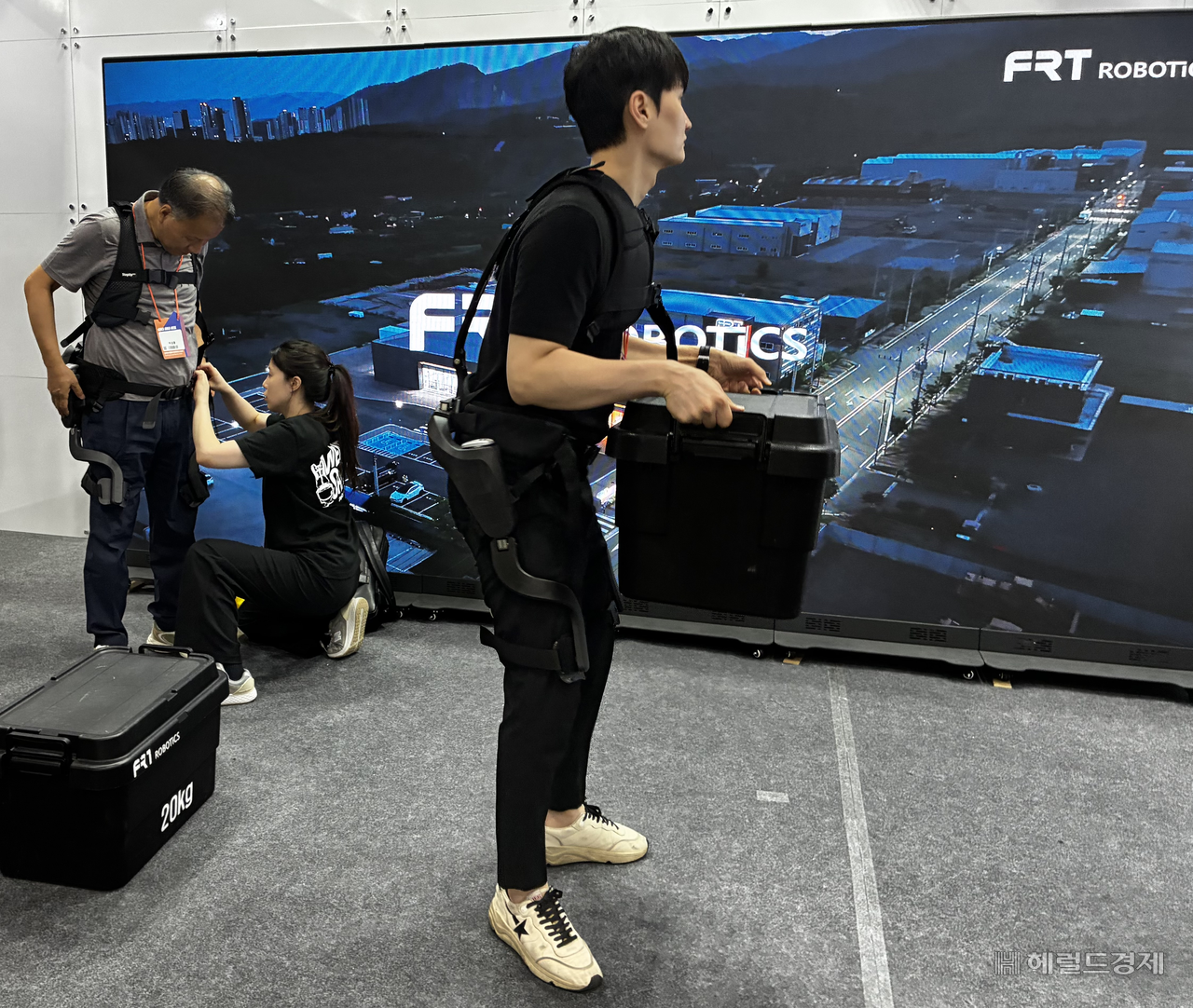
Wearable robots and physical AI took center stage as the headline technologies in the construction hall this year. At the FRT Robotics booth, visitors strapped on a wearable exoskeleton and lifted a 20-kilogram box. Choi Ho-hyeon, 27, who tried it himself, said the support was noticeable. "The load felt slightly different depending on how I positioned myself, which was a bit of a drawback," he said. "But there was a force supporting my lower back, so it was less of a strain than lifting with nothing on."
UND Robotics demonstrated a four-legged walking robot paired with a robotic arm mounted on its back, both controlled with a joystick-style gamepad. The system pairs a quadruped capable of navigating stairs and uneven terrain with a robotic arm to carry out inspections and tasks at construction and disaster sites that are difficult for humans to reach. The arm's end attachment can be swapped out, allowing a single unit to perform multiple types of work.
Drones, too, have evolved well beyond simple aerial cameras into full-fledged tools for construction site management. The exhibition floor featured drones used for exterior wall cleaning, water spraying, surveying, spatial data collection and facility inspection. A representative from a company specializing in drone-based crack detection and analysis on exterior walls said competition among waterproofing firms had pushed the industry toward new technology. "The waterproofing market is so fiercely competitive that companies are now turning their attention to drones," the official said. "We started our research last year and commercialized it this year."
In building materials, fire safety and construction efficiency emerged as the defining competitive factors. Growing public concern over building fires pushed non-combustible and fire-resistant insulation to the forefront. At the same time, rising labor costs and a shortage of on-site workers drove demand for products thinner and lighter than conventional stone or wall panels — materials easier to transport and install. Foam ceramics and ultra-lightweight stone slabs were among the products designed to reduce weight and thickness while maintaining insulation and finishing performance, with the goal of cutting construction time and easing the physical burden on workers.
The 2026 Korea Build Week runs through Saturday at COEX halls A through D, featuring about 700 companies and 2,000 booths. The show brings together products and technologies spanning the full construction industry — building materials, interior design, construction technology and equipment, and building systems.
snsd@heraldcorp.com





