![[Getty Images Bank]](https://wimg.heraldcorp.com/news/cms/2026/08/06/news-p.v1.20260806.427a6071e79446518df99a056f642acf_P1.jpg)
In 2003, Nick Bostrom, a philosophy professor at the University of Oxford, published a paper arguing that we are very likely virtual beings living inside a simulation run by future humanity. The "simulation hypothesis" — the idea that the universe we take to be real may in fact be a computer simulation — has of late become one of the most actively debated topics in science and philosophy.
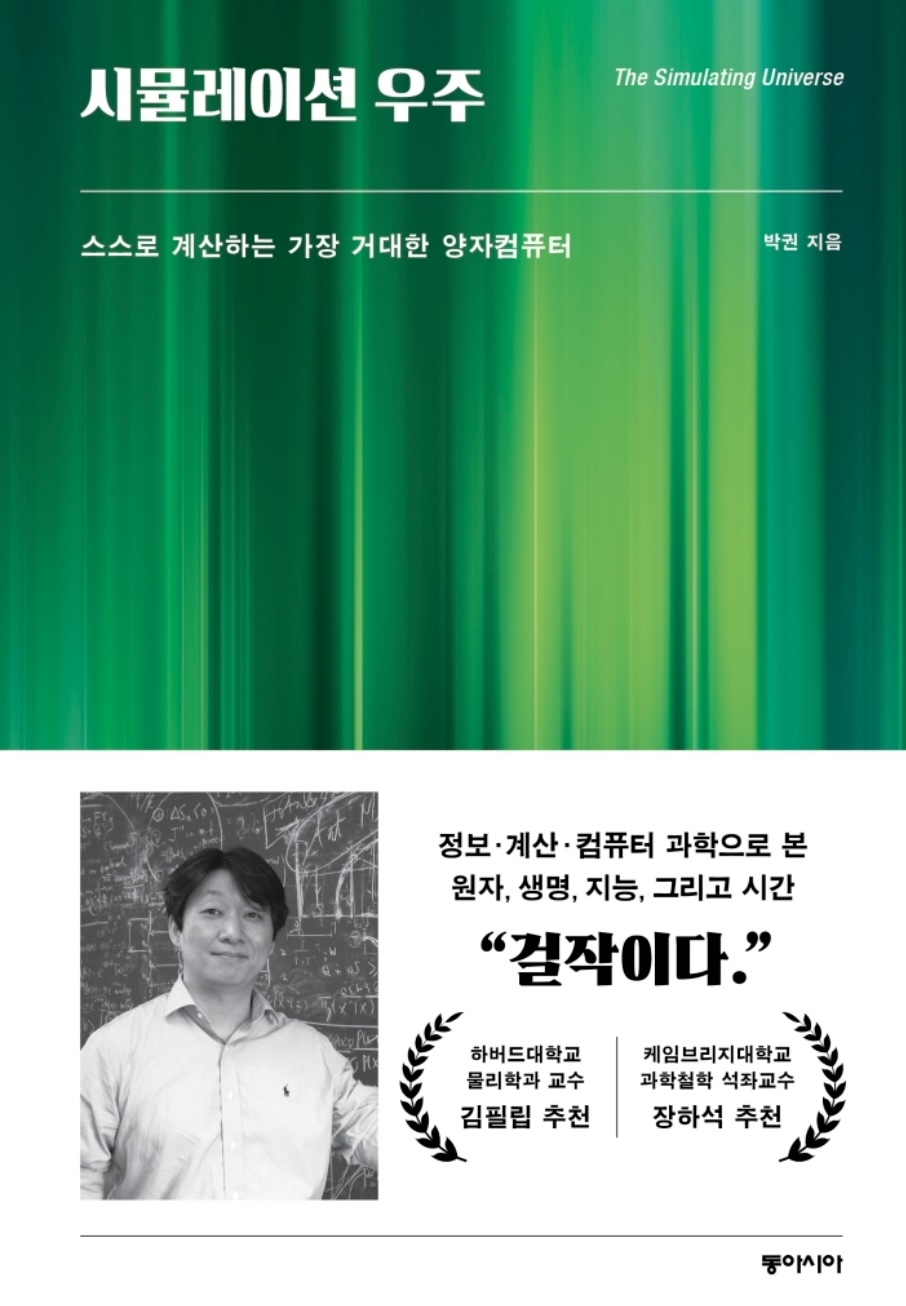
Park Kwon, a professor at the Korea Institute for Advanced Study and a theoretical physicist of international standing, takes up that proposition in his book "Simulation Universe," drawing on discoveries and insights spanning physics, mathematics, quantum mechanics and AI to approach the claim that the universe is a giant computer.
The book takes as its starting point the proposition put forward by John Archibald Wheeler — known as "the physicist's physicist" — that "it from bit": everything emerges from information. From there, Park explores what information is and how every physical system can function as a computer, before turning to the quantum mechanics that governs the universe, the quantum computers that may one day model it, and the question of what role human beings play in a cosmos of that kind.
The essence of life lies in the "information" encoded in DNA and the "computation" that processes it. Even at the microscopic scale of atoms and molecules, measuring information determines physical properties. The mathematical definition of the quantity of information is, it turns out, no different from the physical quantity that gives time its direction.
Park interprets Wheeler's "it from bit" as meaning that every physical object contains information. He argues that the physical properties of atoms, living things and time are themselves information, and that changes in those properties can be expressed as basic logical operations — NOT, OR and AND. The universe itself, in other words, is a vast information system.
Park also traces the advance of technology to note that vacuum tubes, semiconductors and even water or air can serve as computers capable of performing calculations. "We can always build a physical system that can carry out a given task," he said, adding, "We can use everything in the universe to build a computer."
AI, too, sits on the same continuum of information and computation. The mathematician and computer scientist John von Neumann observed that "the logical structure of the nervous system is fundamentally identical to that of a digital computing device." By that logic, AI could in principle replicate not only human intelligence but human consciousness itself.
Nobel physics laureate Roger Penrose pushed back, however, arguing that intuition is "the essence of human thought" and that "AI cannot think like a human because it follows deterministic algorithms." What transcends those deterministic algorithms, Park notes, is quantum mechanics — which is precisely why Penrose also suggested that "humans are computers operating on quantum mechanical principles, that is, quantum computers."
The universe obeys quantum mechanics. What state the universe will take is determined only through measurement, and the outcome changes depending on how that measurement is made. To simulate everything in the universe with perfect fidelity, one would need to account even for the indeterminacy that quantum mechanics demands — and here, again, the quantum computer makes its entrance.
"A quantum computer can consider an enormous number of possibilities simultaneously, but the answer is given only probabilistically," Park writes. "In exchange for abandoning deterministic algorithms, we have embraced the fundamental uncertainty of the universe."
As science and technology have advanced, humans have built ever-better computers to simulate the universe, using whatever tools were available at the time. But humans are themselves part of the universe. Park offers this reading: "The universe is coming to understand itself by having humans — a part of itself — simulate itself."
He arrives, through Wheeler's concept of the "participatory universe" — in which the cosmos gradually constructs itself by interacting with humans through the act of measurement — at the conclusion that "humans play a decisive role in shaping our universe into the form we know today."
"The universe is slowly evolving into a computer that understands itself ever more deeply," Park writes. "This evolution happens because humans, as part of the universe, ceaselessly question the universe in order to understand it. To exist is to compute."
"Simulation Universe" by Park Kwon / Dongasia
balme@heraldcorp.com