Eight out of every 10 designated heat shelters in Seoul were closed on Sunday, an investigation has found. The shelters — set up in neighborhood community centers, public libraries and senior centers — operate on the same schedules as the facilities that house them, leaving vulnerable residents with little access to air conditioning on weekends when offices are shut.
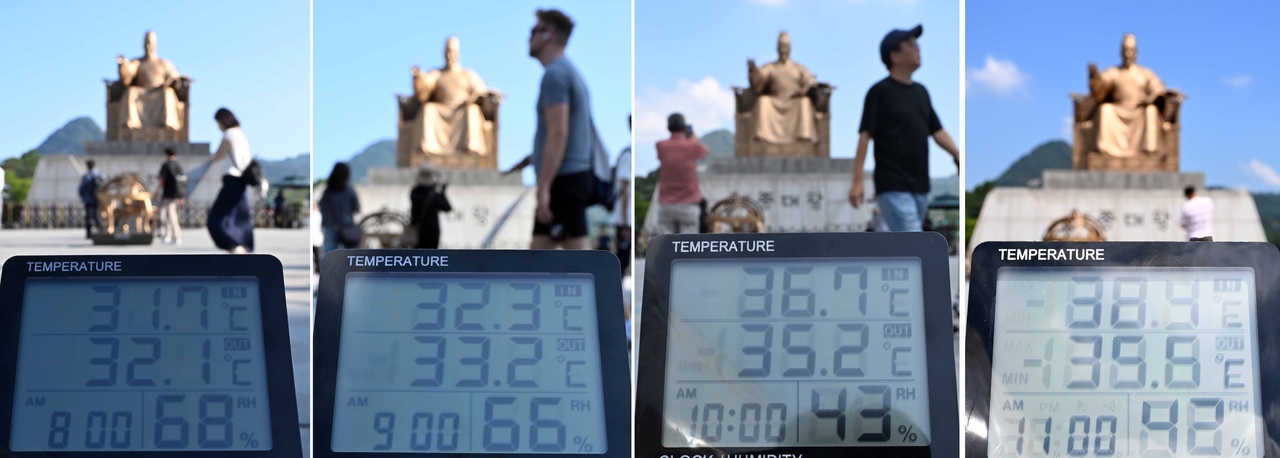
Of Seoul's 4,035 registered heat shelters as of Sunday, only 869, or 21.5 percent, were open that day. Sunday was the hottest day of the summer so far, with temperatures reaching 42.5 C in Yangsan, South Gyeongsang Province, and 34.9 C in Seoul.
The situation was only marginally better the day before. On Saturday, just 1,024 shelters — 25.4 percent, or roughly one in four — were open. A Seoul Metropolitan Government official acknowledged the shortfall. "It would be better to have more heat shelters open on weekends, but there are limits in terms of staffing and budget," the official said. City data bear that out: of the 475 public buildings designated as heat shelters — including neighborhood community centers — only 175, or 36.8 percent, are listed as extending their hours on weekends when a heat wave alert is issued.
Even shelters that are open are often off-limits to the general public. Of the city's total heat shelters, 2,878 — 71.3 percent — are senior centers that restrict access to registered members. Only 200 of those centers, just 6.9 percent, are listed as having obtained member consent to admit anyone.
Another 165 shelters, or 4.1 percent of the total, are located inside financial institutions and close when those businesses do. An additional 55, or 1.4 percent, are classified as everyday private establishments — churches, cafes and real estate offices — all tied to their own operating hours and difficult to keep open on weekends or at night.
Around-the-clock shelters are also scarce. The city has designated 24 of its 25 district office buildings as 24-hour emergency evacuation centers — all except Gangbuk-gu, which is using a temporary facility. Beyond district offices, city data show only one other location operates around the clock: a migrant workers' shelter in Gwanak-gu called Gwanak Forest.
Mapping Seoul through the lens of heat vulnerability reveals blind spots scattered across the city where residents struggle to reach cooling facilities.
A study published in May by the National Disaster Management Research Institute through the Korean Society of Hazard Mitigation found that certain areas in southwestern and southeastern Seoul showed consistently high heat vulnerability, with limited access to heat shelters.
By contrast, northern and southern parts of the city — home to Bukhansan, Gwanaksan and Buramsan — showed relatively lower vulnerability, as mountains and green spaces help dissipate heat. Jung-gu and Yongsan-gu, though short on green space, also registered lower vulnerability scores, thanks to dense urban infrastructure that makes it easier for residents to reach a shelter quickly.
cook@heraldcorp.com