Mayor explains withdrawal of Seoul annexation bid at press briefing
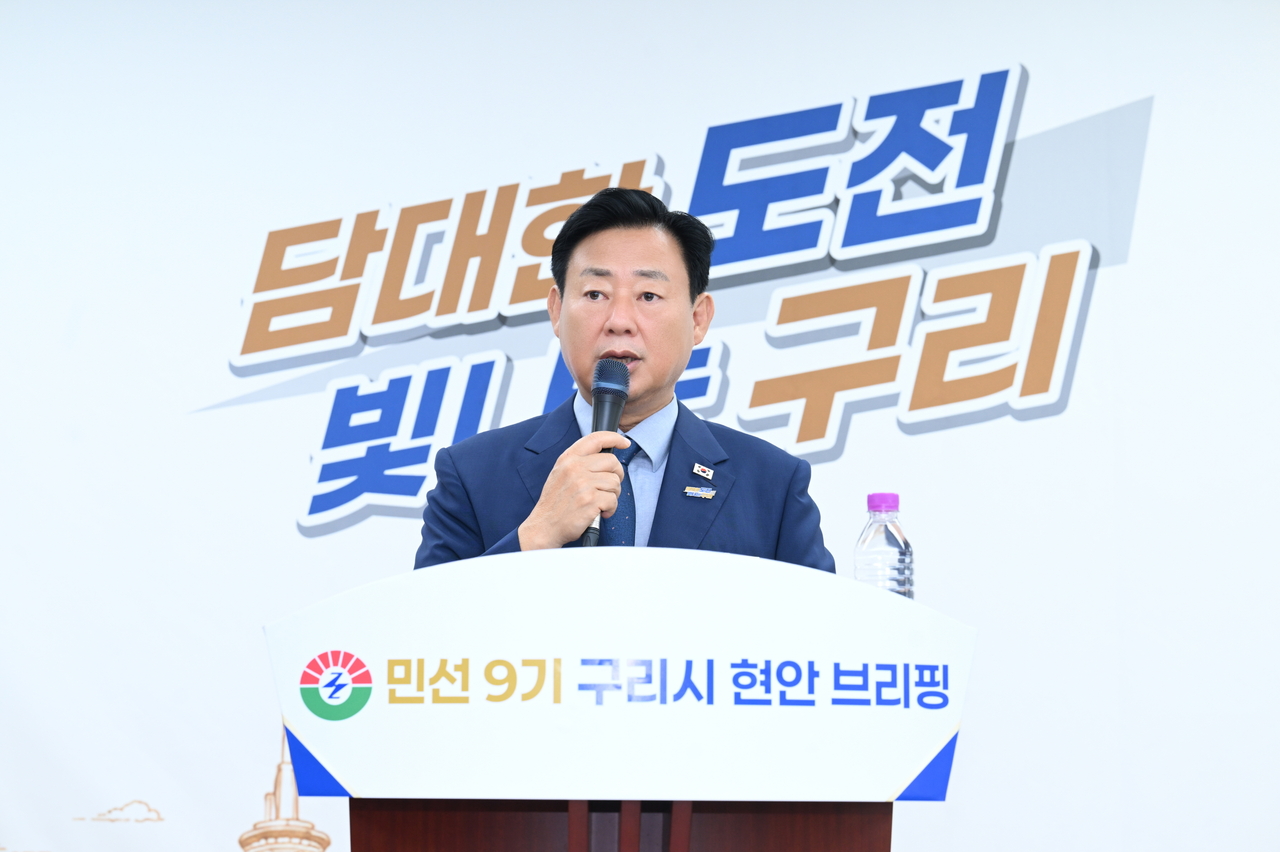
"Regarding Guri's annexation into Seoul, the city will have no involvement whatsoever going forward — under any circumstances, including civic movements."
Guri Mayor Shin Dong-hwa made the statement Thursday at a press briefing held in a city hall conference room.
Shin laid out in detail the city's withdrawal of its Seoul annexation push — alongside an update on the relocation of Gyeonggi Housing and Urban Development Corp. (GH) to Guri — and repeatedly stressed his position.
He said the city sent official notices to Gyeonggi Province and the Guri City Council on July 10 formally withdrawing the annexation bid.
"Seoul annexation is a matter of inter-metropolitan restructuring — it cannot happen simply because Guri wants it," he said.
Shin said the city would stop chasing the unrealistic prospect of Seoul annexation and instead concentrate its administrative resources on the GH relocation, which he described as an achievable goal.
The following is the full text of the briefing.
Good afternoon.
I am Shin Dong-hwa, mayor of Guri — a city of bold challenges and a bright future.
First, I sincerely thank the members of the press for attending today despite the sweltering heat and for your continued interest in Guri's city administration.
On this Thursday, I would like to address two matters: the city's official withdrawal of its push to be annexed into Seoul, and the relocation of Gyeonggi Housing and Urban Development Corp. (GH) to Guri.
Guri has advocated for Seoul annexation for the past three years, but has not made a single step of progress.
Seoul annexation cannot be pursued by Guri's will alone. It requires agreement from the parties directly involved — Gyeonggi Province and Seoul — as well as strict legal and administrative procedures, including the enactment of legislation.
Most critically, Gyeonggi Province declared on Feb. 21, 2025, that "the pursuit of Seoul annexation and the GH relocation to Guri are incompatible," and halted all administrative procedures related to the GH relocation.
Gyeonggi Province has maintained a clear position against annexation, and Seoul has not moved proactively on the matter either.
Given these circumstances, it has become clear that Seoul annexation is not a realistic goal. The ninth elected administration of Guri has therefore concluded that it can no longer expend administrative resources and budget on a discussion with little prospect of success.
What we need now is focus and prioritization.
We will concentrate the city's full capacity on two realistic and urgent priorities that will strengthen Guri's future competitiveness: the GH relocation to Guri and the establishment of a new Guri Education Support Office.
Accordingly, the city sent official notices to Gyeonggi Province and the Guri City Council on July 10 formally withdrawing the Seoul annexation push, and reported the withdrawal at the plenary session of the 361st extraordinary assembly on July 31.
I am aware that some have said this decision was made without sufficient public input.
However, this decision was by no means made in disregard of residents' wishes.
A public opinion survey on Seoul annexation conducted in July 2024 — covering 700 Guri residents — found that 468 respondents, or 66.9 percent, supported annexation.
The main reasons cited at the time were expectations for expanded infrastructure in education, culture and welfare, and improvements to transportation conditions, including subway extensions and expanded bus routes.
However, that survey was conducted before subway Line 8 opened in August 2024. Since then, access to Seoul has improved significantly, and the living conditions and transportation environment surrounding Guri have changed considerably.
The survey also asked respondents to choose between "Seoul annexation" and "incorporation into the Gyeonggi Northern Special Autonomous Province." The latter option, however, was merely discussed during the eighth elected administration and was never formally pursued.
The survey results therefore cannot be considered a reliable reflection of Guri residents' current views in 2026.
The GH relocation to Guri is the city's top campaign pledge to residents and the cornerstone project for the city's leap forward.
For reference, a 2021 public survey on attracting GH to Guri found that 874 of roughly 1,000 respondents — 87.2 percent — supported the move.
Notably, even amid COVID-19 restrictions that made public gatherings difficult, about 10,000 Guri residents signed a petition supporting the GH relocation.
Civic petitions and challenges calling for the GH relocation continued afterward, confirming sustained and strong public interest.
In May 2021, Guri was ultimately selected as the relocation site in a competitive bid involving 11 cities and counties, backed by strong public support and consensus.
Decisively, in the June 3 local elections — where GH relocation and Seoul annexation were directly pitted against each other — residents chose the city's direction with GH relocation as its core campaign pledge, not Seoul annexation.
The choice made by 53,227 Guri residents is, I believe, the most direct and official confirmation of the public's will.
I respect the choice of our residents and intend to reflect their wishes in city governance by making the GH relocation the top priority of this administration.
If Seoul annexation was a long-term goal that remained out of reach, the GH relocation is a project whose selection was already confirmed — and once administrative procedures resume, it will deliver tangible results that residents can feel.
The GH relocation is not simply a matter of moving one public institution.
Once Gyeonggi Housing and Urban Development Corp. — with assets exceeding 22 trillion won ($15.4 billion) and annual sales surpassing 1 trillion won — is established in Guri, the city will serve as a hub to accelerate a wide range of urban development projects across northern Greater Seoul.
With GH as an anchor, related businesses and industries will follow, laying the foundation for Guri's future growth through quality job creation, a revitalized local economy and an enhanced city brand.
The relocation is also expected to generate approximately 8 billion won in annual local tax revenue — including local income tax and resident tax — which will serve as a vital source of funding for expanding key public services such as welfare and transportation.
In addition, the presence of GH employees and an influx of visitors will stimulate local consumption and expand direct and indirect employment opportunities for residents, injecting new vitality into the local economy.
Now that cooperation with Gyeonggi Province is back on track, the GH relocation will move forward with momentum.
At a meeting between the Gyeonggi governor and city and county mayors on July 22, I asked Gyeonggi Province Governor Choo Mi-ae to resume procedures for the GH relocation and pledged to "make it the top priority of my term and deliver visible results within a year."
This morning, I held a working meeting on the GH relocation with the head of Gyeonggi Province's housing and urban affairs division, a Gyeonggi Provincial Assembly member and the president of Gyeonggi Housing and Urban Development Corp.
We are in negotiations to secure a temporary office this year and to have GH employees working in Guri by the first half of next year.
Guri will continue to work closely with Gyeonggi Province to ensure the GH relocation proceeds without a hitch, committing all of the city's administrative resources to the effort.
Now that the obstacle of Seoul annexation has been removed, Guri will work with Gyeonggi Province under the shared goal of balanced development — and prove the GH relocation's worth through results.
pjh@heraldcorp.com