![LG AI Research co-directors Lee Hong-rak (left) and Lim Woo-hyung [LG]](https://wimg.heraldcorp.com/news/cms/2026/08/07/news-p.v1.20260807.52d752513b4a4db1996599875802ea6b_P1.png)
LG AI Research said Friday that its AI model Exaone has surpassed Google and Alibaba in foundation model evaluations for industrial data prediction, demonstrating competitiveness in specialized AI that can be deployed directly on the factory floor — beyond general-purpose language models.
LG said Exaone Tabular, which predicts tabular data, and Exaone Forecast, which predicts time-series data, have each achieved state-of-the-art performance on their respective global leaderboards. The leaderboards assess and verify the predictive capabilities of AI foundation models using real-world data generated across a range of industries.
Exaone Tabular ranked first overall in categorical data prediction on TabArena, a leading global leaderboard. Unlike conventional general-purpose language models that convert tables into text before analysis, Exaone Tabular is a tabular foundation model trained on large volumes of synthetic structured data. It can directly understand the structure of rows and columns as well as the relationships between data points.
Exaone Tabular posted an ELO score of 1,760, edging out the 1,749 recorded by TabFM, Google's latest model released in July.
The model can quickly adapt to new problems with limited data and generate predictions, making it highly useful in environments where data is scarce. The development extends Exaone's reach into the processing and prediction of tabular data, which is widely used across industrial settings.
LG AI Research says the achievement is particularly significant because it gives LG an early foothold in the structured-data AI market, an area where global technology giants including Google are now moving aggressively. The lab plans to run proof-of-concept trials of Exaone Tabular in three sectors — manufacturing, biotech and healthcare, and finance — in the second half of this year, with the aim of converting them into commercial projects.
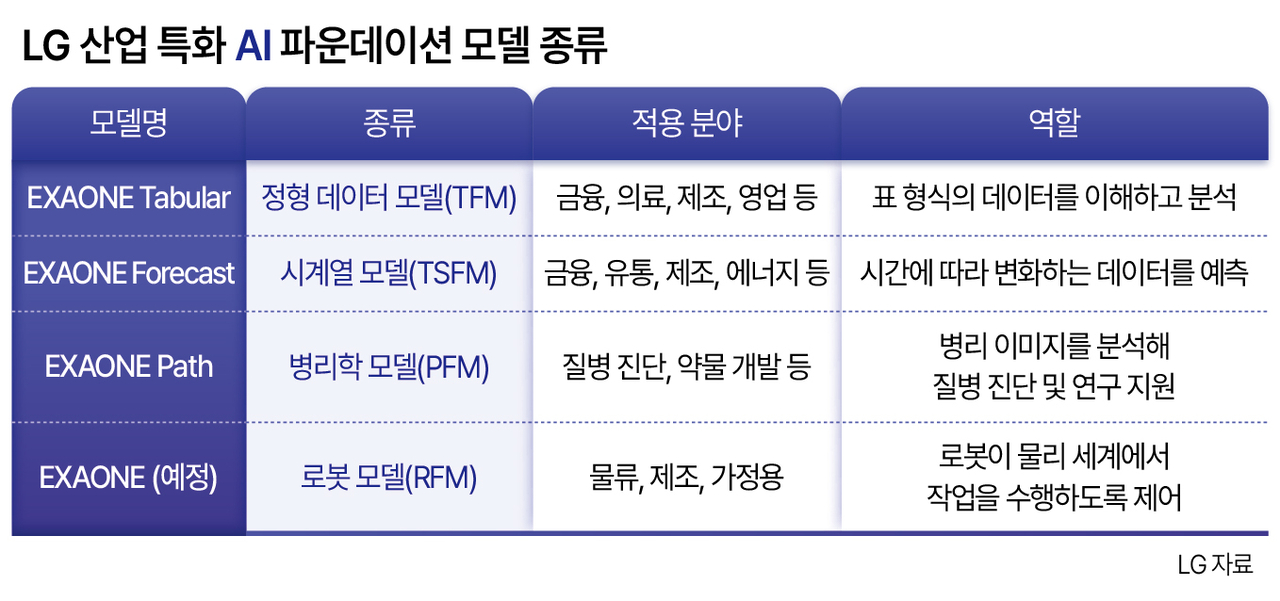
Exaone Forecast, which predicts the future based on time-series data, achieved top-tier prediction accuracy on GIFT-Eval, a leaderboard developed by Salesforce, the global customer relationship management company.
Exaone Forecast beat US and Chinese technology giants including Google and Alibaba to claim top performance in the zero-shot category — accurately predicting data from domains the model has never encountered, without additional training. It also ranked second in the agentic AI category, in which the model independently analyzes data and generates predictions.
Exaone Forecast was trained on real-world time-series data from industries including the internet, energy, economics, healthcare and transportation, as well as about 2 trillion synthetic time-series data points simulating real-world conditions. The model generates future scenarios by combining trends, volatility, structural shifts and interactions among variables.
Because a single model can handle time-series forecasting across different industries, its range of applications is broad and development efficiency is high. LG AI Research has worked with affiliates including LG Electronics and LG Energy Solution to build AI models that forecast seasonal product demand and the prices of raw materials such as lithium, and has applied them to actual business operations. Starting this year, the lab launched a stock market prediction AI service with Koscom and the London Stock Exchange Group, analyzing about 8,000 securities listed in South Korea and the United States on a daily basis.
LG AI Research is broadening Exaone's reach by centering its strategy on industry-specific foundation models optimized for the data and operational characteristics of real industrial environments.
The lab released Exaone Path, a pathology foundation model, in 2024 and is currently developing a cancer agentic AI that diagnoses tumor types and supports clinical decision-making by specialist physicians.
LG AI Research is also continuously expanding the types of data Exaone can process. A robot foundation model is under development that interprets visual information and translates it into control signals enabling robots to perform physical tasks in the real world.
"Global technology leaders are rapidly shifting their attention from general-purpose language models to industry-specific AI foundation models that solve real problems on the factory floor," said Lim Woo-hyung, co-director of LG AI Research. "This achievement demonstrates that data accumulated across manufacturing and other industries can become a differentiated competitive advantage for Korean AI."
jeongwan@heraldcorp.com