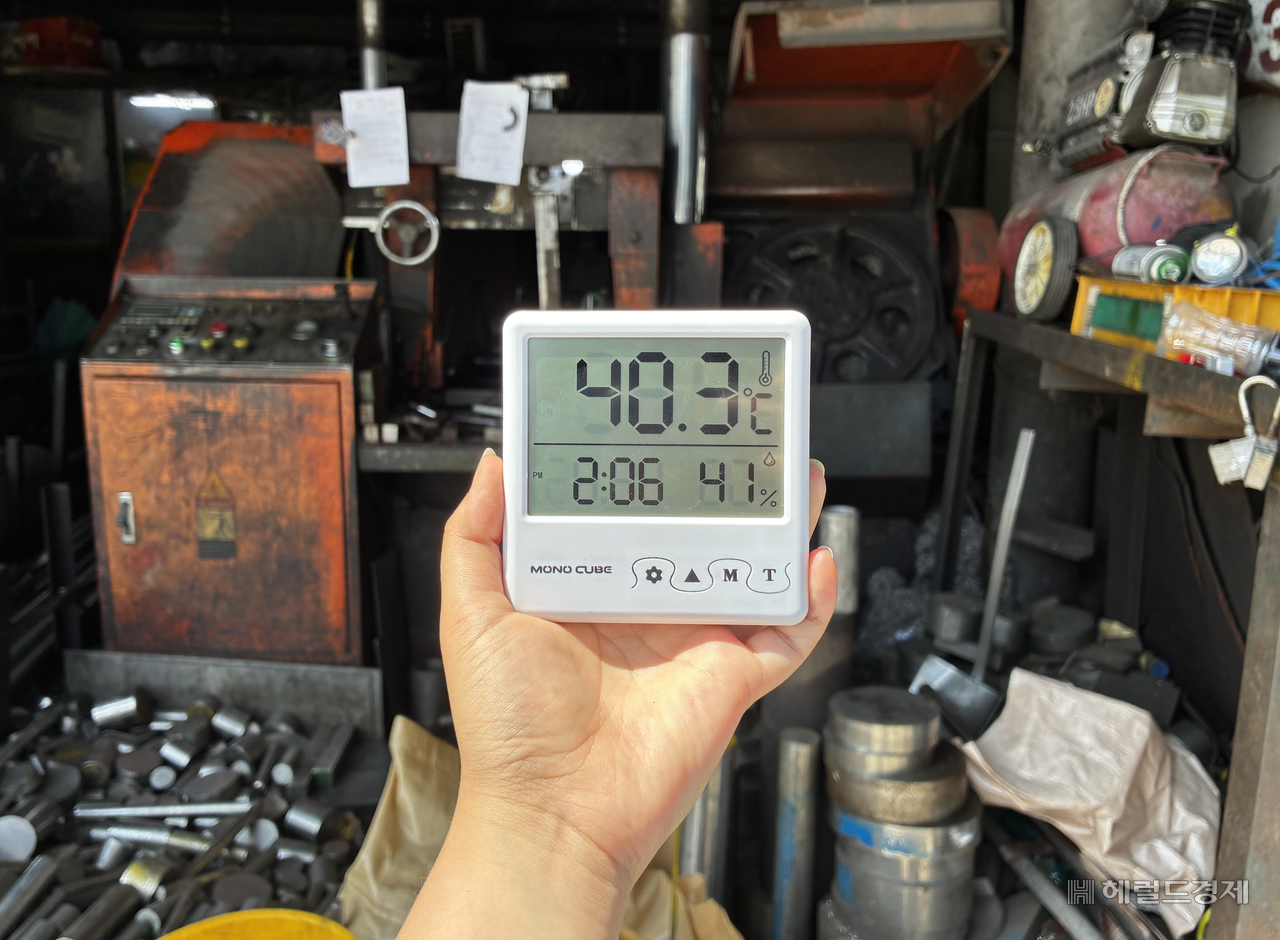
40.3 degrees Celsius.
That was the temperature inside a stainless steel products factory in Mullae-dong, Yeongdeungpo-gu, Seoul, around 2 p.m. Thursday — the hottest part of the day. The Korea Meteorological Administration's official reading for the same moment was 36.3 degrees. But inside the workshop, which has no air conditioning and opens directly onto the street, the thermometer climbed well past 40.
"36 degrees? That's a lie. If you stand here long enough, it doesn't feel like 40 — it feels like 50," said a worker stationed in front of a large mechanical press at the center of the floor. "The heat coming off the machines makes it even worse," he added. He briefly retreated to a small office — barely 3.3 square meters — that had an air conditioner, but returned to the floor in less than five minutes.
A reporter who visited about 20 small machine and metalworking factories in the Mullae-dong industrial cluster that day found that more than half had no air conditioning at all. Most are built with roll-up shutter fronts that open entirely onto the street, leaving no enclosed interior space where a cooling unit could function. The shutter goes up, and the workshop becomes an extension of the outdoors. Mullae-dong is typical of Seoul's inner-city manufacturing clusters, where small factories are packed between apartment buildings, cafes and shops — leaving no room to expand or add separate cooling and rest areas.
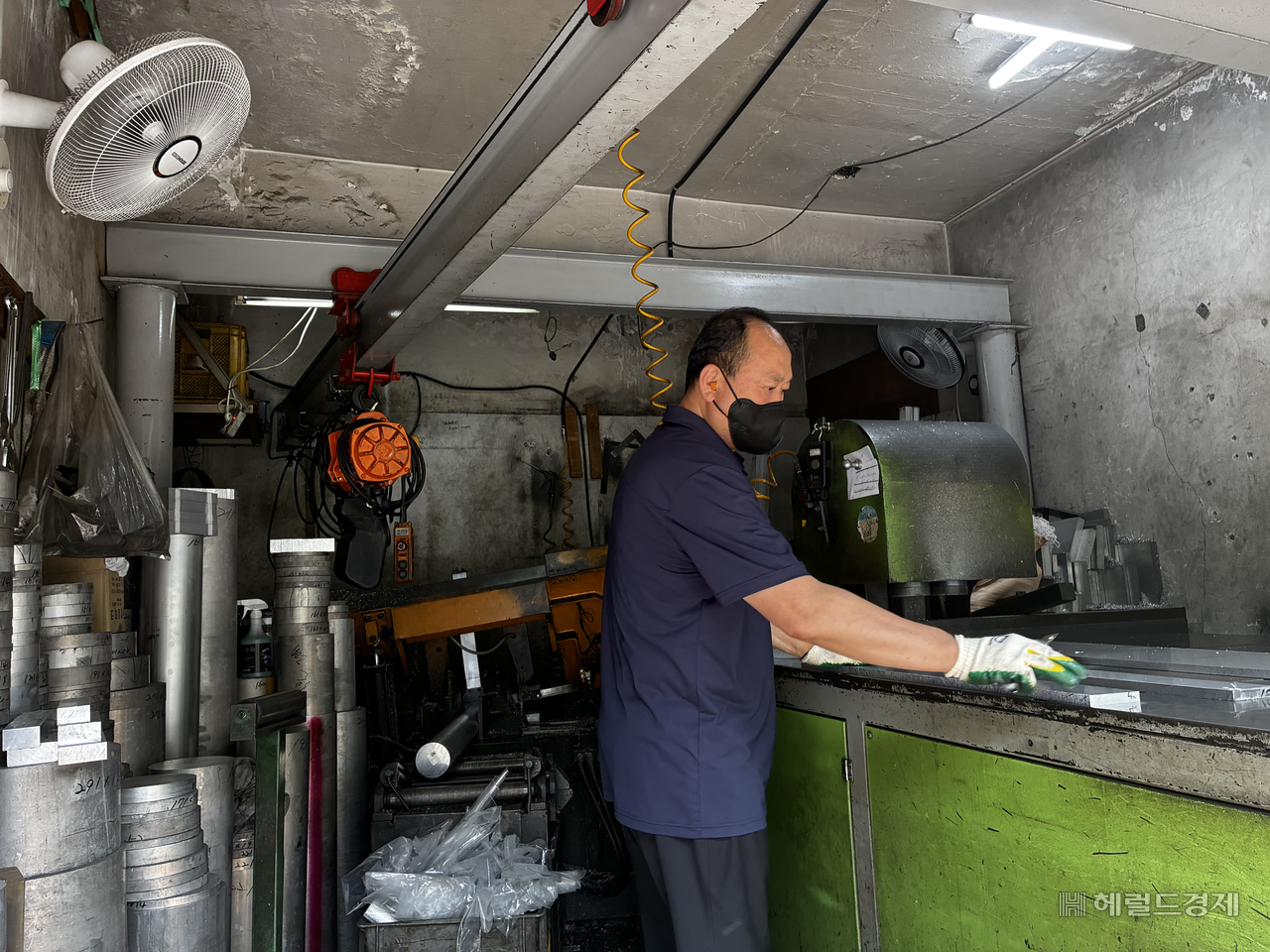
One metal factory spanning about 165 square meters had only three large electric fans and no air conditioner. Shin Chang-yeol, 48, an employee there, said he had worked in the trade for more than 20 years but had never seen heat like this. "The energy just drains out of you while you work," he said. "The ceiling is so high that even if we installed an air conditioner, we couldn't afford the electricity bill." He added that only about five factories of comparable size operate in the alley, and that cooling costs make air conditioning impractical even for the larger ones.
The factory once employed six workers, but as the economic downturn dragged on, five were let go last year. Since the start of this year, Shin has been covering the entire floor alone. "I'm doing the work six people used to share, so I'm constantly moving back and forth across the workshop," he said. "The headcount dropped and now the weather has turned brutal — it's so much harder than before."
A nearby metal factory of similar size was no different. Two workers relied on a pair of large fans. One explained that running an air conditioner would require keeping the shutter down, but delivery trucks come and go constantly, making that impossible. Next door, at an aluminum pipe manufacturing and sales business, two workers were hauling long pipes between the workshop and the street, loading them onto a truck. They wore caps and arm sleeves to block the sun, but their faces and work clothes were soaked with sweat within minutes.

Some workers in the cluster handle heat of around 1,500 degrees Celsius even as the air around them pushes past 40. At a laser processing shop with a single fan and no air conditioner, a 52-year-old worker identified only by his surname Kim crouched on the floor welding red square steel tubing. "Stand back — it's hot," he said before pressing his equipment against the metal. Asked why he was not wearing a face shield, he said he knew he should wear one even for simple jobs. "But on a day like Friday," he said, "sweat pools inside it and it gets unbearable."
At a nearby metal sales and cutting business, Kim Jeong-mun, 57, was slicing steel sheets to specification. He kept a black mask on throughout. "Metal dust flies everywhere when you cut steel, so I cannot take the mask off — but in this weather it feels like I am suffocating," he said. He added that two machines and stacks of metal products filled the workshop, leaving no space for an air conditioner.
A colleague who has worked alongside Kim for 30 years said the heat this year had finally broken him. "I stayed when the whole alley turned into a cafe strip and my coworkers left one by one, because I loved this work," he said. "But this summer is too much. I am thinking I would be better off quitting and opening a convenience store."
Under industrial safety regulations revised in July 2025, employers must give workers at least 20 minutes of rest every two hours when the heat index reaches 33 degrees Celsius or above. They must also provide personal cooling or ventilation devices and other measures to prevent body temperature from rising.
On the ground, however, the reaction was largely: "We don't know anything about that." Kim said the rules sounded like something for larger small and medium-sized enterprises, not micro-businesses like his. "When work comes in during a downturn, you do it — no matter what," he said. Workers at other factories said the same: either they had never heard of the standard, or meeting deadlines made scheduled rest breaks impossible.
Smaller, enclosed workshops do have air conditioners, but they are no less vulnerable to the heat. Kwak Gyeong-hun, 48, who runs a metal parts manufacturing company, said his shop is small enough to seal up and cool — but the dust generated during machining means the ventilation fans must run constantly. "That's why it never actually gets cool, no matter how hard the air conditioner works," he said.
His factory covers about 66 square meters. The thermostat was set to 26 degrees Celsius, but the indoor temperature read 29. Two workers share the space. This year the business shifted its hours from the previous 9 a.m.–6 p.m. schedule to 7:30 a.m.–4:30 p.m. to avoid the worst of the afternoon heat. "We changed the hours to dodge the heat, but it is still hot in the morning, and coming in earlier means fatigue builds up," Kwak said.
Kwak said his factory mainly supplies electric vehicle battery components, but orders have fallen since last year — possibly because EV sales have slowed. "This is a sector that moves with the economy. When orders come in, they come in all at once, so you have to produce in bulk," he said. "If I let workers go now because there is no work, I will not be able to find skilled hands again when orders pile up." He added that on top of the economic pressure, cooling costs this year look set to exceed last year's.
Business owners said small manufacturers would continue to struggle until the broader economy recovers, but in the immediate term they were united on one request: portable air conditioners. "You can get government support to buy storage units or workbenches, but there is no purchase support for portable air conditioners," Kwak said. Another owner said private companies advertise subsidy programs but the pitches feel more like sales tactics than genuine help. "If the government or a local authority offered direct support, I would be very willing to bring in more portable units," he said. "The heat we are seeing now is unlike anything before, and cooling has become more urgent than ever."
snsd@heraldcorp.com
hong@heraldcorp.com