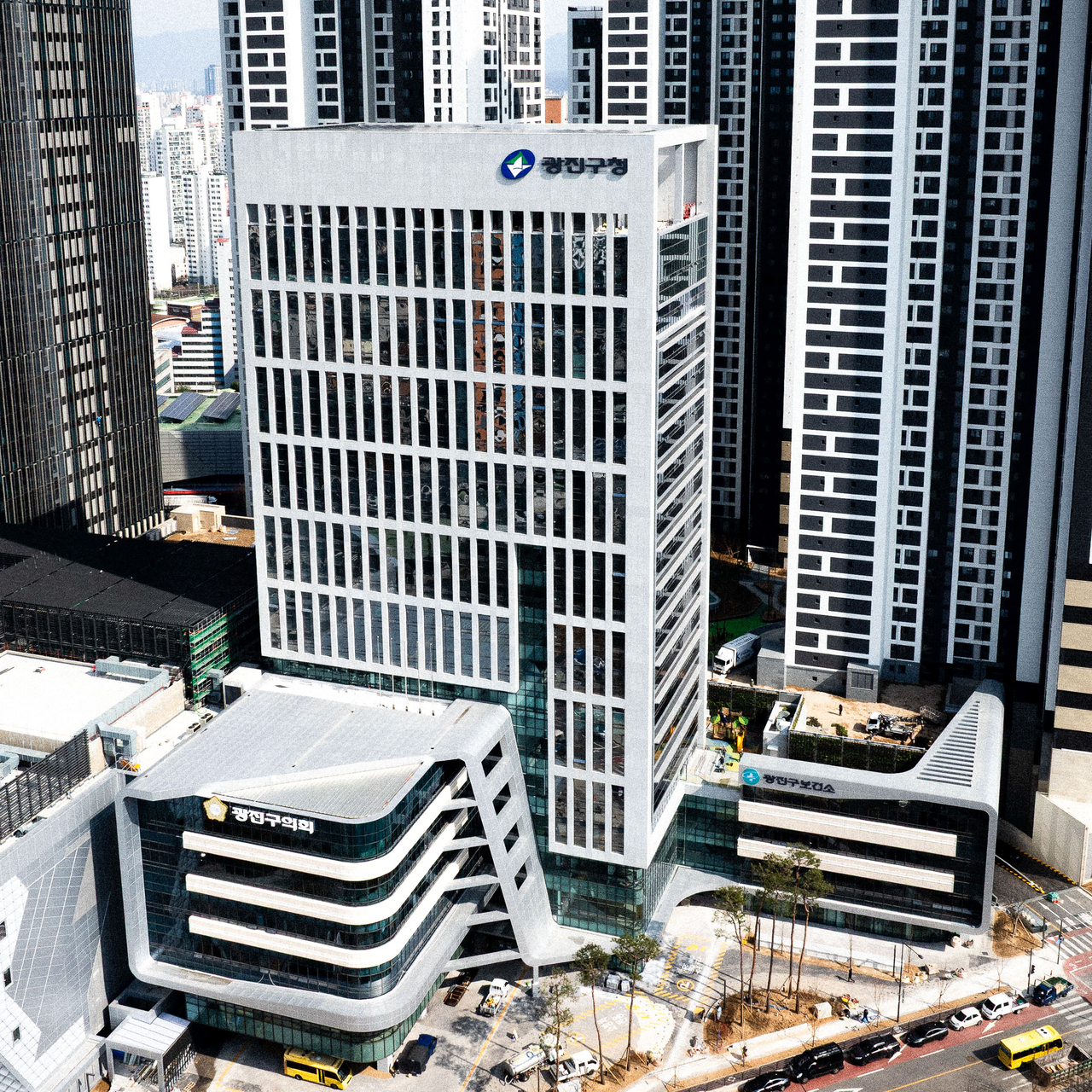
"It's scorching outside, but walking into the integrated new building — I feel like I can finally breathe."
With temperatures approaching 40 degrees Celsius day after day, staff at the Gwangjin-gu district office are expressing strong satisfaction with their working environment, about a year and a half after moving into the new integrated building.
A senior official at Gwangjin-gu recently told a reporter the change from the old building had been total. "The working conditions are completely different from what they used to be," the official said.
The old Gwangjin-gu office had been spread across several aging structures, including a building that once served as a training center for the Democratic Republican Party in the 1970s. The facilities were badly deteriorated, and poor heating and cooling made conditions difficult for staff.
Another senior official recalled that the public affairs office sat directly below the rooftop, meaning summer heat poured straight down into the workspace. "It was unbearable in the summer," the official said. "Since we moved to the integrated building near Guui Station, the working environment has improved enormously."
Gwangjin-gu had been pursuing a new building since the tenure of District Mayor Kim Ki-dong during the sixth round of local elections, as a way to address the chronic problems with its aging facilities.
After more than a decade of preparation, the integrated building was finally completed. District Mayor Kim Gyeong-ho, serving in the eighth round of local elections, became the first district mayor to move into the new building, doing so in March last year. Kim also had reason to celebrate on another front: he won re-election in the June 3 local elections around the same time as the move.
Former deputy district mayors Baek Il-heon and Yun Jae-sam, as well as current Deputy District Mayor Kim Ki-hyeon, have also had the good fortune of working in the new building.
One of the building's biggest advantages is its accessibility and convenience.
It connects directly to Guui Station on Seoul Metro Line 2, allowing staff to commute without getting wet in rain or snow. The adjacent Lotte Castle Eastfall and other large mixed-use residential complexes have brought in nearby commercial facilities, making it far easier to find a meal or use everyday amenities.
The addition of an underground parking garage has also transformed conditions compared with the old building, which had long struggled with a chronic shortage of parking.
Gwangjin-gu is not alone. Dongjak-gu has also entered a new-building era, with staff working conditions and public accessibility both significantly improved.
The wave of new district office buildings across Seoul's autonomous districts shows no sign of stopping.
Gangseo-gu has begun preparations in earnest for a move to its new building, targeting October, while Gangbuk-gu has construction underway on its own new facility.
By contrast, a number of district offices — including those of Gangnam-gu, Seocho-gu, Nowon-gu, Seodaemun-gu, Eunpyeong-gu, Guro-gu, Gangdong-gu and Songpa-gu — still lack underground parking garages and face comparatively poor conditions in terms of facilities.
As climate change drives increasingly intense summer heat waves, the quality of district office buildings is becoming more than a matter of comfortable offices. It is emerging as a critical piece of administrative infrastructure that affects staff health, work efficiency and the convenience of residents who visit to handle civic matters.
"Honestly, when I see the staff at districts that have recently moved into new buildings, I feel envious," said an official at one Seoul district office. "A district office is not just a workspace for employees — it is a space residents use every day. The need to upgrade aging buildings will only grow."
seouldream01@heraldcorp.com