The Democratic Party of Korea is moving quickly to draw up measures to boost housing supply in Seoul as market concerns grow over the party's proposed real estate tax reform. Options under discussion include expanding the supply of non-apartment housing such as row houses and multi-family units, while shortening the timelines for redevelopment and reconstruction projects.
Han Byung-do, the Democratic Party's acting party leader and floor leader, said Monday at a Supreme Council meeting that "about 500,000 units of redevelopment projects in Seoul and about 400,000 units of supply and housing projects in the greater metropolitan area are waiting for legislation." He called for swift passage of two bills — one that would cut redevelopment project procedures by up to three years, and another that would accelerate public housing project timelines by more than two years.
Beyond redevelopment projects, the Democratic Party is also reviewing plans to expand the supply of non-apartment housing — including row houses and multi-family units — as well as youth public housing. The intent is to deploy every available means to bring housing to market quickly, separate from large-scale apartment redevelopment projects that take considerably longer to complete.
Han Jeong-ae, the party's policy committee chairwoman, said Sunday that the party is asking the government to make modular construction mandatory and provide budget support for youth housing and non-apartment units to speed up supply. "If mixed-use development is done in modular form, it can be completed within a few months," she said. The party is also pursuing plans to expand support for the Korea Land and Housing Corporation in next year's budget to increase public housing supply, including purchased rental housing.
A Democratic Party lawmaker on the National Assembly's Land, Infrastructure and Transport Committee said the party is reviewing every available option — redevelopment projects, public redevelopment, non-apartment row and multi-family housing, and even remodeling. "Particularly to resolve the jeonse and monthly rent shortage, we need to make efforts to supply row houses and multi-family units quickly," the lawmaker said.
Some within the party are skeptical about the effectiveness of expanding non-apartment supply. Given Seoul's limited buildable land, they argue that redevelopment and reconstruction projects that increase density on existing residential sites must ultimately be the core solution. A two-term lawmaker representing a Seoul constituency said the city's fundamental problem is not a lack of homes but a lack of land to build them on. "Non-apartments have limited demand and have little impact on housing prices," the lawmaker said.
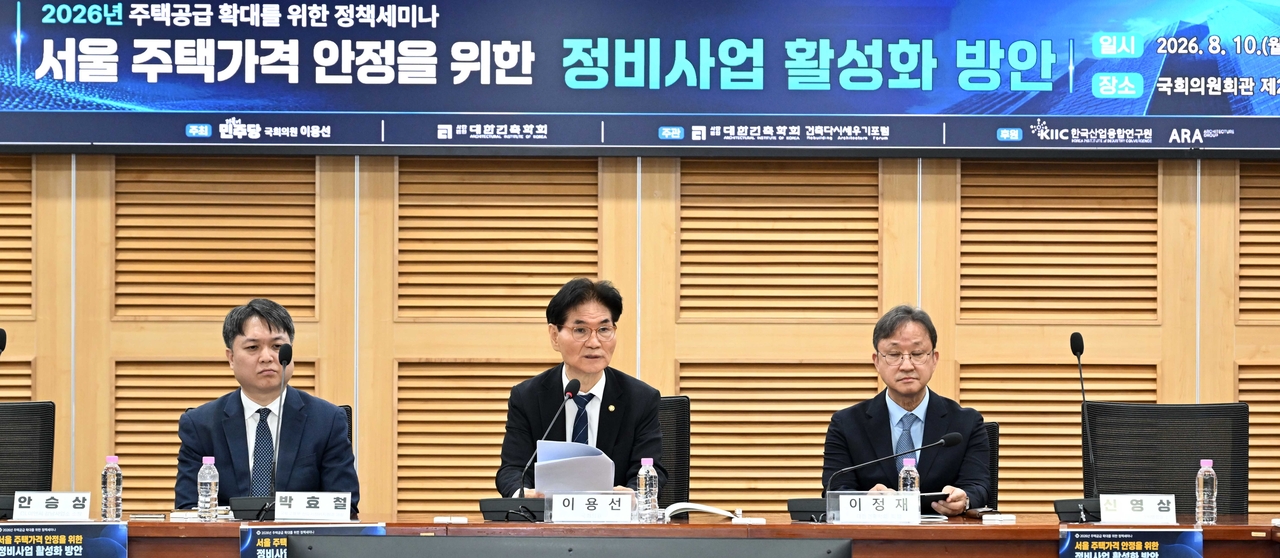
Calls have also emerged for easing floor-area ratio and consent-rate requirements, introducing a project viability adjustment coefficient, providing financial support for relocation costs, and reducing construction cost burdens. These measures were discussed Monday at a seminar on revitalizing redevelopment projects to stabilize Seoul housing prices, hosted at the National Assembly by Democratic Party lawmaker Lee Yong-seon of the Land, Infrastructure and Transport Committee.
Lee said housing supply through redevelopment projects is essential given Seoul's shortage of available land. Lee Jung-jae, chairman of the Korea Institute of Registered Architects, said that outside popular areas, securing the consent of association members is difficult due to the burden of additional contributions. "To carry out redevelopment projects smoothly, real estate regulations need to be eased and financial support needs to be increased," he said.
thanks@heraldcorp.com