![A reconstruction site at an apartment complex in Seocho-gu, Seoul. [Yonhap]](https://wimg.heraldcorp.com/news/cms/2026/08/11/rcv.YNA.20260723.PYH2026072313800001300_P1.jpg)
Contrary to cautious assessments that urban renewal projects offer limited housing supply benefits, completed projects in key Seoul districts have in fact produced a substantial net increase in unit counts. As the government moves toward an all-out supply push — including opening up greenbelt and restricted zones in high-demand areas such as Gangnam — major Gangnam-area complexes rebuilt at higher densities added more than 12,000 units over the past five years, according to an analysis. Many complexes saw their unit counts rise by more than 50 percent through reconstruction.
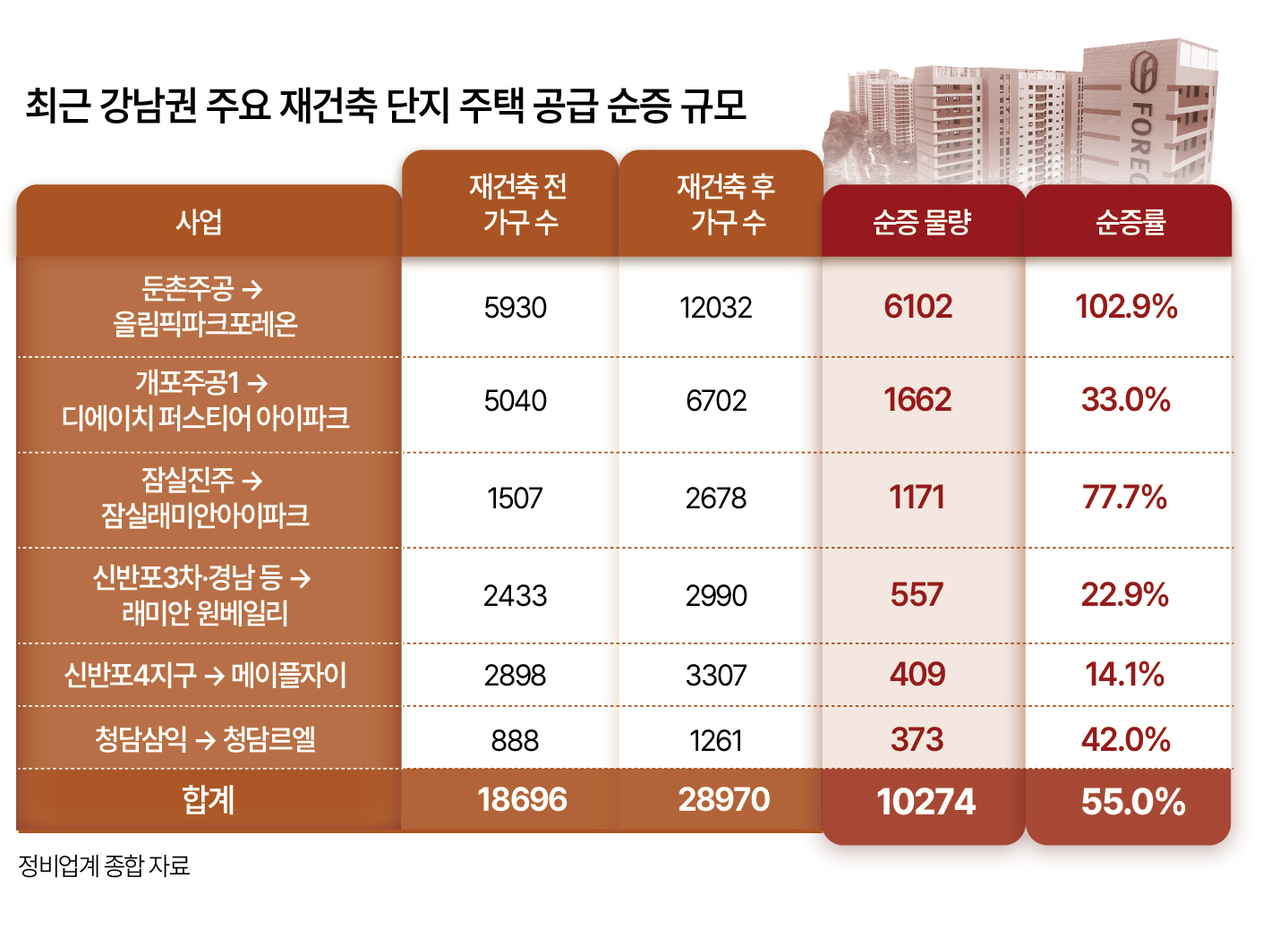
An analysis of 12 major reconstruction complexes that completed move-ins or construction in Gangnam-gu, Seocho-gu, Songpa-gu and Gangdong-gu over the past five years found that the total number of units grew from 23,832 before reconstruction to 36,057 afterward — a net gain of 12,225 units, or a 51.3 percent increase over the pre-reconstruction count.
The largest supply gain came from Olympicpark Foreon in Gangdong-gu, built on the site of the former Dunchon Jugong complex. The project expanded from 5,930 units to 12,032 — an increase of 6,102 units, or 102.9 percent — more than doubling the original count.
DIH Firstier iPark in Gangnam-gu, which replaced the Gaepo Jugong 1 complex, grew from 5,040 units to 6,702, adding 1,662 units, or 33.0 percent. Jamsil Raemian iPark in Songpa-gu, built on the site of the former Jamsil Jinju apartment complex, added 1,171 units — rising from 1,507 to 2,678, a net gain of 77.7 percent.
Smaller complexes posted even higher percentage gains. Raemian One Pentas in Seocho-gu, which replaced the Sinbanpo 15 complex, grew from 180 units to 641 — an increase of 461 units, or 256 percent.
Redevelopment projects delivered an even larger supply boost. Among major redevelopment completions in the four Gangnam districts over the past five years, the Geoyeo 2-1 zone in Songpa-gu was transformed into Songpa Signature Lotte Castle with 1,945 units, while the Cheonho 1 zone in Gangdong-gu became Gangdong Millennial Jungheung S-Class with 999 units. The Cheonho 4 zone added The Sharp Gangdong Central City with 670 units, and the Seongnae 3 and 5 zones were developed into Hillstate Cheonho Station Gentris (160 units) and Grants River Park (407 units), respectively.
Across these five redevelopment projects, the total unit count rose from 1,812 before the projects to 4,181 afterward — a net gain of 2,369 units. The gains are attributed to the high-density redevelopment of low-rise detached homes, multi-family houses and small apartment buildings into apartment towers and mixed-use residential complexes.
The findings stand in contrast to the more cautious stance the government has taken on the supply effects of redevelopment and reconstruction. President Lee Jae-myung said at a public forum on real estate policy held July 23 that "the supply effect from redevelopment and reconstruction may be limited," adding that "in particular, a significant number of existing residents leave the area during the redevelopment process, which can actually reduce the total number of households."
Land, Infrastructure and Transport Minister Kim Yun-deok echoed that view at a real estate forum held July 27, saying that "redevelopment and reconstruction involve lengthy procedures, and when existing homes are demolished first during the renewal process, housing supply can temporarily decline and potentially drive up prices."
The Seoul Metropolitan Government has pushed back firmly against the central government's cautious stance. After President Lee's remarks last month, Seoul Mayor Oh Se-hoon said renewal projects the city is managing for ground-breaking through 2031 are expected to produce a net increase of about 87,000 units.
Future renewal projects could yield even larger net gains. In September 2024, the city revised its "2030 Urban and Residential Environment Improvement Master Plan," introducing a "project viability correction coefficient" that grants additional floor-area ratio to low-viability sites, along with a system that recognizes existing floor-area ratios.
At some sites where the viability correction coefficient has already been applied, the number of units planned for supply has exceeded earlier projections. The city is using the coefficient alongside floor-area ratio incentives to increase the number of units available for general pre-sale and boost overall supply, improving the financial viability of renewal projects.
Experts say that in Seoul, where available land is in effect exhausted, new land supply and urban renewal should not be treated as an either-or choice. They argue the city must manage the demolition and relocation demand that arises in the early stages of projects while also securing a medium-to-long-term net increase in units through higher floor-area ratios and shorter project timelines.
Lee Chang-moo, a professor of urban engineering at Hanyang University, said that when a large number of renewal zones were dissolved in Seoul in 2014 and renewal activity contracted, a calculation of the opportunity costs from longer commute times — assuming that displaced housing demand shifted to outlying development districts — showed that social costs rose by about 500 billion won ($362 million) per year.
"At the time, single-person households were increasing in Seoul while family households were experiencing a net outflow — and it is hard to attribute all of that to voluntary relocation," Lee said. "A significant share of demand was pushed to the outskirts because people could not find housing of the size they needed in Seoul." He added that activating not only public-led projects but also private-sector renewal projects, and ensuring an adequate supply of mid-size and larger homes, would ease the problem.

quq@heraldcorp.com