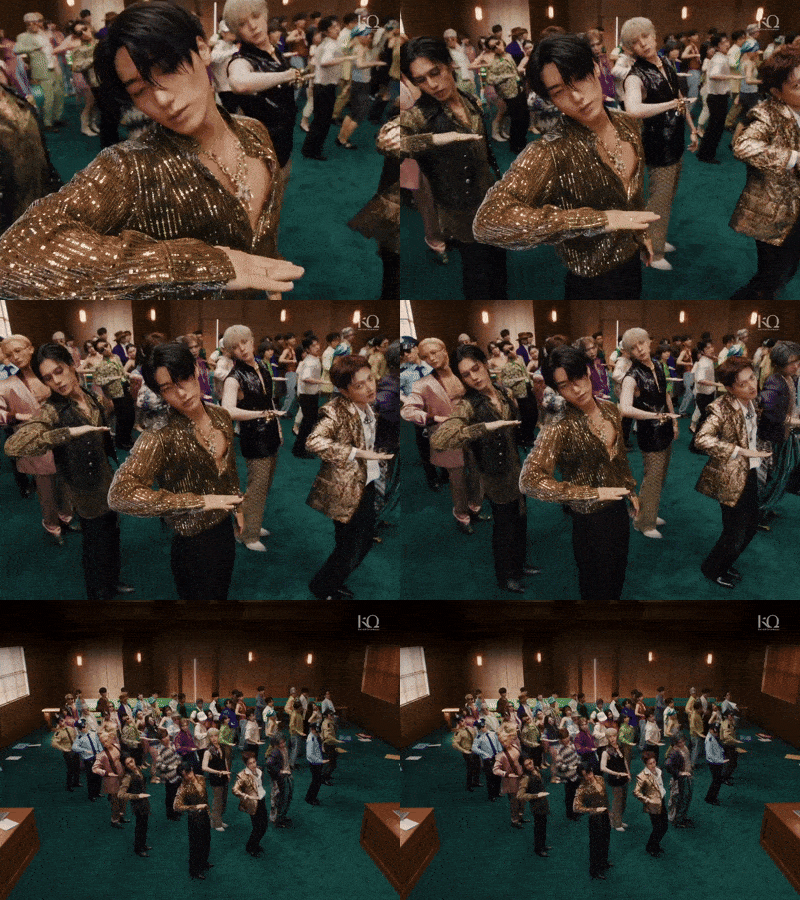
A joke has been making the rounds in the K-pop world this summer: "All it took was one chest bounce, and I was a fan." The quip refers to a roughly five-second choreography move in "BAD," the latest release from ATEEZ.
Industry insiders agree it is one of the most talked-about moments to sweep both the domestic pop music scene and global short-form platforms this summer.
"BAD" is the title track of ATEEZ's 14th mini-album "GOLDEN HOUR : Part.5." The group has long shared the global stage with BTS and Stray Kids. Though the move appears after the song reaches its musical climax, fans worldwide have crowned it the true highlight of the performance.
The moment — member San, dressed in a glittering gold shirt, delivering a restrained chest-bounce in time with the beat — swept TikTok and Instagram Reels immediately after its release. The music video surpassed 50 million views in August. Fans call the sequence the "let's all die" part, a nod to the lyric at that moment. San co-created the choreography alongside dedicated dance team BBTRIPPIN and choreographer Lee Jung.
What makes the phenomenon particularly striking is that San's performance clip has spread well beyond the idol fandom, going viral among people in their 30s and 40s and the general public. ATEEZ, whose fanbase had been concentrated overseas rather than at home, charted in the top tier of Melon's daily Top 100 — South Korea's leading music streaming platform — for the first time since their debut, driven by the clip's reach.
"The beast idol, which hadn't been in the mainstream spotlight, has been summoned back — and ATEEZ is leading the charge," a music industry insider said.
![ATEEZ [Provided by KQ Entertainment]](https://wimg.heraldcorp.com/news/cms/2026/08/11/news-p.v1.20260811.544002e7fd8a4961a610a00c47b5ad52_P1.jpg)
K-pop meets subculture: The 'Northern Duke' fantasy comes to life
The "new beast idol" of 2026 is a different creature from the original archetype once embodied by 2PM. San's version carries a layered image that fuses ATEEZ's fictional universe with the romance-fantasy genre of web novels and webtoons — and crucially, it was not engineered by the agency's marketing team but grew organically among fans.
At the center of the craze is a nickname: "Northern Duke." When San promoted "Ice On My Teeth" in 2024, his sharp suit silhouette and matching cold charisma earned him the title. Fans even said the stylist "really knew what they were doing." At the time, however, "Northern Duke" was a quietly shared piece of lore circulating only within ATEEZ's fandom.
Now, with "BAD," San has added a second chapter. Performing to a South American-inflected Brazilian funk rhythm with sun-bronzed skin and a noticeably upgraded physique, he has acquired a new epithet: "Southern Duke." A nickname coined two years ago has grown into a full narrative arc, and that arc is now generating fresh momentum.
In the romance-fantasy subculture — known in Korean fan circles as "ro-pan" — the Northern Duke is a cold, calculating lord who guards a harsh, frozen domain. He has broad shoulders, a sharp jawline and dark hair, yet carries a twist: he is tender only to the one person he claims as his own. The Southern Duke, by contrast, is set against a warm, glamorous social world — a multidimensional character defined by a roguish manner, a radiant smile and fatal passion.
![ATEEZ's San [Yonhap]](https://wimg.heraldcorp.com/news/cms/2026/08/11/rcv.YNA.20260809.PYH2026080906180001300_P1.jpg)
San occupies a singular position in K-pop as a real-life leading man who moves between both extremes. Onstage, his piercing gaze, wide shoulders and muscular frame perfectly embody the silhouette of the Northern Duke straight out of a webtoon. The contrast between his intense stage presence and his sunny, warm-hearted offstage persona is widely cited as a key driver of his expanding fandom.
The industry has a saying: an idol group's success comes from "reversal charm" — the contrast between who an artist is onstage and off. That gap is a time-tested tool for elevating individual members. San's conquest of the algorithm worked precisely because it hit the pressure point K-pop fandoms respond to.
Layered on top of that is the romance-fantasy archetype dominating webtoon and web novel consumption among people in their 20s and 30s — the devoted man who is gentle only to his own person. That archetype has now been projected onto a K-pop boy group. Beyond sheer physical appeal, the fantasy that 2D content consumers carry — a desire to be protected by someone strong and dependable — found real-world fulfillment on a live stage. The synergy of that "narrative fusion" proved powerful.
"The fantasy narratives of subculture acted as a catalyst, merging with a K-pop artist's real physical presence and performance to draw webtoon and web novel audiences into K-pop — beyond the existing fandom," a music industry insider said.
![ATEEZ San's 'let's all die' part [Provided by SBS]](https://wimg.heraldcorp.com/news/cms/2026/08/11/news-p.v1.20260811.e2034c8e44da4613abc545bcd12ef92c_P1.jpg)
Fatigue with the 'fresh boy' sound opens the door for the 'new beast idol'
For the past several years, the dominant K-pop boy group template has been the "fresh idol" — easy-listening music, a harmless boy-next-door image stripped of elaborate fictional universes, and a slim, fine-featured aesthetic. The trend took hold from the third generation of K-pop groups onward.
"As resistance to macho, intimidating masculinity grew within fandoms, and as global gender-fluid trends aligned with high-fashion styling, an unwritten rule emerged over roughly a decade: boy groups had to be lean and pretty," a major agency insider said.
After years of the fresh-boy concept, visual and sonic fatigue began building among both the general public and dedicated fans. A latent market appetite for raw, instinctive energy and powerful visceral stimulation was ready to surface. San's explosive physical performance, in particular, landed a direct hit on what many described as a "dopamine deficit."
The beast idol of today is fundamentally different from its second-generation predecessor of the mid-to-late 2000s, however. "Second-generation beast idols put their raw physicality front and center — muscular builds, aggressive choreography," a music agency insider said. "Today's version avoids excessive exposure and instead emphasizes body lines through muscle-fit sleeveless tops or restrained cuts."
![Actor Ma Dong-seok performing ATEEZ's 'BAD' "let's all die" part [Ma Dong-seok's social media]](https://wimg.heraldcorp.com/news/cms/2026/08/11/news-p.v1.20260811.5b77e90d863646ac92cb5fb8e24542d6_P1.png)
ATEEZ did not simply showcase rough masculine appeal — they built their own narrative by layering high-end brand styling onto a dystopian fictional universe. Short-form video played a major role in carrying that "aesthetic of narrative" to a mass audience.
ATEEZ has placed three albums at No. 1 on the Billboard 200, a testament to the strength of their overseas fandom. Performance clips remade into short-form content spread the group to the general public. Their profile among international fans had already surged after it emerged that one of the Lion Boys members in the popular Netflix animated series "KPop Demon Hunters" was modeled on San.
American pop music critic Tessa Smith told Forbes she had not originally been a K-pop fan. After watching "KPop Demon Hunters" on Netflix, the algorithm served her San's videos, and she was drawn in first by his intense physicality and the confidence with which he presented his body. Her interest then expanded to his music and voice, and she ultimately attended an ATEEZ concert and became a fan. Overseas, San has even become the subject of a viral internet meme described as a "gay awakening" — a lighthearted online expression for the moment someone first recognizes a same-sex attraction within themselves.
In South Korea, the wave has moved well beyond the idol world into the broader entertainment industry and even the corporate sphere. Actor Lee Sang-i took on the "BAD" challenge alongside San, while comedian Lee Seon-min filmed a parody of the move. Actor Ma Dong-seok recreated San's signature moment in his own style, earning the portmanteau nickname "Ma-San." In the KBO Futures League, Kiwoom Heroes player Son Him-chan adopted the move as a home run celebration.
Samsung Electronics president Roh Tae-moon also drew attention with a video of himself performing the "BAD" choreography and delivering the line "Not using Galaxy? That's BAD." The clip racked up 300,000 views in roughly 10 hours after it was posted. San's choreography had become a universally recognized character and meme in its own right.
Who's next in the 'new beast idol' wave — Monsta X? Enhypen?
With ATEEZ and San having ignited the new beast idol syndrome, the question now is who carries the torch next.
Monsta X, which has built its identity around raw physicality and a fierce monster energy, is among the leading candidates. The group is drawing renewed attention as its members return from mandatory military service.
Having kept the beast idol lineage alive through their overwhelming muscular physiques even during years dominated by the fresh-boy trend, Monsta X is widely seen as the act best positioned to benefit from the new wave.
A Starship Entertainment insider previewed the upcoming comeback, saying the group will return with "more refined and polished music and visuals built on Monsta X's established identity as they enter their 11th year since debut, with bold wit added to the mix."
![Enhypen [Provided by Belift Lab]](https://wimg.heraldcorp.com/news/cms/2026/08/11/news-p.v1.20260811.23f6db87f2f54f17b1308d8503ee9096_P1.jpg)
Enhypen, one of the defining acts of the fourth and fifth generation, is also pushing further into a polished yet lethal physical performance style rooted in dark fantasy and vampire lore. The group returns Aug. 21 with their eighth mini-album "THE SIN : BLISS," and is expected to move beyond a boyish image toward a more restrained physicality and sharper aura.
"We maximized a rough, sexy atmosphere through the raw appeal of a predator on extreme alert — wild and guarded — combined with costumes in intense colors and bold patterns," a Belift Lab insider said. "Audiences will see an untamed, feral charisma."
shee@heraldcorp.com