![An image representing corporate name changes and brand overhauls. [Getty Images]](https://wimg.heraldcorp.com/news/cms/2026/08/12/news-p.v1.20260812.ceb3be076bfb4697b7a83a7dcf220378_P1.jpg)
Listed companies that have recently changed their names are pivoting one after another into new businesses — AI, robotics, data centers and defense — amid a broader search for growth. Nine of the 13 listed firms that changed their names since last month posted operating losses in the first quarter of this year, suggesting that companies unable to find a breakthrough in their existing businesses are now betting on new growth engines.
According to Korea Exchange, a total of 13 listed companies completed name-change listings between July 1 and Tuesday. Among them, Polaris AI Handy (formerly Handysoft), Namu AX (formerly Namu Tech), Hancom (formerly Hangeul and Computer), TimeX AI (formerly PeopleBio), Argos (formerly Human Technology), Quantum Rail (formerly Xcure) and MSDI (formerly RNT-X) have all moved to expand into new business areas.
The pace of rebranding among listed companies is also faster than in previous years. Korea Exchange data show that between July 1 and Aug. 11, the number of name-change listings stood at 11 in 2023, 10 in 2024, 10 in 2025 and 13 this year.
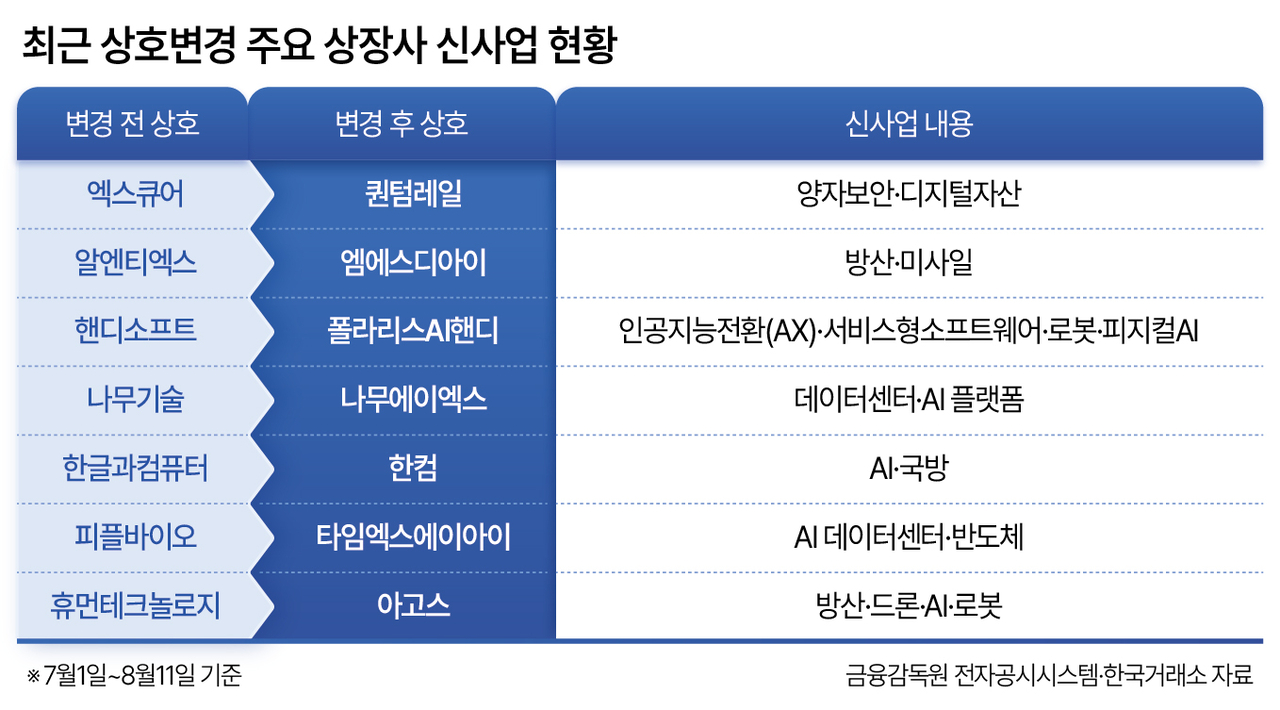
The newly rebranded companies are gravitating toward sectors that have captured the market's attention: AI, robotics, data centers and defense. Polaris AI Handy, which changed its name from Handysoft, has expanded into AI transformation, software-as-a-service and physical AI robotics. Namu AX is building on its existing cloud business to position data centers and an AI platform as new growth pillars, while TimeX AI has identified AI data centers and semiconductors as its future growth drivers.
Several companies are also turning to defense. MSDI is moving away from its image-sensor packaging business to reinvent itself as a defense company covering missile development, mass production, and maintenance, repair and overhaul. Argos has added radar, radio-frequency detection, unmanned aerial vehicles, and AI and robotics to its business objectives. Hancom is pursuing defense projects — including a scientific combat-training system and weapons systems — through its subsidiary Hancom Lifecare, alongside its AI business. Quantum Rail is expanding from its existing smart-card and security-solution technology into quantum security and digital asset infrastructure.
However, many of the companies chasing new revenue streams have yet to turn a profit in their existing businesses. Nine of the 13 recently renamed companies, or 69.2 percent, recorded operating losses in the first quarter of this year. Tulip & Science, TimeX AI and Argos posted operating losses for three consecutive quarters, while Polaris AI Handy, GMI Venture and Aribio Holdings swung from a profit in the fourth quarter of last year to a loss in the first quarter of this year.
Securities industry analysts say investors should look beyond name changes and additions to business objectives, and instead assess whether a company actually has the capabilities to execute its new strategy. Just as the biotech boom once prompted a wave of listed companies to add related activities to their stated business purposes, firms now broadening into AI and other high-interest sectors need to be evaluated on their relevant expertise and technological capabilities, analysts said.
Oversight of business-purpose changes by technology-growth companies has also been tightening. Korea Exchange revised its Kosdaq market rules last month to strengthen disclosure requirements and listing management for technology-growth companies that add or change their business objectives.
"When a technology-growth company resolves to amend its articles of incorporation to add or change its business objectives during the five-year preferential listing period, a disclosure obligation is imposed," said Shin Gyeong-hui, a senior researcher at the Korea Capital Market Institute. "If a technology-growth company adds or changes its business objectives through an amendment to its articles of incorporation, a ground for a substantive review of listing eligibility has been added."

hajun825@heraldcorp.com