![Visitors browse displays at "2026 Intercharm Korea," a finished cosmetics exhibition held at COEX in Gangnam-gu, Seoul, on July 1. [Yonhap]](https://wimg.heraldcorp.com/news/cms/2026/08/14/rcv.YNA.20260701.PYH2026070120150001300_P1.jpg)
South Korea's cosmetics exports have climbed sharply this year, sending K-beauty-related stocks on a broad rally. Securities firms are raising price targets across the entire value chain — from original design manufacturers (ODMs) to brand companies and distributors — citing what analysts describe as a structural turnaround in K-beauty accompanied by improving earnings quality.
Cosmetics exports for Aug. 1–10 came in at a preliminary $341 million, a 92.2% jump from the same period a year earlier, according to the Korea Trade Statistics Promotion Institute's TRASS portal on Thursday. Excluding Greater China, the increase reached 138.2%, with exports totaling $302 million.
Exports posted year-on-year growth every month from January through July. Cumulative exports for the seven-month period reached approximately $6.88 billion, up about 27.6% from roughly $5.39 billion in the same period last year.
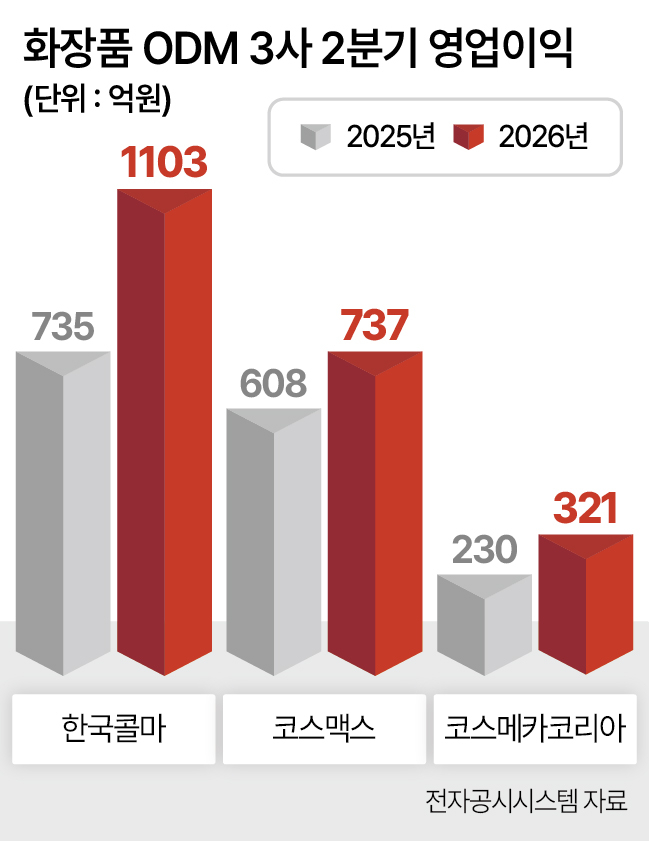
Riding that export momentum, the three major cosmetics ODM firms — Kolmar Korea, Cosmax and Cosmecca Korea — each posted record second-quarter earnings. Their operating profits rose 50.2%, 21.2% and 39.3% year-on-year to 110.3 billion won ($78 million), 73.7 billion won and 32.1 billion won, respectively.
The strong results have powered steep share-price gains. From the end of last year through Thursday, Kolmar Korea surged 117.7%, Cosmax jumped 52.8% and Cosmecca Korea soared 86.9%.
Securities firms have been raising their targets in quick succession. LS Securities lifted its price target for Kolmar Korea to 200,000 won and for Cosmax to 350,000 won — the highest targets set by any brokerage for either company. For Cosmecca Korea, Kyobo Securities holds the top target at 150,000 won after its own upward revision.
Expectations for brand companies are also rising. Emerging players APR and d'Alba Global likewise delivered record second-quarter results. APR's operating profit surged 134.5% year-on-year to 190.6 billion won, while d'Alba Global posted a 61.6% gain to 47.2 billion won. Both companies' share prices have risen 72.9% and 60%, respectively, from the start of the year through Thursday.
Established legacy players Amorepacific and LG Household are also drawing renewed attention. The highest price targets set by brokerages stand at 210,000 won (Kyobo Securities) for Amorepacific and 380,000 won (DB Securities) for LG Household. Their share-price gains have been more modest, however — Amorepacific is up 12.6% this year and LG Household 17.4%.
Analysts say K-beauty has entered a structural turnaround. Where the industry once relied heavily on China and was driven by a handful of large brands through specific distribution channels, that formula has fundamentally changed.
Last year, South Korea's cosmetics exports hit a record $11.42 billion, making the country the world's second-largest cosmetics exporter after France. China's share of those exports, which exceeded 50% in 2021, fell to 17.7% last year, while emerging markets in Europe, the Middle East and Latin America expanded their combined share to 63.3%.
Brands such as APR and d'Alba Global have pushed directly into the United States and Europe through online channels including Amazon and TikTok Shop, and this year they are accelerating their offline expansion as well — moving from specialty beauty retailers Ulta and Sephora into large-format chains such as Walmart, Target and Costco.
The growing influence of ODM firms such as Kolmar Korea and Cosmax has also been a key driver, enabling indie brands to quickly develop and launch high-quality new products without their own manufacturing facilities.
"The center of gravity in K-beauty's recent growth has clearly shifted — away from legacy brands that were heavily dependent on China and toward indie brands that built their following through US online channels, along with the ODM and distribution companies that support them," said Jo Gyeong-jin, an analyst at IBK Investment Securities. "This expansion of K-beauty is sustainable even without assuming a recovery in China."

jiyun@heraldcorp.com