
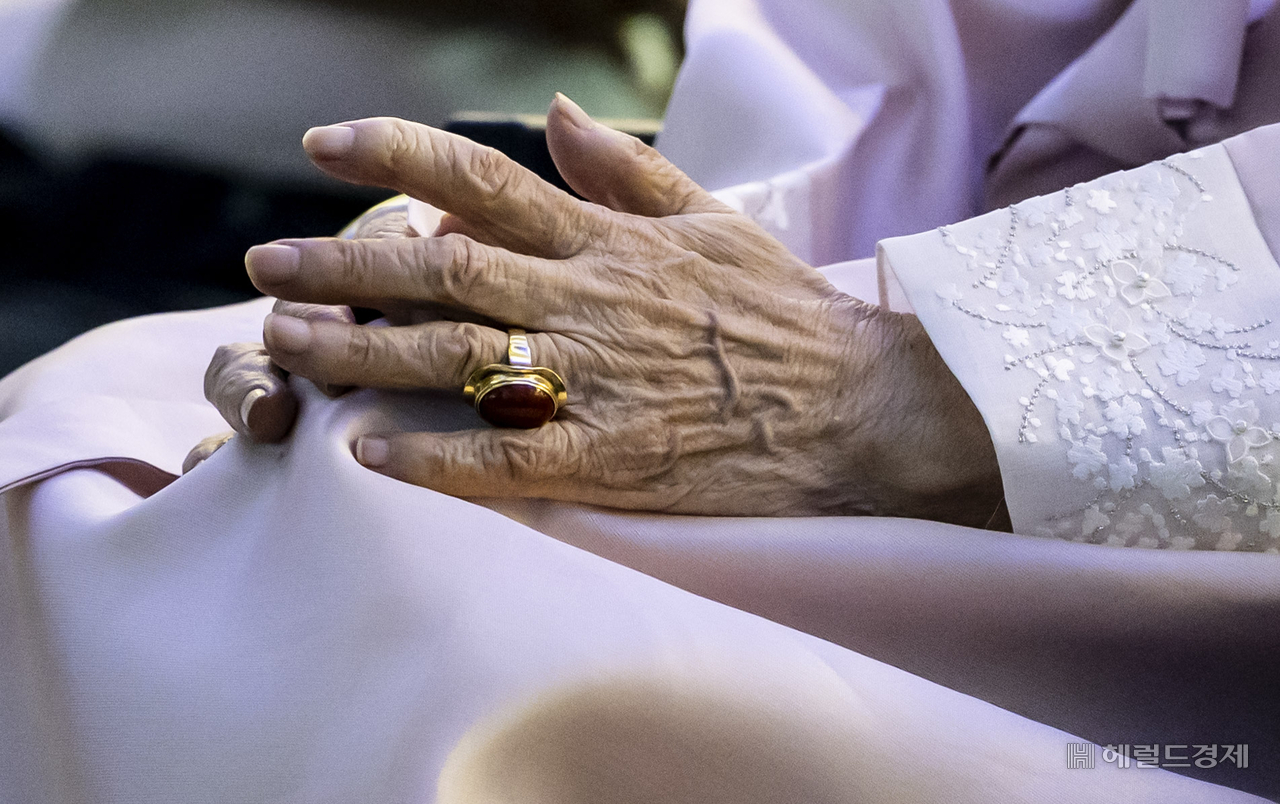
"I am living proof that the 'comfort women' existed. I am right here, alive, having suffered as one of them — yet Japan claims it never took comfort women by force, and our own government says it doesn't know. How can that be?"
On Aug. 14, 1991, the late Kim Hak-soon stepped before a press conference held by the Korean Council for the Women Drafted for Military Sexual Slavery by Japan at the offices of the Korean Women's Associations United, her eyes welling with tears as she spoke those words. Decades of silence born of fear gave way that day as she finally brought into the open the anguish she had long carried inside.
It was the first public press conference at which a survivor of Japan's wartime sexual slavery system came forward under her own name to testify about what had been done to her.
Nobody told me to come out. I did this on my own. I have things I need to say, and I will say them.
Kim testified about the horrors of her spring at age 16. Taken suddenly as a comfort woman, she was held at a Japanese military garrison in central China, forced into hard labor by day and made to serve Japanese soldiers by night. When war broke out, she was confined in a house abandoned by Chinese residents that had been converted into a comfort station, subsisting on rations of rice and side dishes supplied by the military.
Kim's testimony prompted a wave of other survivors to come forward, and a movement to bring the issue of Japan's military comfort women to domestic and international attention began in earnest. Even after going public, she continued to demand that the Japanese government acknowledge its responsibility and apologize. She died of a lung disease on Dec. 16, 1997.
Kim had lived in a public rental apartment in Wolgye-dong, Nowon-gu, on government subsidies. Before her death, she donated 20 million won ($14,100) to her church, asking that it be used for those in greater need than herself.

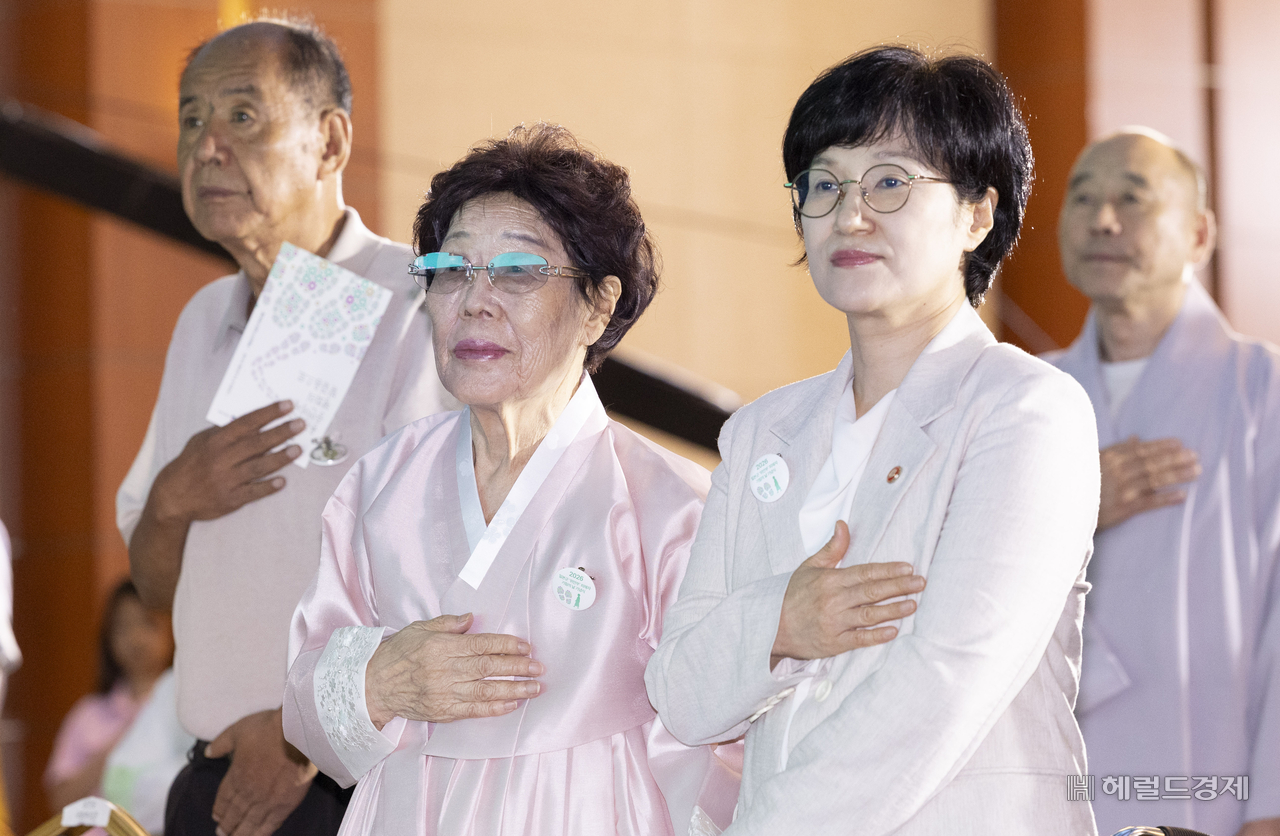
Exactly 25 years after Kim came forward, on Aug. 14, a national commemorative ceremony was held at the Baekbeom Kim Gu Memorial Hall in Hyochang-dong, Yongsan-gu, Seoul — the Comfort Women Memorial Day, a state-designated holiday established in her honor. About 200 people attended, including Lee Yong-su, who disclosed her own experiences the year after Kim's initial testimony, along with representatives from the National Assembly, the government and civic organizations.
Presidential Chief of Staff Kang Hoon-sik read out a message from President Lee Jae Myung at the ceremony. Looking toward Lee Yong-su, 98, he said: "You mentioned that you would like to meet the president. We will arrange a time in the not-too-distant future. Please stay well."
In his message, President Lee said: "Remembering the truth, protecting the dignity of the victims, and building a world where such tragedy is never repeated — I believe that is the greatest expression of respect we, the living, can offer." He added that the government would establish a Women's Human Rights and Peace Foundation to lead solidarity and cooperation efforts across Asia.
The foundation the president referred to would be an independent legal entity dedicated to systematically accumulating research and investigations into the issue of Japan's military comfort women, and to continuously advancing education, exhibition and commemorative projects as well as domestic and international cooperation initiatives.
In June, 10 lawmakers — including Democratic Party of Korea Rep. Jeon Jin-suk and Rep. Lee Su-jin, who has been designated as the ruling party's floor manager on the gender equality committee — introduced a bill in the National Assembly that would provide the legal basis for establishing the foundation.

Gender Equality Minister Won Min-kyung said she had joined the ceremony "to remember the lives and courage of the survivors and to carry their spirit forward to future generations," adding: "We will now continue the steps that began with the grandmothers' courage, and pass them on fully to the next generation."
The Ministry of Gender Equality also plans to conduct a survey of memorials and monuments erected in honor of comfort women victims — including the Statue of Peace — and to manage these commemorative spaces in a systematic manner.
With Liberation Day falling on Saturday, commemorative events for comfort women victims are being held across the country.
The Korean Council for Justice and Remembrance for the Issues of Military Sexual Slavery by Japan is holding its "Nabi Cultural Festival" starting at 7 p.m. in front of the former Japanese Embassy in Seoul. The nearby Statue of Peace, which had been barricaded until just a few months ago, was cleared of its barriers in May for the first time in six years.
The North Jeolla Province Culture and Tourism Foundation, together with the North Jeolla Women's Organizations United, is hosting a commemorative exhibition on the theme of "War and Women, Anti-War, and Japan's Military Comfort Women" at Hayangyangokcip, a multipurpose cultural space in Jeonju, through Aug. 23.
Busan is holding a ceremony with about 200 citizens at the small theater of the Busan Citizens Hall on Friday, featuring a creative performance and an LED candlelight lighting ceremony. On Aug. 21 and Aug. 28, the city will screen the films "I Can Speak" and "Snowy Road" at the multipurpose screening hall of the Busan Cinema Experience Museum.
In Daegu, a memorial concert is being held at Demange Hall of Beomeo Daesong Cathedral starting at 7:30 p.m. Friday, organized by the Citizens' Group Together with Comfort Women Grandmothers.
Only five survivors of Japan's wartime sexual slavery system remain alive in South Korea — among them Lee Yong-su, Park Pil-geun, 98, and Kim Gyeong-ae, 96. All are in their 90s or older.
kido@heraldcorp.com





