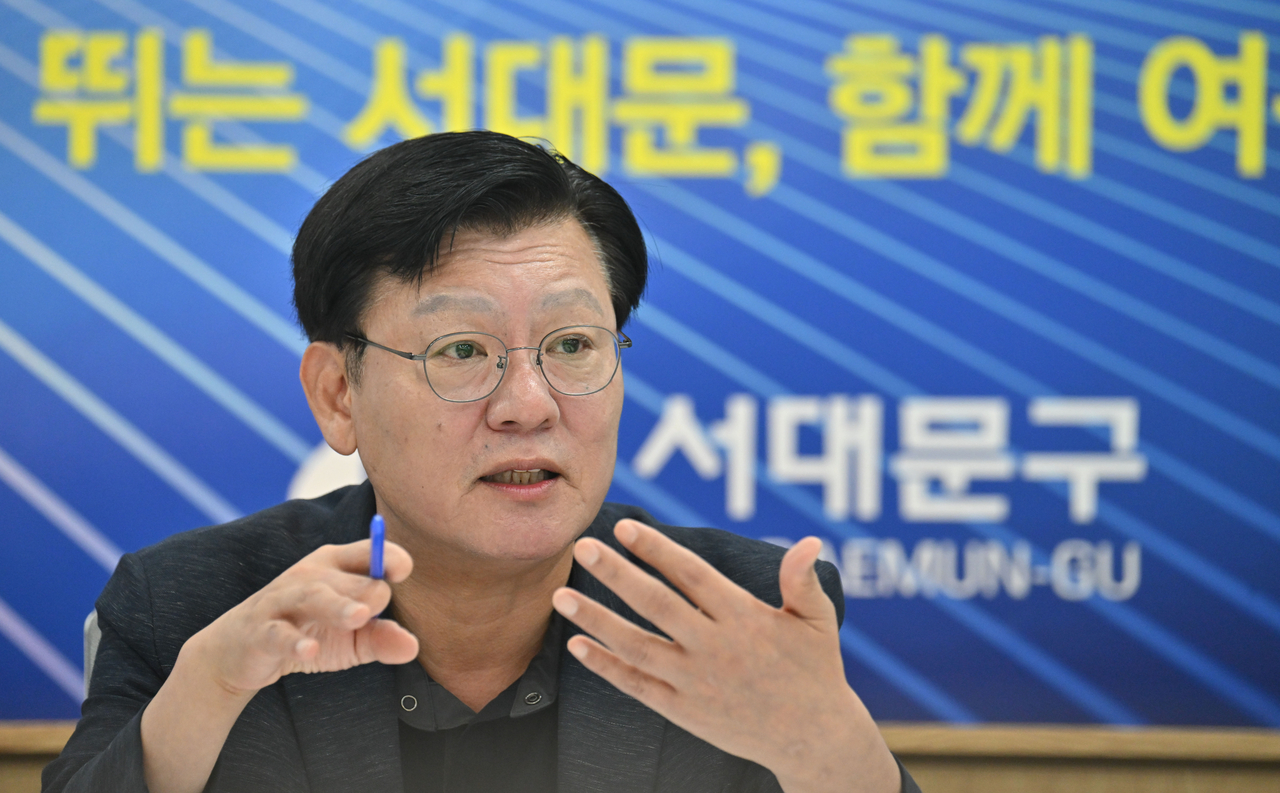
Park Woon-ki, who won the Seodaemun-gu district mayoral seat on his third attempt, has pledged to lead the district through the most democratic means possible by strengthening resident self-governance. He said he intends to apply that political philosophy to local redevelopment and reconstruction projects as well. While most district mayors have been emphasizing speed in residential renewal projects, Park said it is essential to involve residents in the process, hear a range of voices and work toward consensus. He said that deliberative approach would ultimately reduce disputes and accelerate projects rather than slow them down. The Herald Business sat down with Park at Seodaemun-gu District Hall on Thursday for a wide-ranging interview on his vision for "a golden age of Seodaemun built together by all." The following is an edited transcript.
— You won the district mayor's seat on your third try. Was the journey difficult?
The eight years leading up to becoming district mayor in the ninth round of local elections were less about hardship and more about accumulating a wide range of experiences. For three of those years I served as a senior aide in the National Assembly — in the office of Democratic Party of Korea lawmaker Lee In-young — gaining experience I could not have had as a local council member. I was also fortunate enough to spend a year working in the ruling party's floor leader's office. During another two years I worked as a corporate adviser. Those eight years gave me unique experiences and the chance to build a broad network. Particularly over the past four years, I held regular morning meals with residents — a program I called "Woon-ki Breakfast" — where I kept meeting people and listening to the concerns of self-employed business owners.
— When you took office, you told staff to streamline protocol and stop mobilizing people for events.
The first principle of my administration is to communicate with residents and listen to them. That is why I told staff not to fuss over protocol. Support should be provided only to the extent necessary for carrying out official duties, and department heads should not be required to accompany me on weekend or evening schedules where their substantive role is absent. This is also a personal commitment. I come from a student activist background and still think of what I do as a form of civic movement. But power has a way of making people arrogant. I believe refusing excessive protocol will keep me more humble. I have also instructed staff not to forcibly mobilize residents for events — participation should be voluntary. I plan to expand live-streaming on YouTube so that residents who do not attend in person can follow along without feeling any pressure to show up.
— You chose "revitalizing resident self-governance councils" as your first official act.
Sadly, resident self-governance in Seodaemun-gu was dismantled entirely during the eighth term. Residents have been eager to see it restored, so I am committed to bringing it back. I consider myself a genuine believer in resident self-governance — it matters deeply to me. To that end, I plan to introduce a direct election system for dong chiefs next year, a first for Seoul. The dong chief will be chosen from among civil servants, not recruited from outside, and will be guaranteed a three-year term. I will give dong chiefs budgetary authority and powers comparable to those of a district mayor — a dong chief will be a mini district mayor, and the resident self-governance council will be a mini assembly. Through this, I intend to realize true grassroots resident self-governance.
— What are the key projects needed to position Seodaemun-gu as the hub of northwestern Seoul?
Reviving the Gangbuk Transverse Line project and breaking ground early on the Seobu Light Rail line are things Seodaemun-gu absolutely must accomplish. The difficulty is that most of the authority over these projects rests with the Seoul Metropolitan Government. I am prepared to grab Mayor Oh Se-hoon by the sleeve to make it happen — even if we are from different parties. I played a congratulatory video from Mayor Oh at my inauguration ceremony. That was a message to him. Another key element in building Seodaemun-gu into a northwestern hub is creating a landmark, and that landmark is the Yujin Sangga and Inwang Market redevelopment site. The project has made considerable progress, but it has been pushed forward somewhat recklessly. I am now forming a task force to review the process and correct what needs to be corrected.
— Won't forming a task force for review delay the project?
The development of the Yujin Sangga and Inwang Market area moved quickly during the eighth term and cleared the Seoul Metropolitan Government's integrated review. But the financial risks that can arise in a development project, as well as potential conflicts during the compensation process, must be managed. The Seodaemun-gu Maintenance Project Operations Review Task Force is a public-private joint body reporting directly to the district mayor, composed of experts in redevelopment, accounting, taxation and law. We will review the entire process from the ground up and fix whatever is wrong. There may be a misunderstanding — correcting flaws does not mean abandoning the project. The project will proceed, 100 percent. But first, residents must be persuaded. In more than 20 years of local politics, I have seen a great deal of conflict caused by redevelopment and reconstruction. Projects may look fast at first, but when internal disputes break out and lawsuits are filed, there is no telling when they will end. Inwang Market is in exactly that situation right now. There are five associations there, each with different views and positions. One group is currently driving the project, but simply pressing ahead like this could create serious problems later. The task force needs to hear from the other groups and work to bring them on board. Resolving these risks in advance means there will be no brakes on the project down the road. Going through this process could actually move the project forward one to two years faster.
— What is your plan to restore the energy that Sinchon and the Ewha Womans University area once had?
Reviving Sinchon and the Ewha area requires a different approach from what has been tried so far. The process has been far too government-led. The real stakeholders here are university students, young people and merchants — their voices need to be heard. Our role is simply to provide support. I recently held a briefing with residents on Sinchon's development, and the consensus was that Sinchon must ultimately be revived through culture and the arts. I am thinking of proposing the creation of a youth economic special zone linking Sinchon and Hongdae. The Ewha area has far too many vacant storefronts, and lowering rents is critical — which means giving building owners incentives to do so. My dream is to make Seodaemun-gu an eco-friendly city, and one part of that is converting buildings into net-zero energy houses by installing solar panels and improving insulation. That kind of construction is expensive, but if building owners in the Ewha area agree to retrofit their properties as eco-friendly buildings, the district will actively support them and provide incentives.
ikson@heraldcorp.com