![Actor Ha Young [left, from her Instagram] and a photo of the Ahn Sang-ho family published in the Dec. 10, 1918 edition of the Maeil Sinbo newspaper. [National Library of Korea]](https://wimg.heraldcorp.com/news/cms/2026/08/14/news-p.v1.20260814.b7f791ac09314a56a40b1951771e2860_P1.jpg)
Research drawing renewed attention reveals that Ahn Sang-ho, the great-grandfather of actor Ha Young, married a Japanese woman through an introduction by Gu Yeon-su, a Korean figure implicated in the assassination of Queen Myeongseong.
The finding appeared in a 2007 paper titled "The Life and Activities of Ahn Sang-ho, Korea's First Modern Private Physician," authored by Lee Jeong-eun, a senior researcher at the Institute for Korean Independence Movement Studies at the Independence Hall of Korea, according to the Ilyo Sinmun on Friday.
Ahn frequented the Tokyo residence of Prince Yi Gang, also known as Uichinwang, where he became acquainted with a Japanese woman named Kawaguchi Isoko, who handled administrative work there. He married her through an introduction by Gu, who was in exile in Japan at the time.
Gu Yeon-su (1866–1925) was a military-trained official who passed the state military examination. He appears on the list of 705 pro-Japanese collaborators compiled by the Truth Commission on Pro-Japanese Collaborators and is a fixture on various rosters of colonial-era collaborators.
He is identified as one of the Korean collaborators who helped Japanese assassins enter the royal palace and kill Queen Myeongseong during the 1895 Eulmi Incident. A publication by the Institute for Research in Collaborationist Activities, "99 Pro-Japanese Collaborators," describes Gu as the person who oversaw the burning of the queen's body.
After fleeing to Japan following the Eulmi Incident, Gu returned to Korea in 1907 and served as a council member of the Iljinhoe. He later held police-related posts under the Japanese Residency-General and the Government-General of Joseon.
Gu's father-in-law was Song Byeong-jun, who ranks alongside Lee Wan-yong as one of the most prominent pro-Japanese collaborators of the era.
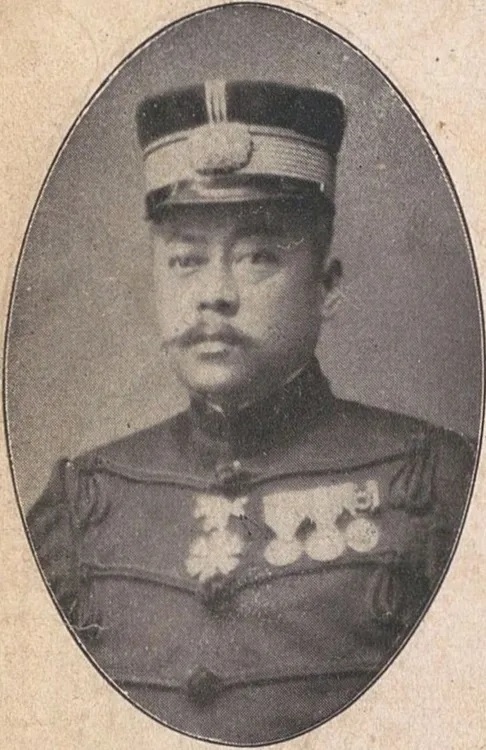
Japanese colonial authorities promoted a policy known as "naeseon ilche," or the unity of Korea and Japan, partly through "seonbu ilcheo" — marriages between Korean men and Japanese women. Ahn, whose union was brokered by Gu, was held up as a model case of this assimilationist ideal. In an interview with the Maeil Sinbo, Ahn said: "I am exactly the same as a Japanese person. I do not own a single piece of Korean clothing, and I cannot eat spicy food at all." He added that his children "use only Japanese at home and cannot speak Korean at all," saying he was raising them "as a completely Japanese household." He also remarked that he had "little to do with Koreans."
Ha Young had recently introduced her family on television as a "four-generation family of doctors," only to face public criticism after it emerged that her great-grandfather was Ahn Sang-ho, a figure mired in pro-Japanese collaboration controversy. Ahn, recognized as the first Korean to practice modern medicine as a private physician, has been confirmed to have joined the Daejeong Chinmok-hoe, a pro-Japanese organization; to have treated Lee Wan-yong after the prominent collaborator was attacked by an independence activist; and to have had his name listed on the preparatory committee for a memorial service for Ito Hirobumi, who was killed by independence fighter Ahn Jung-geun.
paq@heraldcorp.com