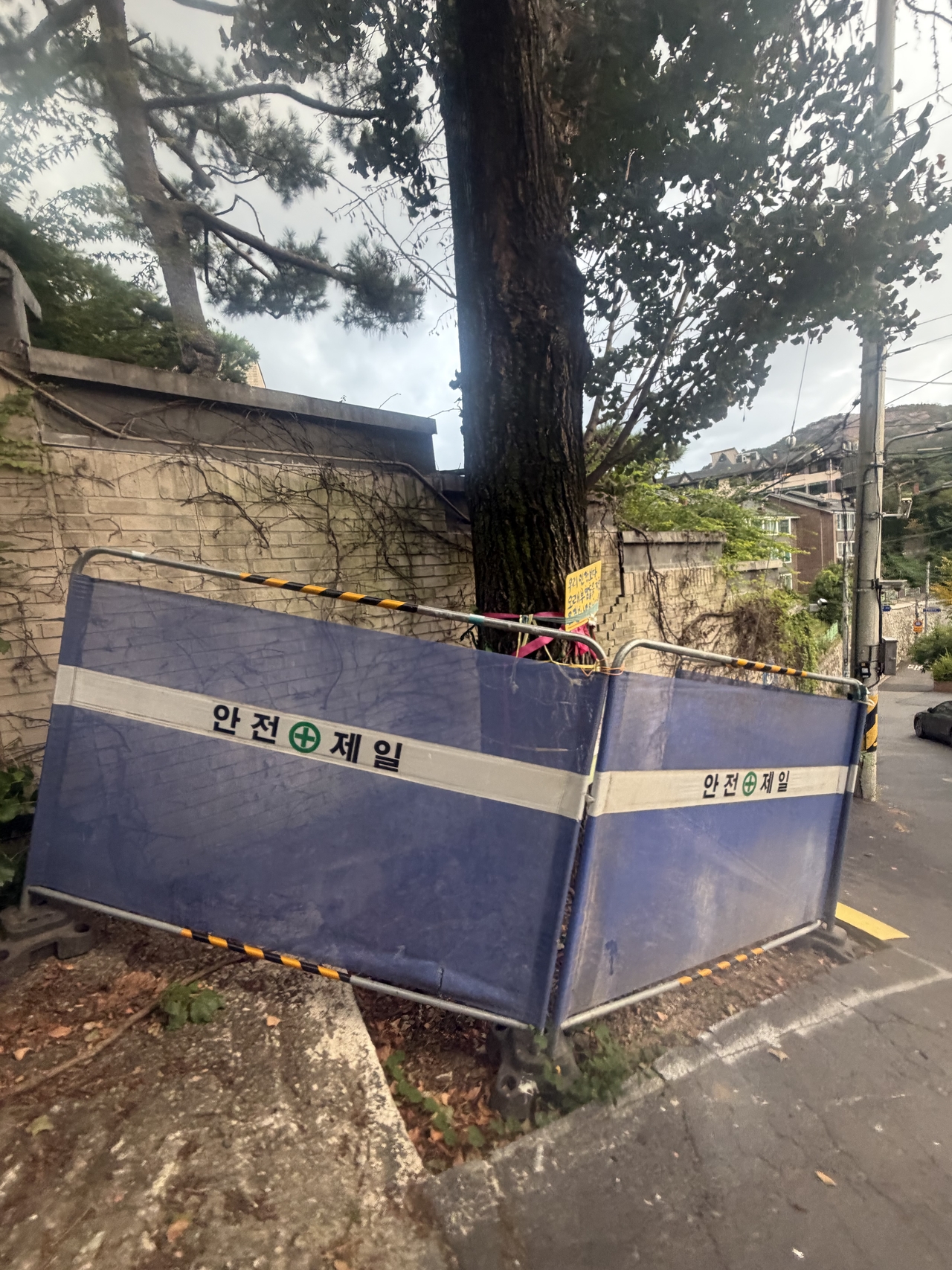
Whanki Museum has formally asked Jongno-gu to remove a ginkgo tree in Buam-dong, Seoul, citing concerns about the safety of its perimeter wall. The museum said the request was intended to prevent casualties before an accident could occur.
The two sides, however, offered conflicting accounts of what prompted the removal request. The museum said it arose in the course of responding to a district request for data on hazardous trees, while Jongno-gu said it never made any such request.
In an official letter sent to Jongno-gu on July 29, the museum cited the dangers posed by the ginkgo tree and urged the district to act. "In accordance with the provisions proposed in Jongno-gu's official letter of July 24, 2026 — specifically the support for tree maintenance, including dead-branch removal, under the Jongno-gu Ordinance on Support for Hazardous Tree Maintenance in Residential Areas — and pursuant to Article 240 of the Civil Act, we earnestly request the removal of the ginkgo tree in order to prevent serious safety accidents that could occur at any time and to avert any resulting casualties," the letter read.
The museum attached supporting materials to the letter arguing that the tree's growth posed a risk to the wall's structural integrity. Under Civil Act Article 240, when branches of a tree on adjacent land cross a boundary, the owner may be asked to remove them; if the owner does not comply, the requesting party may remove the branches. Civil Act Article 214 separately grants the right to demand removal of any interference with property rights.
A museum official, speaking by phone, said the removal request came after Jongno-gu indicated it was reviewing both a "beautiful tree" designation and a hazardous-tree designation for the ginkgo. "We provided relevant data and earnestly requested the tree's removal," the official said. "We were particularly concerned about safety and submitted safety-related materials we have accumulated over the past 10 years." The official added that the area around the wall was "a dangerous situation where casualties could occur" and that "safety concerns have been overlooked amid the controversy."
In its July 24 letter, Jongno-gu told the museum it was "seeking the landowner's opinion" on two matters: designating the ginkgo tree at 210-4 Buam-dong as a "beautiful tree" under the Jongno-gu Rules on the Designation and Management of Beautiful Trees, and carrying out maintenance — including dead-branch removal — under the Jongno-gu Ordinance on Support for Hazardous Tree Maintenance in Residential Areas.
The district said it planned to "comprehensively review the expert advisory opinion commissioned by the district and the tree-growth improvement measures taken by the museum, and establish a future management plan for the tree." It also asked the museum to submit detailed records of any measures taken regarding the tree by July 29.
The museum maintained that hazardous-tree maintenance support was "a provision proposed by Jongno-gu in its official letter," and that the removal request came as part of its response to that correspondence. Jongno-gu disagreed. A district official said the request for the landowner's opinion was aimed at "obtaining consent for maintenance in case dead branches — including those damaged by herbicide — fall," and that the data request concerned "the history of measures taken regarding the tree's growing environment," not removal.
Jongno-gu's letter to the landowners of the plot where the ginkgo stands asked for opinions on two items — designating it a "beautiful tree" and pursuing hazardous-tree maintenance including dead-branch removal — and stated that the district "supports the maintenance of trees that could cause harm to nearby residents under the ordinance" and intended to "promptly carry out maintenance to ensure resident safety if there is concern about falling dead branches." A district official said: "We did not ask for the records in order to review removal. The museum is free to express its wish for removal, but even looking at the sequence of events since the incident, we cannot mobilize administrative resources for the purpose of removal."
Under the Jongno-gu Ordinance on Support for Hazardous Tree Maintenance in Residential Areas, the district mayor must take necessary measures for the maintenance of hazardous trees that have caused or are likely to cause harm to residents. Applicants for maintenance support must submit an application form during a period designated by the district mayor, and if the applicant is not the tree's owner, must also obtain the owner's consent. The district mayor reviews applications through on-site inspections and notifies applicants of the decision. A Jongno-gu official said the museum's request could not be granted because "the requirements are not met." The land on which the ginkgo is planted covers 1,850 square meters and has 46 owners.
Jongno-gu has also determined, based on advice from a tree clinic, that the ginkgo does not qualify as a "hazardous tree" — meaning it fails to meet the basic eligibility criteria. A district official said it was "a stretch to attribute the wall cracks solely to the ginkgo tree" and that the museum had not accounted for the overall deterioration of the wall. Regarding the Civil Act provisions cited by the museum, the official said: "The Civil Act governs rights and obligations between private parties, and it is not appropriate to use it as grounds to ask Jongno-gu to remove the ginkgo tree."
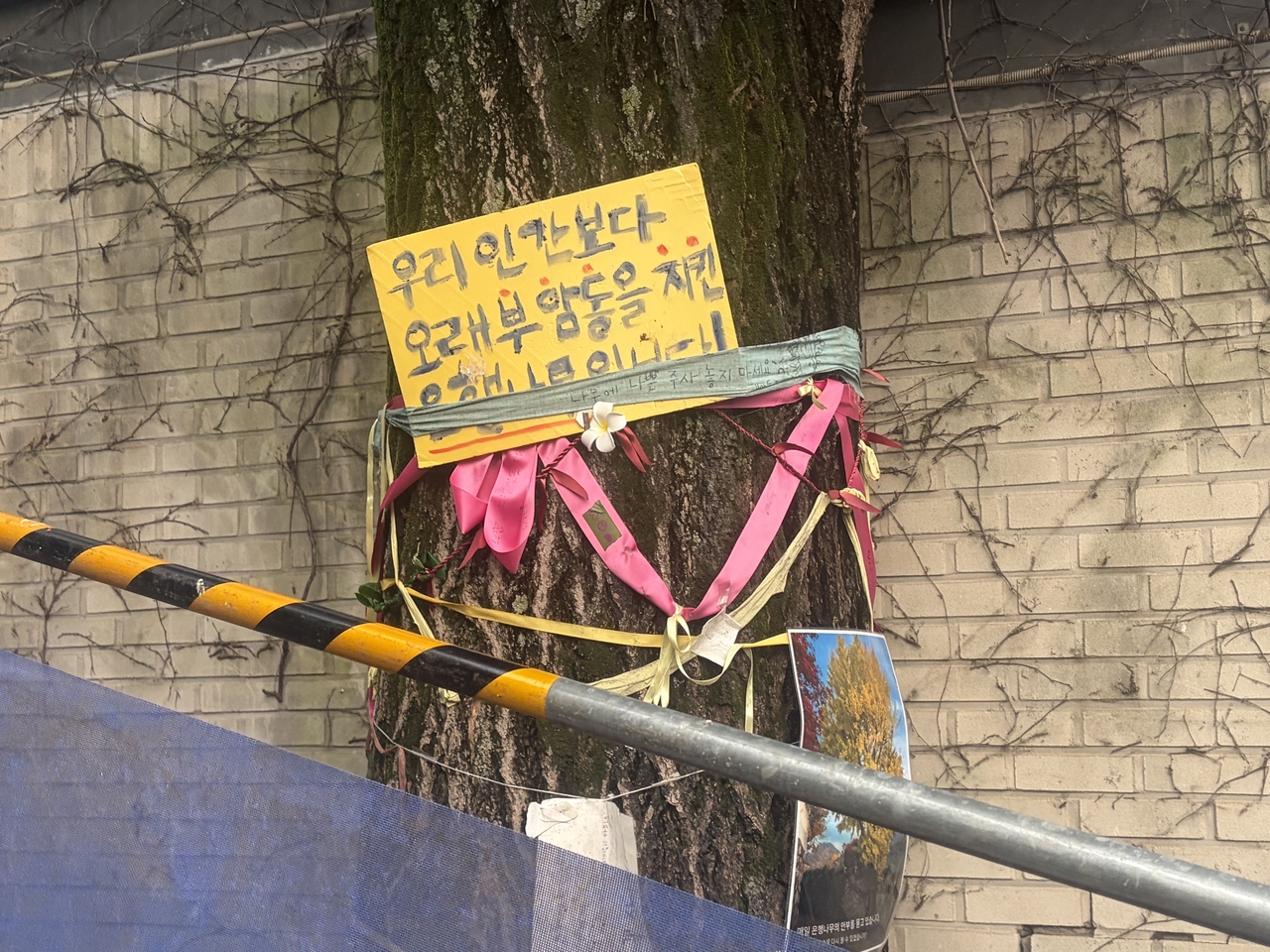
The controversy over the Buam-dong ginkgo tree erupted in May after it emerged that herbicide had been injected into the tree, which stands on private land along a road beside the museum wall. Jongno-gu visited the scene on May 22 after receiving a complaint and assessed the damage. A tree clinic diagnosis on May 26 found that the crown was dying due to the chemical. The museum later admitted it had hired a landscaping company to inject the herbicide.
The controversy escalated into allegations of deliberate poisoning. On July 1, the museum posted an apology on its website titled "We apologize." The museum said it was "deeply sorry for causing concern to those who cherish Buam-dong and Whanki Museum in connection with the ginkgo tree," adding that it was "making every effort and taking necessary steps toward the tree's recovery and a comprehensive improvement of the related situation."
The museum also said it had "confirmed that the museum wall is collapsing due to the current state of the tree's roots" and that it had "sought to resolve the situation given the gravity of the matter, but in doing so caused concern to those who cherish Buam-dong and the museum — for which we again offer our deepest apologies."
Jongno-gu filed a criminal complaint against the museum on July 1 on charges of property damage — the second such complaint related to the ginkgo tree, following one filed by a civic group, the Seoul Environment Federation. Earlier, on June 2, a group of 60 people called "Buam-dong Ginkgo Tree Rescuers" — comprising Buam-dong residents, public figures and the Seoul Environment Federation — filed a complaint against museum director Park Mi-jung and the Whanki Foundation on charges of property damage and violation of the Soil Environment Conservation Act.
The group said CCTV footage showed two workers drilling holes in the ginkgo tree outside the museum wall and injecting herbicide at around 9 a.m. on May 22, and that the museum had failed to respond appropriately when confronted.
Jongno-gu sent an official letter on June 4 urging the museum to implement measures to improve the ginkgo tree's growing environment. The museum replied on July 6, but the district sent another letter on July 23 requesting specific details of the measures taken and related materials.
A Jongno-gu official said the first reply had stated only that the museum was taking steps to improve the tree's growing environment, which was why the district sent a follow-up letter on July 23 requesting specific details of the measures taken and related materials.
cook@heraldcorp.com