![A construction site. [Herald DB]](https://wimg.heraldcorp.com/news/cms/2026/08/19/news-p.v1.20260408.6d94c4cc3fc645279f17b2acafede213_P1.jpg)
Korean construction companies are expanding their overseas footprint beyond simple contract work, increasingly targeting high-value plant projects. With the US government proposing a string of cooperation projects worth tens of trillions of won, Korean builders are cementing their position in the global plant contracting market. Seoul is channeling policy resources into expanding financial support and upgrading the contracting framework to help Korean firms grow their global market presence and sharpen their competitiveness in plant orders.
The Ministry of Land, Infrastructure and Transport — the government body overseeing overseas construction policy and contracting support — plans to hold a briefing for domestic construction companies on Aug. 27 on US investment-development construction projects, introducing opportunities in large-scale plant and infrastructure work and encouraging Korean firms to participate, according to industry and government sources Tuesday.
The briefing follows a proposal last month in which the US government presented the ministry with more than 10 investment-development cooperation projects spanning sectors including ammonia factories and fertilizer plants. The US Department of Energy, which oversees energy and advanced industry policy, asked Korea to cooperate on five or six plant projects, while the US Department of Agriculture, which manages rural infrastructure and bioenergy, separately reached out to arrange an unscheduled meeting with the ministry and requested additional projects, sources said.
Each of the more than 10 US-proposed investment-development projects is valued at roughly 2 trillion to 3 trillion won, putting the combined total at around 30 trillion won ($20.4 billion). Korean companies are expected to participate by securing a stake in individual projects rather than taking on entire contracts exclusively. The cooperation is separate from the $200 billion in investment commitments to the United States that emerged from last October's Korea-US summit.
The ministry is reviewing the specific scale and terms of the proposed projects and is working on financial structuring to design how Korean firms will participate and what equity stakes they will hold.
The US government also raised the prospect of building out power grid infrastructure to support the industrial facility projects it proposed, sources said. The request reflects surging electricity demand driven by the rapid expansion of AI data centers and advanced manufacturing factories, with Washington asking Korean companies — whose technical capabilities have been proven — to deliver infrastructure packages. A report by the Overseas Construction Association on US AI data center development shows that global data center power consumption stood at 415 terawatt-hours in 2024, based on International Energy Agency statistics, with the United States accounting for 43 percent, or 180 TWh. Global data center power consumption is projected to more than double to 945 TWh by 2030, with US consumption expected to reach 606 TWh.
The string of large-scale plant cooperation proposals from the US to the Korean government reflects a track record of government-to-government projects already proceeding smoothly — among them a blue ammonia plant in Indiana and a lithium-boron plant in Nevada. US confidence in Korea's technical capabilities and on-site execution has translated directly into additional project proposals.
![The US Department of Energy headquarters. [UPI-Yonhap]](https://wimg.heraldcorp.com/news/cms/2026/08/19/news-p.v1.20250317.ceba56f107254278b54011cbab50e7d5_P1.png)
The blue ammonia plant project involves building a facility in Indiana capable of producing about 500,000 tons annually. It draws on 83 billion won from the ministry's Plant, Infrastructure and Smart City fund — known as the PIS Fund — along with $1.5 billion in US policy financing, and was awarded jointly to Samsung E&A and a US company. The PIS Fund, established with contributions from the government, the private sector and the Korea Overseas Infrastructure and Urban Development Corporation, known as KIND, is designed to help shift the overseas construction industry away from its reliance on contract-based work toward a financing-linked contracting model.
Land Minister Kim Yun-deok attended the blue ammonia plant groundbreaking ceremony in January and met with US Deputy Secretary of Energy James Danly to discuss expanding Korea-US infrastructure cooperation and linking policy financing. At the time, Kim identified additional potential cooperation projects including a lithium plant and potassium carbonate facilities. One of those — the Nevada lithium-boron plant — produced a development MOU just six months after it was proposed, in July. First Vice Minister Kim I-tak, who attended the signing ceremony, also held talks with US Under Secretary of Energy Kyle Haustveit on expanding cooperation, discussions that led to the proposal of more than 10 additional projects.
"In the past, Korean construction companies mainly entered overseas markets by following large domestic conglomerates building semiconductor or manufacturing facilities abroad, but as local operations have matured and subsidiaries have taken root, Korean builders are now at the stage of directly entering independent US projects on their own," a government official said. "In particular, because the US has many investment-development private projects, a stable structure has been put in place where KIND — as a specialized investment institution — participates alongside Korean construction companies, enabling them to enter the market together."
Experts say the cooperation drive shows that Korea has emerged as a key partner substantively backing the US government's push to rebuild its manufacturing base and stabilize its supply chain. "It is very positive that contracts covering not just construction but entire project management are increasing in the United States, which has one of the world's largest construction markets," said Lee Eun-hyung, a research fellow at the Korea Research Institute for Construction Policy. "The US holds the core plant technology, but there is a large gap in construction execution capacity, so Korean companies with proven technical skills are playing a role in helping rebuild American manufacturing." She added that the trend will likely lead to additional related contract wins over the long term.
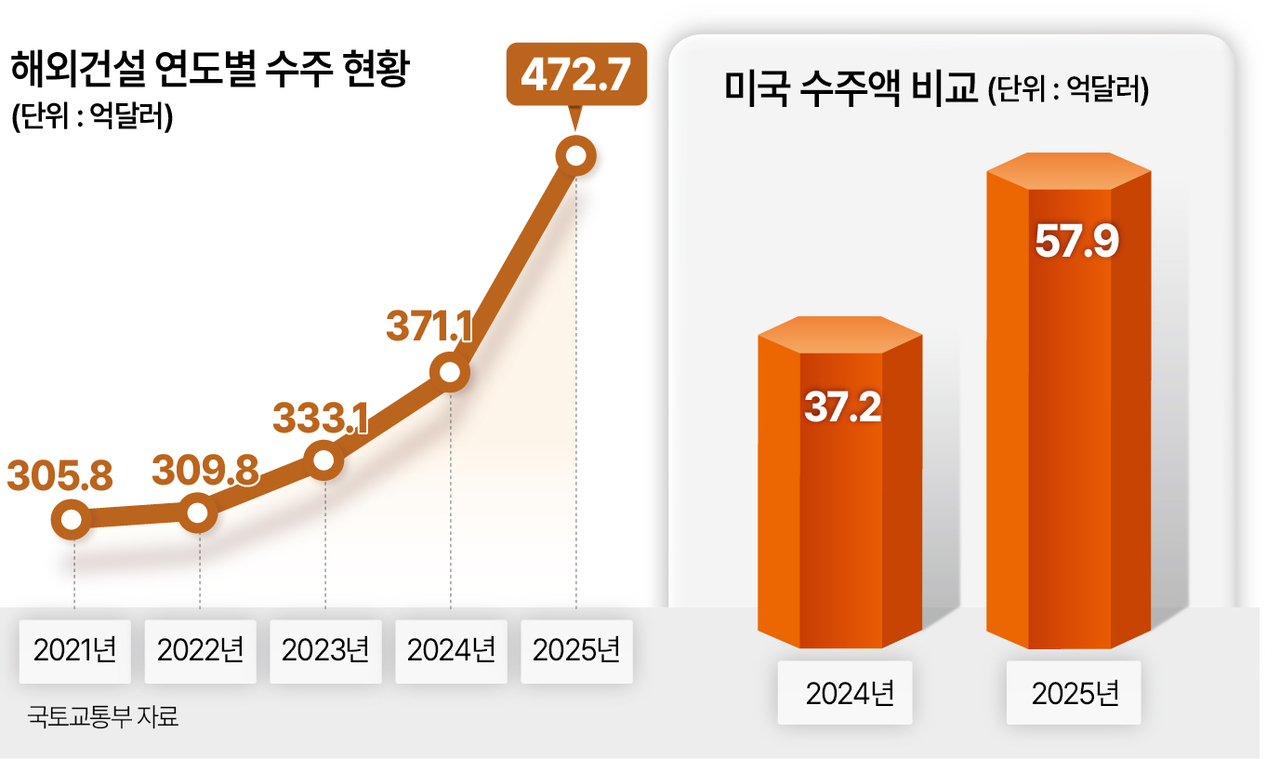
As Korean builders' standing in the United States grows, overseas construction contract awards are trending upward. Last year, US contract awards reached $5.79 billion, a 55.6 percent increase from $3.72 billion the year before. With major project wins continuing — including nuclear power plant contracts in the Czech Republic and large projects across Middle Eastern countries — total overseas construction awards last year reached $47.27 billion, the highest in 11 years since the all-time record set in 2014 and the first time annual awards have exceeded $40 billion since 2015.

hwshin@heraldcorp.com
hss@heraldcorp.com