![[Getty Images Bank]](https://wimg.heraldcorp.com/news/cms/2026/08/19/news-p.v1.20260819.f730bb64c1974fe9b1259cfd634d77bd_P1.jpg)
Most South Korean export companies are managing carbon emissions data in fragmented, non-standardized ways, even as overseas carbon regulations such as the EU's Carbon Border Adjustment Mechanism gather force, a new survey shows.
The Korea Chamber of Commerce and Industry released the results Wednesday of a joint survey conducted with the Korea Industrial Complex Corp. covering 300 export companies, examining demand for an industrial complex carbon emissions management — or MRV — platform.
The survey found that 99.3 percent of export companies had already been asked by customers to submit carbon emissions data, or expected to receive such requests. An additional 90.3 percent said they were already requiring, or planned to require, the same data from their own suppliers.
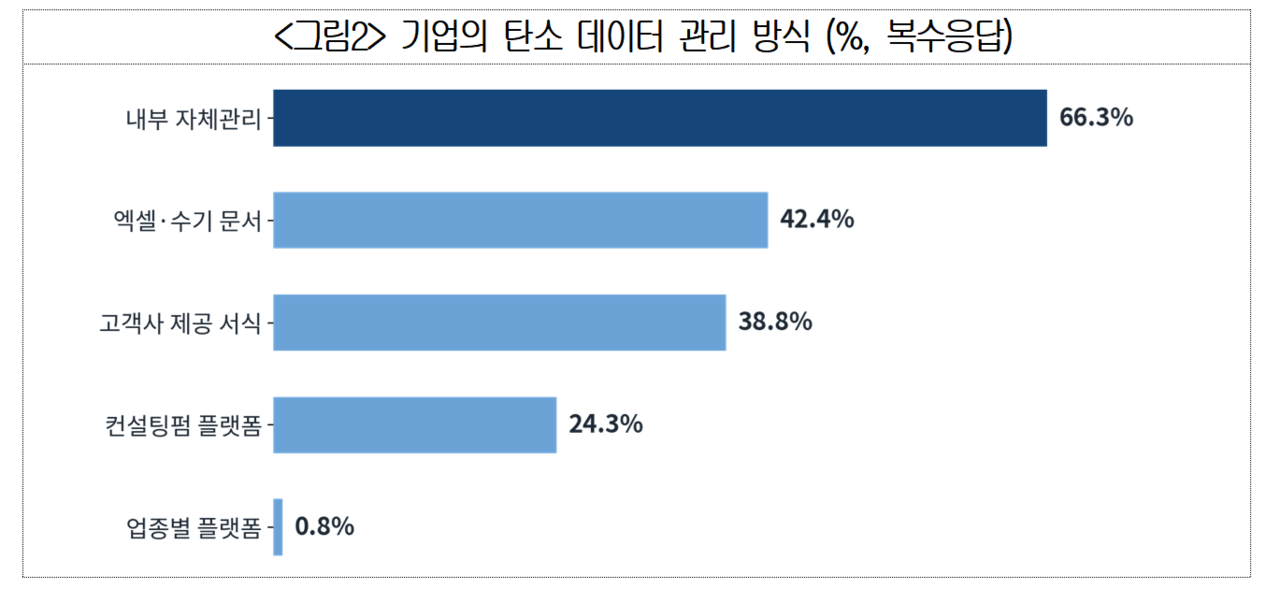
Yet companies' data management capabilities are struggling to keep pace with regulation. When asked how they manage carbon data, six in 10 firms — 66.3 percent — said they had built their own in-house systems, but without a shared standard platform, each was effectively left to fend for itself.
That fragmentation has created a growing double data-entry burden: to respond to customer demands, companies are manually re-entering and reformatting data using spreadsheets or handwritten documents (42.4 percent) or individual customer-specific forms (38.8 percent).
To enable smoother data exchange, companies identified their top support needs as standardized forms and templates (64.0 percent) and a collaborative platform for data exchange (53.7 percent).
While companies broadly recognize the need for a shared platform, cost remains a significant barrier to adoption. Survey respondents cited system construction and integration costs (64.0 percent) as the single biggest obstacle. Some 44.7 percent of respondents expected to spend between 10 million won ($71,000) and 50 million won on data management over the next three years, while 43.3 percent anticipated spending 50 million won or more.
As prerequisites for platform adoption, companies ranked platform security and interoperability highest — specifically, protection of proprietary business data (54.0 percent) and compatibility with international standards and overseas requirements (54.0 percent).
"With domestic disclosure rules now being codified into law and global carbon regulations tightening, verified carbon data has become an urgent necessity — without it, exports face disruption and supply chain carbon data management is now a burning issue," said Jo Young-jun, head of the Korea Chamber of Commerce and Industry's Sustainable Management Institute. "The chamber will continue providing practical education and support so companies can respond to regulations easily through a standard platform, without worrying about costs or staffing."
Ha Min-geun, head of the industrial complex digital transition office at the Korea Industrial Complex Corp., said the organization plans to enhance the industrial complex MRV platform's role as a support tool for export companies navigating carbon regulations. "Together with the chamber, we will continue to expand tangible policy support that companies can feel — including help with platform adoption and integration costs, and personnel support," he added.
The industrial complex MRV platform, launched by the Korea Industrial Complex Corp. in June, is an integrated support system that helps companies handle the full cycle of carbon emissions management — from measurement and reporting to verification — in a single process. The Korea Chamber of Commerce and Industry is participating in the initiative to expand platform adoption and provide corporate support.
Based on the survey findings, the two organizations outlined a phased policy support plan to ease the burden on companies. In the adoption phase, the key measure is expanded support for installing measurement equipment such as meters and sensors; in the utilization phase, priorities include carbon data calculation consulting and wage subsidies for dedicated personnel.
yeongdai@heraldcorp.com