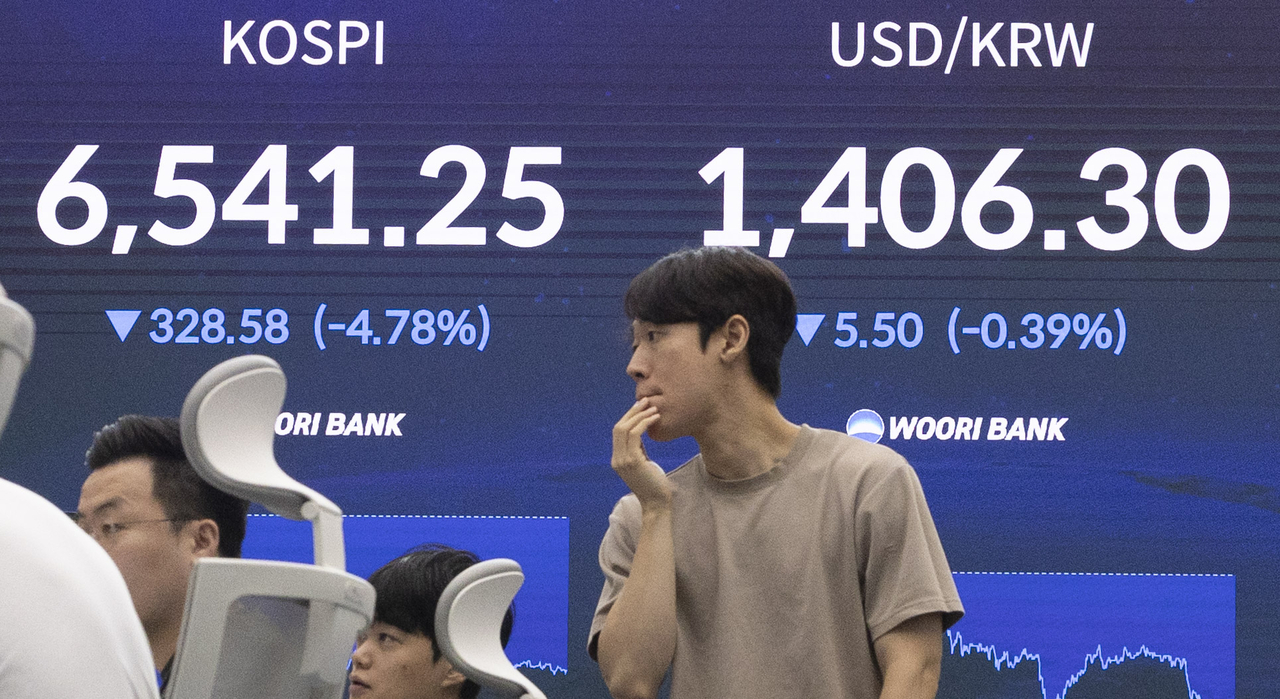
The Kospi tumbled nearly 6 percent on Wednesday, crashing into the 6,400 range as macroeconomic headwinds battered investor sentiment.
The benchmark index closed at 6,471.17, down 5.80 percent from the previous session, according to Korea Exchange. At its intraday low, the index slid as far as 6,400.81, briefly threatening to breach the 6,400 level.
The severity of the drop triggered a sell-side sidecar, a circuit-breaker mechanism that temporarily halts program sell orders.
Foreign investors and institutions net sold 3.49 trillion won ($2.47 billion) and 1.32 trillion won, respectively. Retail investors stepped in with 4.64 trillion won in net purchases to cushion the index, but the buying proved insufficient.
The steepest losses came from Samsung Electronics and SK Hynix, the Kospi's two largest companies by market cap.
Samsung Electronics closed down 7.82 percent at 247,500 won, while SK Hynix fell 9.75 percent to finish at 1.5 million won.
For Samsung Electronics, it was a second consecutive session of losses, following a 2.19 percent decline on Tuesday.
As a result, the combined Kospi market cap share of the two stocks fell to roughly 47.6 percent, from 49 percent on Tuesday.
After the close, SK Hynix announced it would acquire and retire 40 trillion won worth of its own shares to enhance shareholder value. Even so, the stock continued to fall more than 3 percent in after-hours trading.
The two stocks topped the net selling lists for both foreign investors and institutions. Foreign investors net sold SK Hynix and Samsung Electronics by 1.83 trillion won and 1.04 trillion won, respectively, while institutions net sold Samsung Electronics by 733.3 billion won and SK Hynix by 471.7 billion won.
Other large-cap names also declined: Samsung Electronics preferred shares fell 7.75 percent, SK Square dropped 11.54 percent, Samsung Electro-Mechanics lost 3.68 percent, and Hyundai Motor slid 4.83 percent.
Against the trend, LG Energy Solution rose 1.85 percent, Samsung Biologics gained 0.85 percent, and Hanwha Aerospace advanced 2.71 percent.
Hanwha Aerospace bucked the broader selloff after news broke that it had secured a prototype contract for the US Army's next-generation self-propelled howitzer. The stock climbed as high as 1.29 million won intraday before giving back much of its gain by the close.
The day's sharp decline was driven largely by macroeconomic uncertainty. Rising oil prices and growing inflation concerns weighed heavily on investor sentiment.
Tensions in the Middle East escalated after a vessel was struck in the Strait of Hormuz, pushing international crude futures higher. Meanwhile, the yield on the 30-year US Treasury bond rose as high as 5.33 percent during trading, its highest level since 2007.
Those pressures had already hit Wall Street on Tuesday, where AI and memory chip stocks fell: Nvidia dropped 2.34 percent and Micron Technology slid 7.02 percent. SK Hynix's American depositary receipts plunged 9.20 percent, and the Philadelphia Semiconductor Index tumbled 4.98 percent.
The Kosdaq closed down 1.17 percent at 824.46. On that market, retail investors net sold 71.6 billion won, while foreign investors and institutions net bought 14.7 billion won and 49.9 billion won, respectively.
Among Kosdaq's top market-cap stocks, Alteogen rose 1.85 percent and Ecopro BM gained 0.64 percent, while Ecopro fell 1.03 percent, Rainbow Robotics dropped 1.60 percent, and Jusung Engineering declined 4.29 percent.
Han Ji-young, a researcher at Kiwoom Securities, said the market's resilience is being tested. "It has barely emerged from the July crash — which was driven by concerns over AI profitability and leveraged position unwinds — and is now facing fresh macroeconomic uncertainty. Market fatigue is building," she said.

jiyun@heraldcorp.com