The additional power needed to run the government's three mega-projects — including AI data centers and semiconductor clusters — is estimated at 38.4 GW, equivalent to roughly 260 TWh of electricity per year, or 40 to 50 percent of South Korea's total power generation last year.
The figure exceeds previous projections and is expected to place a significant burden on future national power supply planning, as well as the construction of generation facilities and grid infrastructure. A state-run research institute said that securing the necessary generation capacity and building out power infrastructure must proceed in tandem with the mega-projects.
Analysts also warned that even if the Lee Jae-myung administration fully achieves its 2030 target of 100 GW in renewable energy capacity, the three mega-projects would still face an annual shortfall of around 110 TWh. The findings prompted calls to recognize renewable energy expansion as a necessary — but not sufficient — condition for meeting carbon neutrality goals.
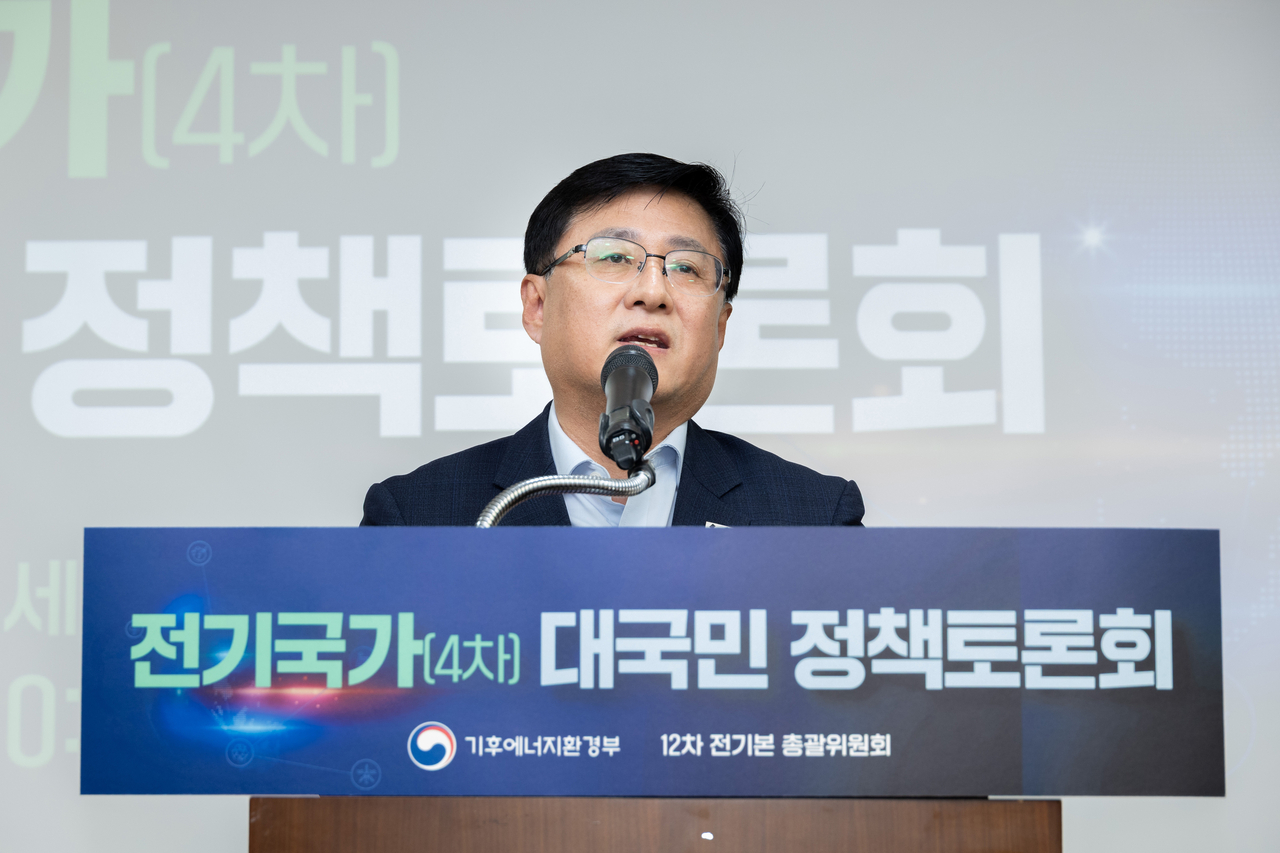
Park Woo-young, head of the energy transition policy research division at the Korea Energy Economics Institute, presented the analysis in a paper titled "Future Power Demand and Energy Policy Direction in Light of Mega-Projects" at the fourth public policy forum, held Thursday and organized by the steering committee overseeing the drafting of the 12th Basic Plan for Electricity Supply and Demand.
According to the government, the mega-projects are estimated to require an additional 38.4 GW of power — 18.4 GW for AI data centers by 2035 and 20 GW for semiconductor clusters by 2041.
Park calculated that the three projects would together add 260 TWh of annual electricity demand, comprising 121 TWh for AI data centers and 140 TWh for semiconductor clusters.
"This amounts to roughly half of the current power system's capacity and represents a dual challenge — managing rising demand while simultaneously decarbonizing existing consumption," Park said. He added that the 12th Basic Plan must establish a supply-and-demand monitoring framework tied to confirmed construction and capacity expansion decisions.
He also said that even if the 100 GW renewable energy target for 2030 is met in full, actual generation would reach only about 150 TWh when accounting for renewable utilization rates — well short of the roughly 260 TWh in additional demand from the mega-projects. "Expanding renewable energy supply is a necessary condition for achieving carbon neutrality, but it is not a sufficient one," he said.
He added that while aggressively scaling up renewables to increase their share of the energy mix is an essential social goal, careful consideration of securing multiple carbon-free power sources and timely decision-making are also required.
Earlier, the government released a preliminary plan in April projecting peak power demand in 2040 at between 131.8 GW and 138.2 GW. However, after announcing in June that the three mega-projects were expected to generate 24.7 GW in new electricity demand, the government began revising those projections. Contentious debates over power generation and grid policy are set to move to the forefront in September and October, when the government plans to hold a series of follow-up forums covering topics including new nuclear power plants, a coal phase-out roadmap, electricity market reform, and transmission and substation planning.
Minister of Climate, Environment and Energy Kim Sung-hwan said South Korea has become "almost the only country in the world that holds both chips and power, from steel to semiconductors," and outlined a direction for future electricity supply centered on renewable energy supplemented by nuclear power.
"Which country will be the first to build a new society — one where AI data centers and AI robots are powered by clean energy, combining renewables with some nuclear, and where humanity can live more equally and happily thanks to those benefits? I believe South Korea has the greatest potential," Kim said. He added that the 12th Basic Plan would reflect that vision in detail.
oskymoon@heraldcorp.com