
![[Generated with ChatGPT]](https://wimg.heraldcorp.com/news/cms/2026/08/20/news-p.v1.20260820.4d9542c623874fd5ab0b9a0bdecaed5c_P1.png)
The rise of AI presents humanity with both opportunity and crisis. Beyond dramatically boosting labor productivity, it is replacing jobs outright. According to a report on the macroeconomic impact of AI recently released by the Korea Development Institute, the spread of AI is estimated to raise total productivity by 0.15 to 0.35 percentage points annually over the next decade — while eliminating 256,000 jobs every year. The displacement of workers by AI is expanding across all sectors, from office and professional roles to production and manual labor.
The AI revolution, which is reshaping society at large, is bound to affect labor-management relations as well. The author of the new book "Union Chairman's Handbook" — a labor attorney who previously worked as a journalist — argues that the role of labor unions actually grows larger in an era when AI threatens jobs. Ethical standards governing AI technology, measures to address displaced workers, and frameworks for distributing income generated by AI are ultimately issues that today's workers must demand and negotiate into existence, the author explains.
The author notes that union bargaining power expanded substantively after an amendment to the Trade Union and Labor Relations Adjustment Act — commonly known as the Yellow Envelope Act — took effect in March, bringing "management decisions that affect working conditions" within the scope of labor disputes. Management decisions such as the introduction of AI or humanoid robots can now become subjects of labor-management bargaining when they lead to workforce adjustments. The author argues, however, that what is needed is not a confrontation-driven "militant union" but a "calculated union."
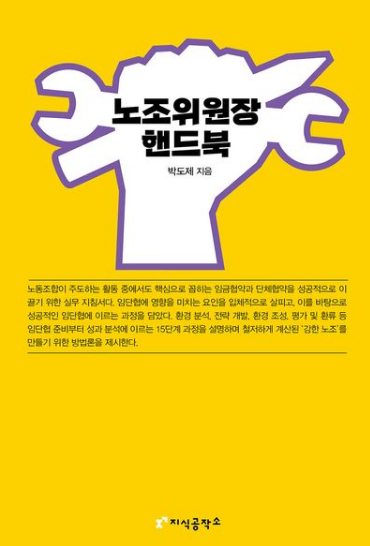
Translating expanded bargaining power into real results requires sophisticated strategy, the author argues. The book lays out a 15-step process for developing strategy and detailed tactics in preparation for wage and collective bargaining agreements — the core of union activity — starting with external environment analysis, then covering internal environment analysis, strategy development, tactical review, environment building, and evaluation and feedback. Particularly notable is the use of business strategy tools such as PEST (political, economic, social and technological) analysis and SWOT (strengths, weaknesses, opportunities and threats) frameworks to shape union strategy.
When analyzing the external environment — the starting point of bargaining strategy — the author applies PEST analysis to forecast this year's bargaining trends. SWOT analysis is then used to assess internal and external union conditions before setting strategy. The author does not limit the book's scope to preparation, process and procedure; it also proposes methods for evaluating outcomes after negotiations and for advancing union activities through AI. "The sense of rights, critical thinking and the spirit of resistance are uniquely human traits — and the greater AI's social influence grows, the more necessary they become," the author writes. "Unions built on autonomy and democracy are where all of these can be cultivated."
"Union Chairman's Handbook" / Written by Park Do-je / Jisik Gongjakso
carrier@heraldcorp.com





