Partners to cooperate on technical consulting, joint research, talent development
Aims to strengthen aerospace, electronic warfare technology
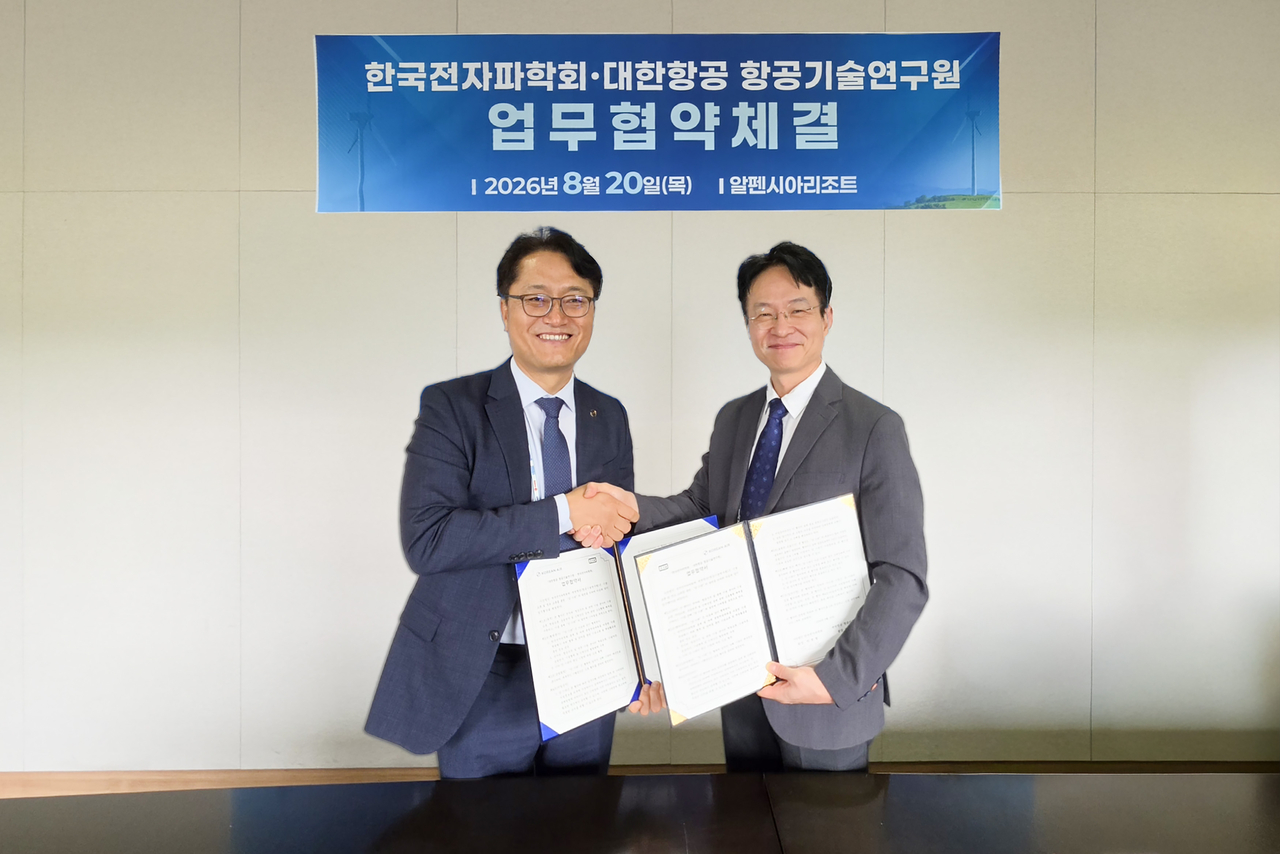
Korean Air announced Thursday it has partnered with the Korea Institute of Electromagnetic Engineering and Science (KIEES), the country's leading academic body in the electromagnetic field, to strengthen core electromagnetic technology capabilities in the aerospace sector.
Korean Air signed the MOU with KIEES on the sidelines of the institute's Summer Comprehensive Academic Conference, held Wednesday through Saturday at the Alpensia Resort in Pyeongchang, Gangwon Province.
The signing ceremony was attended by Kim Gyeong-nam, head of Korean Air's Aviation Technology Research Institute, and Park Young-cheol, president of KIEES.
Under the MOU, the two organizations plan to expand cooperation across a range of areas, including co-hosting and participating in academic events related to electromagnetic waves and aerospace, as well as technical consulting, joint research and talent development. They also intend to promote mutual technology exchange to contribute to the advancement of domestic electromagnetic and aerospace technology.
Korean Air has been participating since 2025 in the Electronic Warfare Aircraft (Block-I) System Development project, a key initiative to secure electromagnetic spectrum capabilities for the Republic of Korea Air Force.
The project aims to develop a large special-mission aircraft capable of collecting and analyzing threat signals from neighboring countries and, in wartime, disrupting and neutralizing enemy air defense networks and wireless command-and-control systems through electronic attack. The program carries a total investment of 1.92 trillion won ($1.37 billion) and is expected to complete development and testing before entering operational service in 2034.
Korean Air is responsible for overall airframe integration and aircraft modification and production within the project.
Korean Air plans to use the MOU as a springboard to broaden its cooperation with KIEES and further sharpen its technological edge in advanced electronic warfare development and related fields.
"Through this MOU, we will work to enhance the domestic technological competitiveness and self-reliance of South Korea in the electromagnetic and aerospace sectors," a Korean Air official said. "We will continue to strive to contribute to the advancement of cutting-edge aerospace and electronic warfare technology and the strengthening of the Republic of Korea's military capabilities."
eyre@heraldcorp.com