![A view of Yongsan Children's Garden inside Yongsan Park in Yongsan-gu, Seoul. [Yonhap]](https://wimg.heraldcorp.com/news/cms/2026/08/21/rcv.YNA.20260820.PYH2026082006020001300_P1.jpg)
Attention is turning to whether the standoff between the Ministry of Land, Infrastructure and Transport and the Seoul Metropolitan Government may shift into a negotiating phase, after Seoul Mayor Oh Se-hoon proposed alternative sites in place of Yongsan Park — the location the government has been considering for youth housing development. The alternatives would have a procedural edge over the park's main grounds, which would require amendments to special legislation, deepening the government's dilemma over housing supply.
On Thursday, Mayor Oh met with Land Minister Kim Yun-deok to discuss housing supply options within Yongsan Park, then told reporters at a briefing that the two sides had been "talking past each other" and that agreeing to convert even part of the Yongsan Park site to residential use "would make me a sinner in history as Seoul's mayor." He said he instead proposed sites near Gyeongni-dan, Camp Kim and the Ministry of Foreign Affairs parking lot.
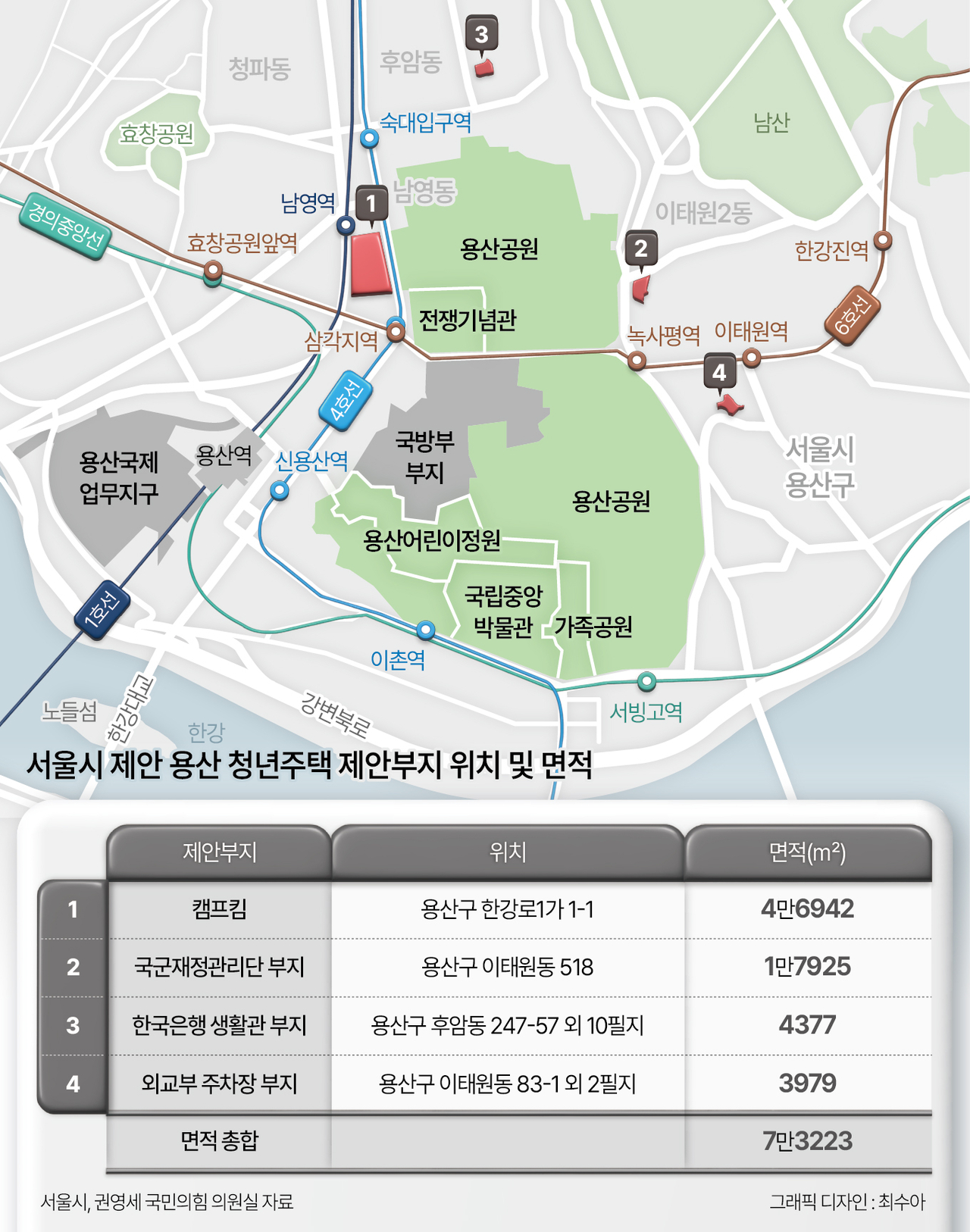
The alternative sites proposed by Seoul, Yongsan-gu and People Power Party lawmaker Kwon Young-se, whose constituency covers the area, are: Camp Kim (46,942 square meters), the Army Finance Command site in Gyeongni-dan (17,925 square meters), the Bank of Korea dormitory site (4,377 square meters) and the Ministry of Foreign Affairs parking lot (3,979 square meters).
![The Ministry of Foreign Affairs parking lot in Itaewon-dong, Yongsan-gu. [Naver Road View]](https://wimg.heraldcorp.com/news/cms/2026/08/21/news-p.v1.20260821.9ba6e2df7170400ebc254c52b85c3918_P1.jpg)
The proposed sites carry the advantage of leaving Yongsan Park untouched and, as public land, could break ground relatively quickly.
However, the sites are scattered across different neighborhoods — near Namyeong Station, Itaewon-dong and Huam-dong — making it difficult to secure the large-scale supply the government had originally envisioned. Combined, the four sites total just 73,223 square meters, well short of the approximately 297,000 square meters of Yongsan Children's Garden, meaning additional land would be needed to meet the government's supply targets.
Camp Kim is the largest of the four, but its capacity has limits. The Moon Jae-in administration initially planned to build 3,100 units there under its Aug. 4 housing measures, only to scale that back to 1,400 units due to green space requirements, before adjusting the figure back up to 2,500 units of late.
The Army Finance Command site and the Bank of Korea dormitory site fall within the Namsan height-restriction zone, which in effect caps building heights. Under Seoul's urban management plan to protect Namsan's skyline, structures in the zone are limited to 28 meters. Seoul eased that restriction in its 2030 Urban and Residential Environment Improvement Master Plan — allowing heights of up to 45 meters under certain conditions — but even so, apartments built there would be unlikely to exceed 15 stories.
![The Bank of Korea dormitory in Huam-dong, Yongsan-gu. The five-story building has about 150 rooms. [Gansam Architects & Engineers website]](https://wimg.heraldcorp.com/news/cms/2026/08/21/news-p.v1.20260821.fb30c9da51e3490cb146918873396c5f_P1.jpg)
The Bank of Korea dormitory site also has an active redevelopment project under way, making resident consultations essential. The building is part of the Donghuam District 3 zone, which Seoul designated as a fast-track integrated redevelopment candidate in August 2024. A redevelopment promotion committee received district office approval in June and is preparing to have the zone formally designated as a redevelopment area before year's end — meaning residents are unlikely to welcome new construction on the site.
Even a renovation of the existing building would require relocating all current residents, and with only five above-ground floors and about 150 rooms, the supply potential is limited. The same applies to the Ministry of Foreign Affairs parking lot near Itaewon's antique furniture street in Itaewon-dong. The site is flat but covers just 3,979 square meters — roughly half a soccer field — and at a floor-area ratio of 300 percent could yield only around 100 small- to mid-sized units.
Industry watchers say the outcome of negotiations will hinge on how the government and Seoul weigh volume against speed. "Seoul also needs youth housing, and there are genuinely aging areas in Yongsan that need improvement, so there are no real grounds to oppose supply itself," one real estate expert said. "It may actually be more effective for the government to step in and help resolve issues with surrounding landowners."
Another industry official said the Land Ministry would be weighing its options carefully. "A site needs to be large enough to allow stable, visible progress as a public housing zone — so the ministry will be calculating which choice gives it the most control over the supply process," the official said.
Meanwhile, Mayor Oh and Minister Kim failed to reach an agreement at Thursday's meeting and are scheduled to meet again next week to continue talks. Seoul's counter-proposal to protect Yongsan Park and the ruling party and government's review of a public opinion poll on the matter are unfolding simultaneously, drawing wide attention to next week's follow-up meeting.
hope@heraldcorp.com