Male soprano Samuel Mariño busking

At 14, the world of Samuel Mariño was entirely colorless. In Caracas, Venezuela, as the voices of his peers deepened into adolescence, his rang out clear and bright as a lark's. That voice became the reason he was bullied and ostracized. There were times he wanted nothing more than to change it — he even visited a doctor to ask about vocal cord surgery.
"Back then, my voice felt like something bad about me," he said. "I wanted to change it, and I didn't believe I could build a career through singing. It seemed too easy — I thought you couldn't make a living from it. I didn't understand how difficult and technical it really was, and I had no confidence in myself."
When that sense of lack became an artistic weapon, color returned to the boy's world. Today, his name is preceded by the description "the opera singer with the rarest voice in the world," as the British newspaper The Guardian put it. That boy is now Samuel Mariño, 33, a Venezuelan-born male soprano hailed as a rising star of the classical world.
Meeting him ahead of his first Korean performances in three years, Mariño said he had brought a new project to honor Korean culture. He will perform Handel arias with Camerata Antiqua Seoul as part of the 2026 Seoul Arts Center International Music Festival — a storytelling production that draws a thread between Handel and the Korean folk tale "Baridegi."
A 'natural' high voice in the castrato lineage — and beyond all categories
"I don't really care much about which category people put me in. The voice is far more complex than a simple male-or-female divide."
The phrase that invariably accompanies any description of Mariño is "rare voice." He is distinct from a countertenor, who trains the falsetto to reach higher registers. Thanks to a physical trait that left him without a voice break, Mariño can sing in full voice at the very top of the soprano range — making him an exceptionally rare "sopranist," or male soprano.
"A countertenor speaks in a low voice in conversation, but I can't speak in a low voice," he said. "This is the only voice I have."
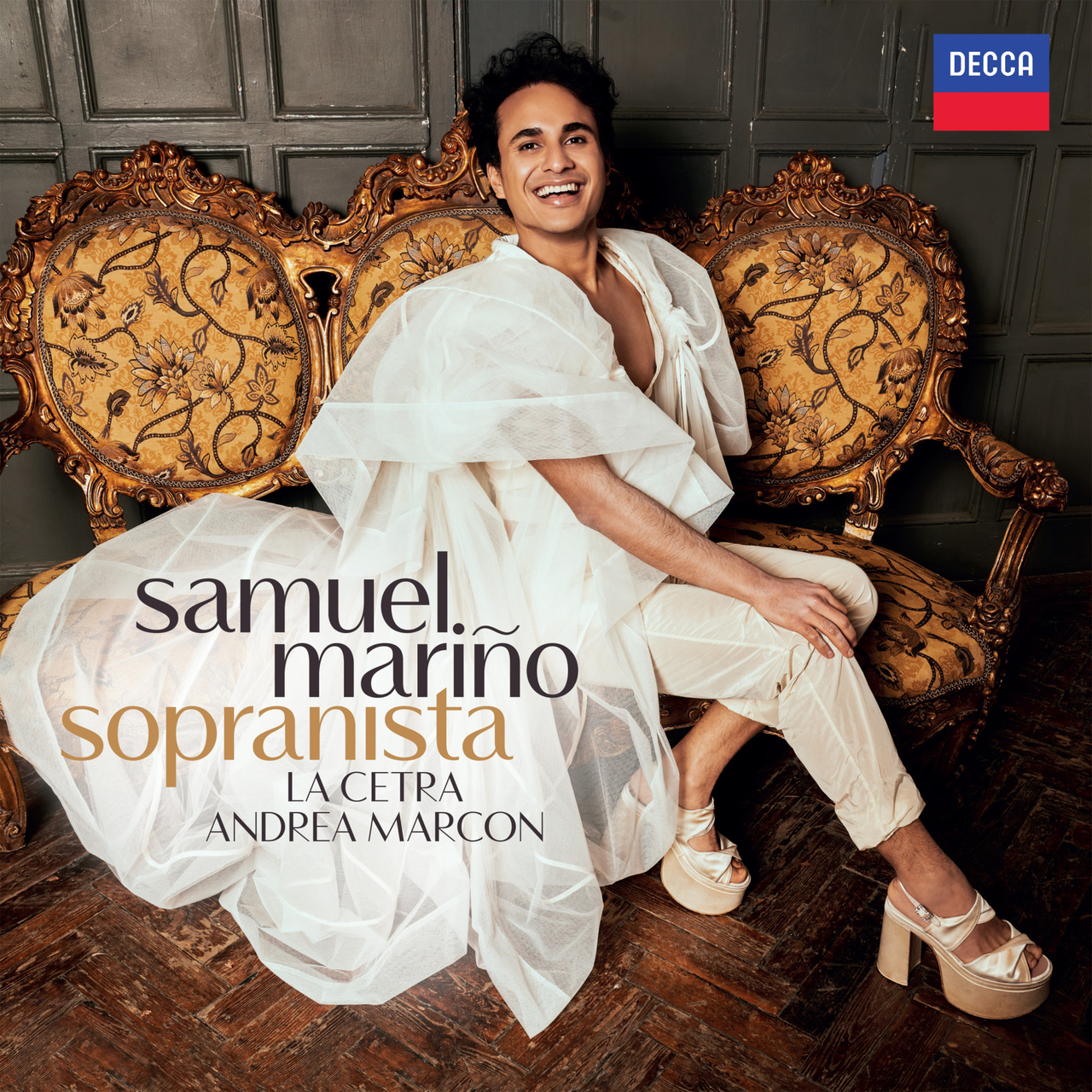
Mariño's life has always been about crossing boundaries and breaking limits. He studied piano and voice, and trained in ballet at Venezuela's national dance school. His life changed when he encountered soprano Barbara Bonney. His musical starting point was the castrato repertoire, and his debut album "Sopranist," released on the prestigious classical label Decca, drew wide attention precisely because a male soprano was singing music written for castratos.
Castratos were singers of the 17th and 18th centuries who were castrated before puberty to prevent changes to the larynx and vocal cords, preserving a high range that was then combined with the lung capacity of an adult. When the castrato tradition died out, their repertoire passed to female sopranos and countertenors. Mariño is the singer who has revived that repertoire in his own voice.
"In a sense, castratos were like Frankenstein's creations — they were often very tall, their bodies formed differently," he said. "Singing these roles is enormously difficult, and very few people can do it. Even I cannot sing everything perfectly." He added that he revives the repertoire "very carefully, always with great attention," in order to protect his voice.

Mariño has continually pushed against the assumption that the male soprano voice belongs only to Baroque music and the castrato tradition. His album "Lumina," released last year on Decca, marks a new milestone — a declaration that, having revived the castrato repertoire on his debut, he would now pursue a broader musical world as a soprano in his own right. That journey has also shifted how he thinks about music and voice.
"A dazzling, fast coloratura aria is like a glass of champagne — fizzy, sparkling," he said. "A lyrical, theatrical sound is like a glass of red wine you can savor slowly, for a long time."
What Mariño prizes now is not extreme high notes or virtuosic technique, but emotion. "Next year will mark 10 years since my debut, and I've grown more mature — both as a singer and as a person," he said. "Now I want every note to do more than impress the audience. I want it to move them."
Misunderstanding and confusion are a daily reality for Mariño. No matter how carefully he explains the difference between a countertenor and a sopranist — distinct ranges, distinct vocal production — it rarely lands easily. But for him, it is not something that needs to be constantly corrected.
"I don't bother correcting people when they confuse the two. My voice is not who I am — I'm just me. Every voice has its own color, its own identity. What matters is what you can express with it. I hope we're moving toward an era where people listen first and categorize later."
Mariño has also gleefully dismantled old conventions in his stage dress. Since 2021, he has shed the black tuxedo and taken to performing in elaborate skirts, dresses and full makeup, crossing gender boundaries with ease. "We often think of opera as rigid about gender, but in the castrato era the relationship between voice, gender and role was far more fluid and varied than it is today," he said.

"I was deeply inspired by Prince and Madonna, who broke down gender walls in their era. I see a similar energy in K-pop today — the freedom to constantly reinvent yourself visually and artistically. Challenging convention is not a rejection of opera's tradition. It is how you keep tradition alive as living art."
For Mariño, breaking boundaries at every turn is, he confesses, "a very personal thing." "Throughout my whole life, being 'different' has meant that people defined what kind of person I should be, what kind of sound I should make, where I should belong," he said.
"So crossing boundaries means staying free — free to evolve, to surprise, to be the artist and the person I choose to be. I don't want my difference to be a limitation. I want it to be a space of possibility. What I'm proud of is showing that my voice doesn't create limits — it opens doors."
'Singing the wounds of the abandoned' — where Baridegi meets Handel
His encounter with the "Baridegi" folk tale was accidental. When he visited Korea three years ago, he came across the story in a bookshop, and it never left him — that is what led him to bring it to the stage through his own music. Onto that foundation he layered Handel, the essence of 18th-century Baroque. Mariño described the production as "like lasagna — one layer of Handel, one layer of Baridegi, one layer of Samuel Mariño, all mixed together, and it works beautifully," he said with a laugh.
The common thread he found between the "Baridegi" folk tale and 18th-century Handel was the story of the abandoned. Baridegi, the princess cast away by her parents, journeys to the underworld to save them. Mariño overlays the emotions of characters from Handel's "Rodelinda," "Giulio Cesare" and "The Triumph of Time and Truth" onto the Korean folk narrative.
"When you look closely at the characters in Handel's operas, many of them are tragic figures carrying the wound of abandonment. Within some of the most radiant and beautiful melodies in opera history, there are people holding pain and loss. I am deeply absorbed in the process of reaching into the inner lives of those who were rejected and hurt by the world, and of transforming that grief into sublime love and redemption."
The pain and loneliness that weighed on him in childhood have become the artistic language through which he connects most deeply with the world. The past still visits him sometimes. "The voice that made me a target for bullying, the harsh reviews — they bring back the pain of those early years," he said. But he knows something has changed.
"In Venezuela there is a saying: 'Darle la vuelta a la tortilla' — to flip the tortilla completely, to turn the situation 180 degrees. That is what happened with my voice. What was once a source of pain became a strength, a career, a way of connecting with people. It became the reason I can share myself with the world."
Mariño believes that what makes us suffer can later become our greatest strength. "Sometimes the very thing that made life hard ends up being the biggest source of power," he said. "To everyone struggling with something that makes them different, I want to say: don't erase that part of yourself you haven't yet learned to love. One day it may become your greatest gift." He speaks from experience.
Mariño forged his own path as a male soprano when there were no maps to follow, and his very existence is an act of innovation. "It brings me great joy to see more male sopranos taking the stage and expressing themselves freely," he said. "I don't want them to become another version of me. I hope they think: 'That person did it in their own way — so I can find the courage to do it in mine.'"
He grew up listening to Britney Spears, Beyoncé and Michael Jackson, and has a deep interest in K-pop. "All of that is part of my musical background," he said. "I put myself into every song." The same holds true for his Handel-meets-Baridegi program. After the Korean performances, he will take to a German stage in a music-theater adaptation of Hermann Hesse's novel "Siddhartha," voicing the protagonist's inner self — once again crossing the boundary between music and theater. "I don't just want to give the audience beautiful sound," he said. "I want to give them an experience."
"At the center of everything in my life there has always been generosity. If my singing can comfort someone in a difficult moment, bring solace and joy on a wounded or lonely night, then art has fulfilled its calling. I want to be remembered not only for my music, but for the warmth and kindness I offered to the world."
shee@heraldcorp.com