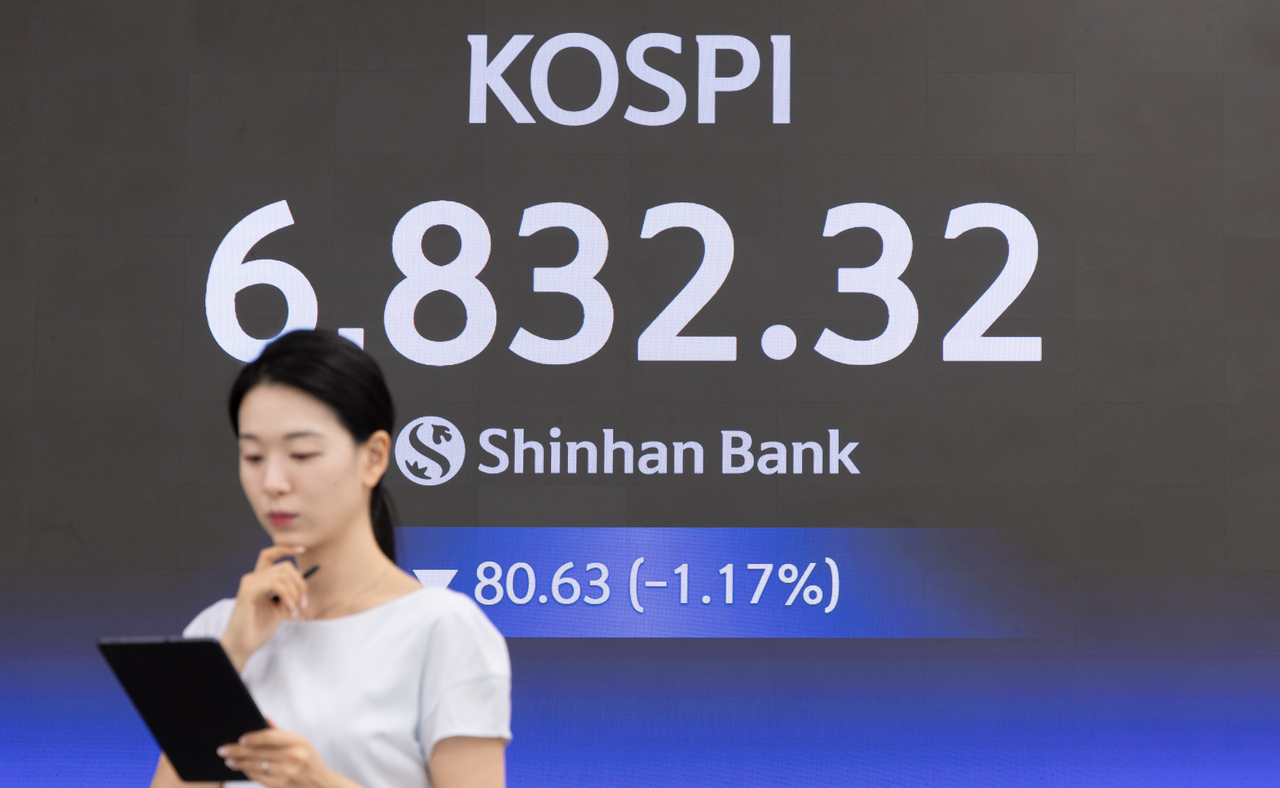
South Korean consumer sentiment turned negative for the first time in four months as sharp swings in domestic share prices weighed on household confidence, even as the broader economy continued to perform well.
The Bank of Korea's Consumer Composite Sentiment Index for August came in at 104.5, down 2.3 points from the previous month, according to the central bank's monthly consumer survey released Tuesday. The index had risen for three consecutive months since May, when it gained 6.9 points, before reversing course.
"Despite favorable real economic conditions, the index fell for the first time in four months as the domestic stock market correction and accumulated price increases dampened consumer sentiment," the Bank of Korea said.
The CCSI is a composite measure of consumer attitudes toward economic conditions. It is calculated using six sub-indices — assessments of current and expected living standards, household income outlook, consumer spending plans, current economic conditions, and the economic outlook. A reading above 100 indicates that sentiment is more optimistic than the long-term average, while a reading below 100 signals pessimism.
Among the sub-indices, the current living standards index fell 1 point to 92, dragged down partly by the decline in share prices. The current economic assessment index dropped 5 points to 79, as stock market volatility fueled more pessimistic views despite solid real economic performance. The Kospi has been swinging sharply between the low and high 6,000s this month.
Park Yong-min, head of the Bank of Korea's economic sentiment survey team, shrugged off concerns that the domestic stock market correction could constrain demand-side inflationary pressure. "The current correction in the domestic stock market is not a reflection of deteriorating economic conditions in Korea," he said. "The real economy is in very good shape, and that will clearly feed through to household income and consumption — so I question whether it will constrain those channels as well."
The job opportunity outlook index fell 3 points to 86, as employment in manufacturing and construction continued to decline and youth hiring remained weak, particularly in sectors with high AI exposure. Park said the job opportunity outlook "declined somewhat more among those under 40."
The housing price outlook index slipped 2 points to 125, reversing course within a month after the government announced tax reform and housing supply measures this month. Last month, the index had hit 127 — its highest level in four years and 10 months — as apartment sale and jeonse prices continued to rise, led by Seoul and Gyeonggi Province.
The current household savings index fell 3 points from the previous month to 94, its lowest level since May last year. Park noted that the savings index covers not only bank deposits and installment savings but also stocks and funds. "The fall in share prices had a negative impact on current household savings," he said.
Consumers' expected inflation rate over the next year held steady at 2.7 percent, unchanged from the previous month, as upward pressures — including the prolonged stalemate in the Middle East war — offset downward factors such as expectations of further interest rate increases and a weakening won-dollar exchange rate. The three-year and five-year expected inflation rates also remained unchanged from the prior month, each at 2.6 percent.
kimstar@heraldcorp.com