![Traffic thins outside the main Myeongchon gate of Hyundai Motor's Ulsan plant in Buk-gu on Friday, when the union staged a full eight-hour strike — its first in a decade. [Yonhap]](https://wimg.heraldcorp.com/news/cms/2026/08/25/rcv.YNA.20260821.PYH2026082103510005700_P1.jpg)
Hyundai Motor and its union reached a tentative agreement on this year's wage and collective bargaining contract after roughly 60 hours of cumulative strikes, bringing a labor dispute that had escalated into the company's first full-day walkout in a decade to the brink of resolution.
The 17th round of collective bargaining began Monday afternoon and stretched past midnight into Tuesday. The two sides finalized the tentative deal at around 1:30 a.m. Tuesday, according to industry sources.
The agreement will be put to a ratification vote by all union members on Aug. 31. If it passes, this year's wage and collective bargaining negotiations will be formally concluded.
Under the tentative wage terms, base pay will rise by 100,000 won ($72). Workers will also receive a performance bonus equivalent to 400 percent of base pay plus 12.7 million won, along with 15 shares of company stock and 500,000 won in hash points.
The terms fall short of what the union had originally demanded. The union had sought a base pay increase of 149,600 won, a performance bonus equal to 30 percent of last year's net profit, a 50 percent raise in regular bonuses, and a mandatory retirement age extension. Under the tentative deal, the base pay increase was trimmed to 100,000 won, while discussions on raising regular bonuses and fixed pay were pushed to the 2027 bargaining round.
Some progress was made on two key sticking points: staffing and retirement age. The two sides agreed to hire 500 new workers between next year and 2028. On retirement age, they agreed that if relevant legislation is amended, the extension would be implemented without expanding the wage-peak system.
The two sides also resolved a separate dispute over damage claims and asset freezes, agreeing to drop all 10 pending cases. Issues related to the basic labor rights of indirectly employed workers were also settled. The summer vacation allowance will increase by 200,000 won, from 800,000 won to 1 million won.
Among regional committee agenda items, those concerning Asan, Jeonju and Namyang moved closer to agreement, while sales-related issues will continue to be discussed.
This year's negotiations were marked by an escalating series of work stoppages. The union began partial strikes and refused overtime from July, then carried out a full-day strike in August — the first in a decade. Total strike hours during this year's bargaining process reached 60.
Management repeatedly urged a swift conclusion, warning that prolonged strikes would disrupt production and reduce employee compensation. The union pushed back, arguing that the company had ample capacity to meet its core demands but was dragging its feet.
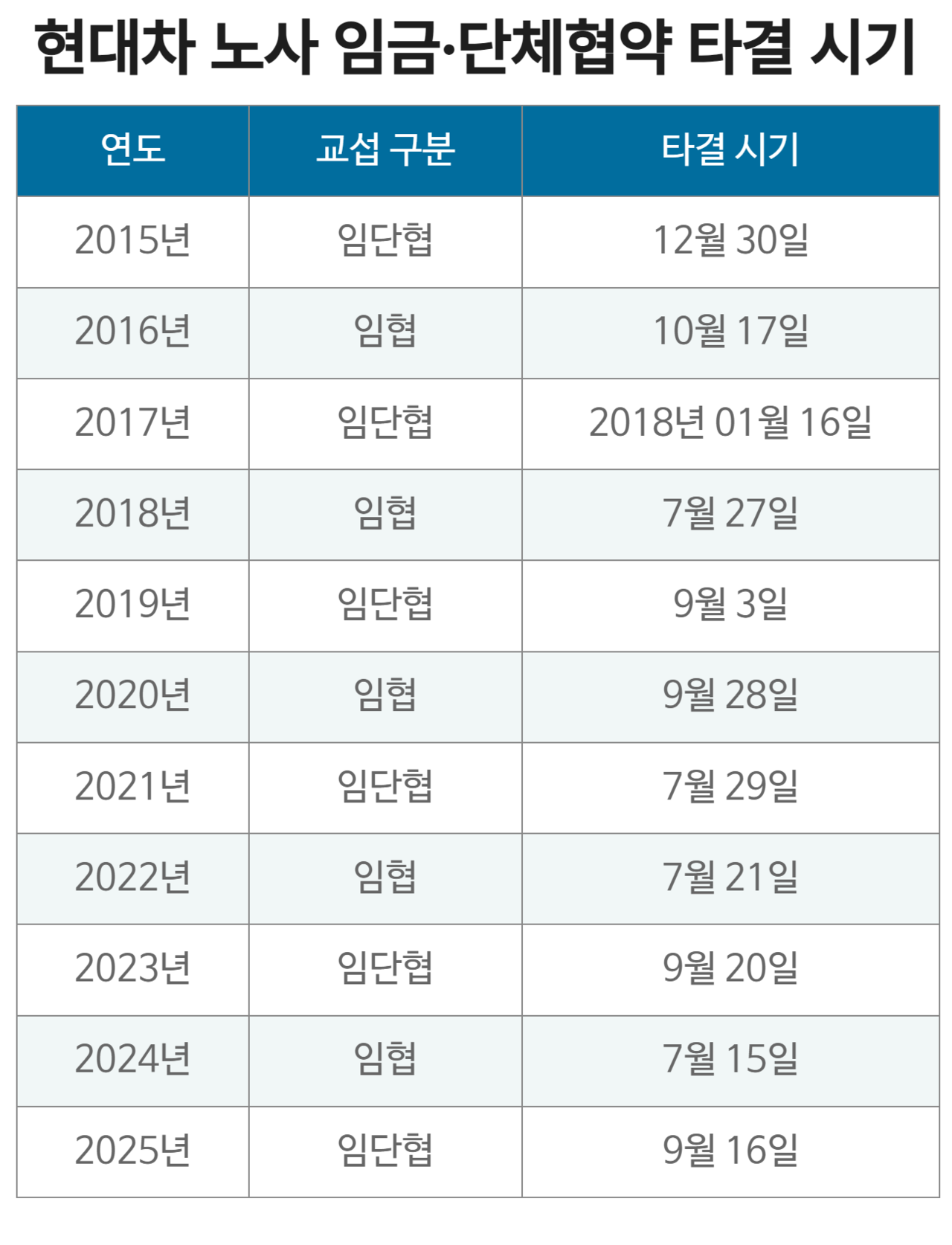
The tentative agreement allows both sides to avoid an outright breakdown for now, though the final outcome hinges on the ratification vote. Last year, Hyundai Motor did not wrap up its wage talks until Sept. 16. If this year's deal is ratified, the company will avoid a second consecutive year of negotiations stretching beyond September.
kwater@heraldcorp.com