
![Ferrari's first all-electric sports car, the Ferrari Luce, on display at the Ferrari Cheongdam showroom in Gangnam-gu, Seoul, after making its Korean debut on Monday. [Provided by Ferrari]](https://wimg.heraldcorp.com/news/cms/2026/08/25/news-p.v1.20260824.be2d5554414b45bbb132af795789114c_P1.jpeg)
Ferrari's first all-electric car, the Luce, made its Korean debut on Monday. The model pairs a 1,050-horsepower electric powertrain with four OLED panels co-developed with Samsung Display, and was built on a dedicated architecture — from the powertrain to the interior interface — entirely distinct from any previous Ferrari.
Ferrari Korea held the domestic premiere at the Ferrari Cheongdam showroom in Gangnam-gu, Seoul, roughly three months after the car's global reveal in Rome, Italy, in May.
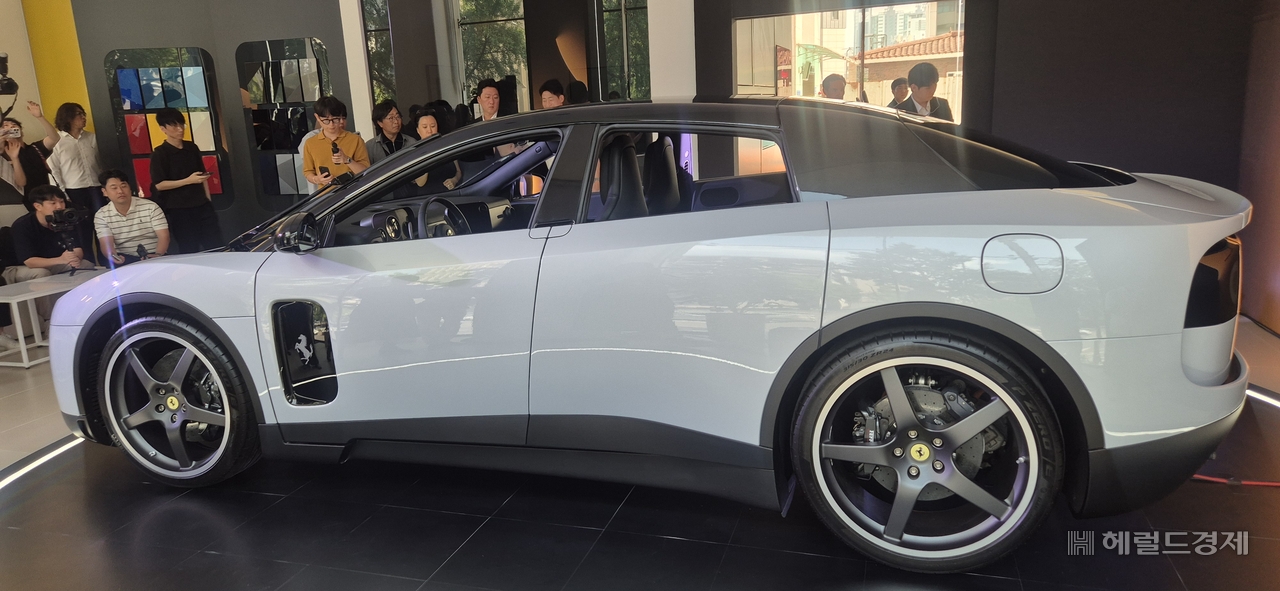
The Luce is powered by four independent electric motors, one at each wheel, producing a combined maximum output of 1,050 cv. It accelerates from a standstill to 100 km/h in 2.5 seconds and to 200 km/h in 6.8 seconds, with a top speed of 310 km/h. A 122 kWh battery provides a maximum range of 530 km on a single charge, and the car supports fast charging at up to 350 kW.

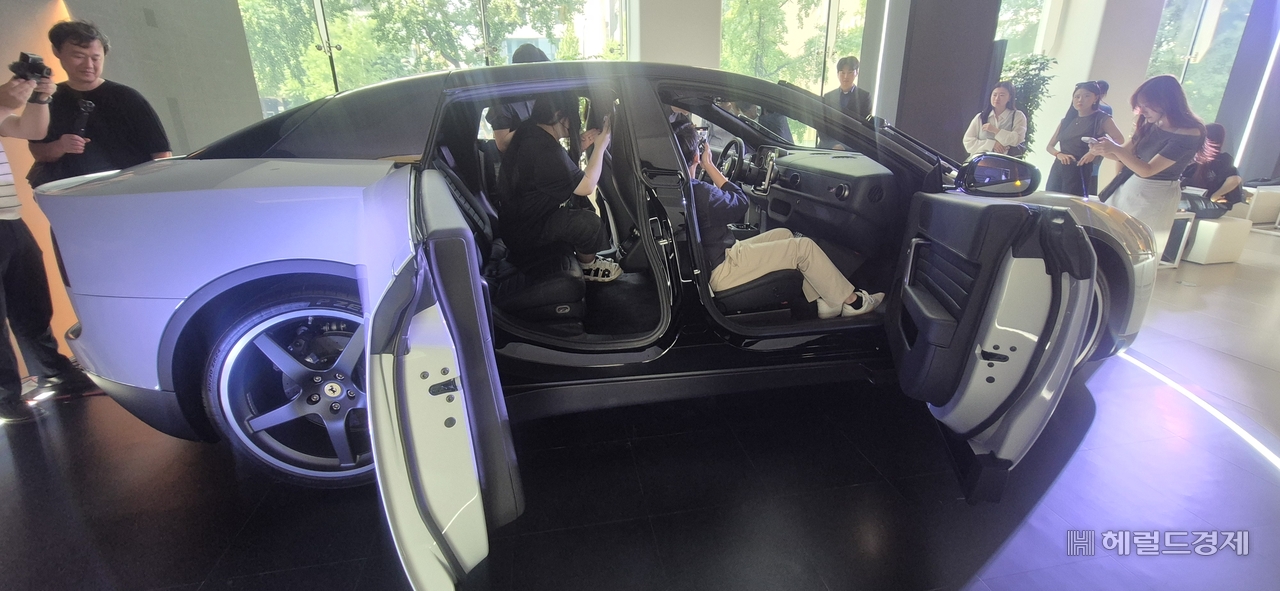
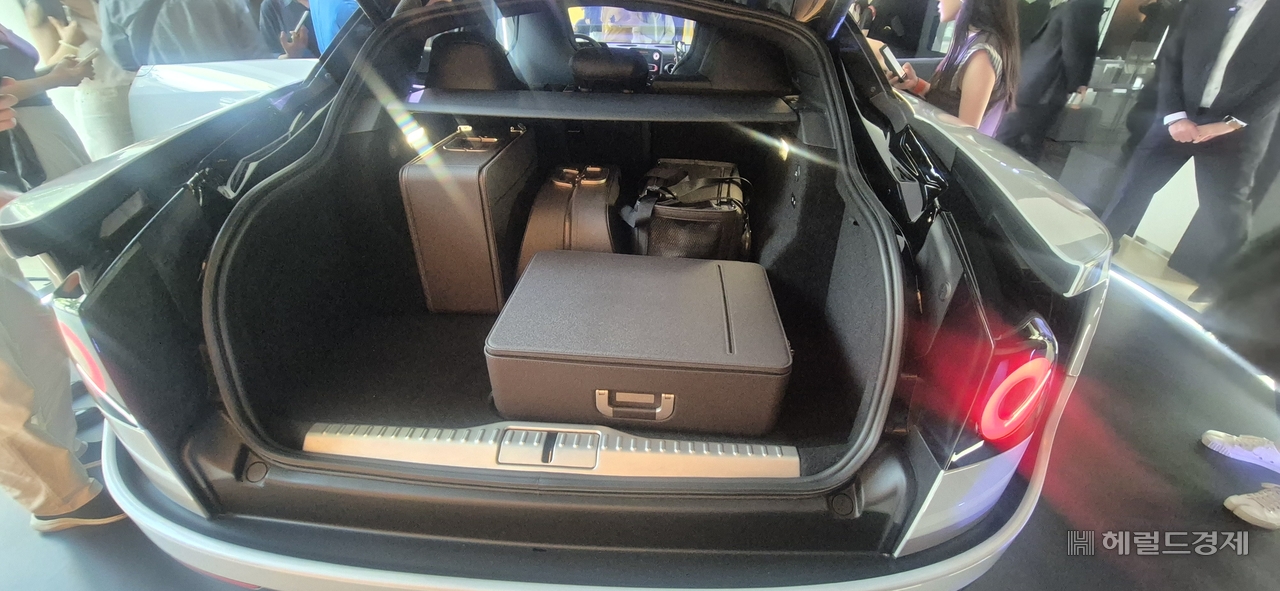
The Luce also marks the first time in Ferrari's history that the brand has adopted a four-door, five-seat layout. The body measures 5,026 mm in length, 1,999 mm in width and 1,544 mm in height, with 597 liters of trunk space — a deliberate attempt to combine sports-car performance with everyday usability in a single model.
Lee Sang-wook, sales director at Ferrari Korea, said at the event that "numbers alone cannot properly measure the Ferrari feeling," describing the car as one "defined by the thrill that driving delivers, beyond any statistic." He added that the Luce was not a simple conversion of an existing platform but was developed from the ground up in every respect.
Four Samsung OLED panels — and a reinvented instrument cluster
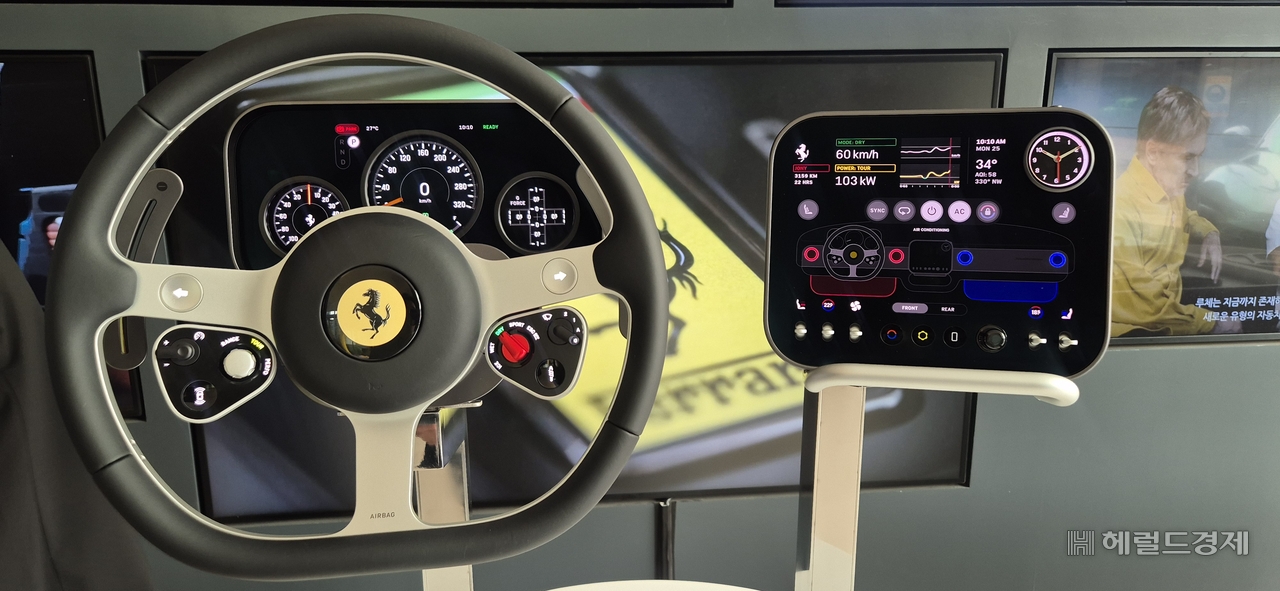
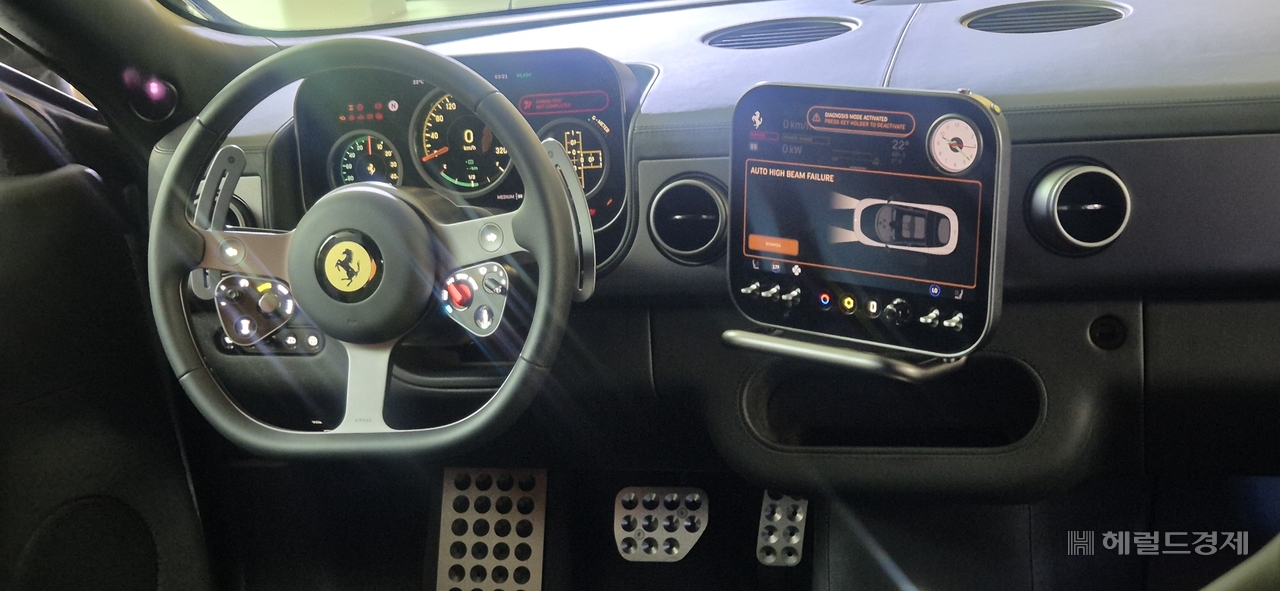
The collaboration with Samsung Display featured prominently at the Korean launch. The Luce incorporates four OLED panels developed by Samsung Display — in the driver's instrument cluster, the central control panel and the rear-seat control panel — measuring 12.9, 12, 10.1 and 6.3 inches respectively.
The driver's instrument cluster is particularly striking: two OLED panels are stacked in a layered structure, with three large cutouts punched through the upper display and a second screen positioned behind them, creating a three-dimensional effect in which digital readouts and analog gauges appear to overlap.
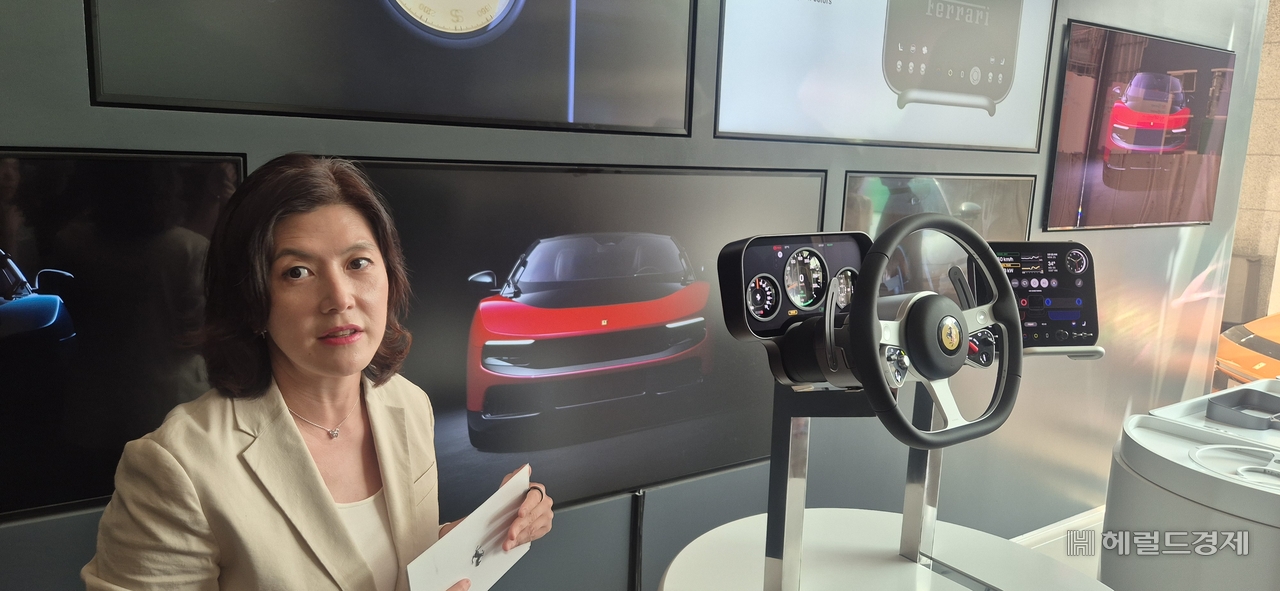
The development process was far from straightforward. Im Ji-su, a group leader at Samsung Display, said Ferrari's request was to cut three holes, each 100 mm in diameter, through the OLED panel — more than 20 times the size of a smartphone camera hole.
Cutting large holes in an OLED panel risks exposing the organic material along the cut edges to air and moisture, and forces display signals to route around the openings, causing uneven image quality. Samsung Display spent about four years solving those problems and began mass-producing the panels last year.
Im called the design "a world first in fact" and said it represented "a breakthrough — a major technological innovation by any measure in the display industry." He added that the process gave his team an appreciation for Ferrari's philosophy of "preserving the analog needle while fusing it with digital to create a single masterpiece."
The Luce's interior combines physical controls with digital screens. A three-spoke steering wheel made from 100 percent recycled aluminum is paired with mechanical buttons, dials and toggles, while the digital displays are focused on delivering essential information. Ferrari co-designed the exterior, interior and user interface with LoveFrom, the creative collective led by Jony Ive, Apple's former chief design officer, and industrial designer Marc Newson.
An EV without a fake engine sound
Ferrari took an unconventional approach to the Luce's driving soundtrack. Rather than synthesizing a simulated engine note, the car captures actual vibrations from the electric motors, gearset and other drivetrain components via an accelerometer mounted on the rear axle housing. Those vibrations are filtered and amplified in a process Ferrari likens to the way an electric guitar converts string vibrations into an electrical signal and amplifies them for the driver. The company said it applied the principle that "sound must be authentic, essential and functional — never artificial."
Ferrari also ensured the motors do not unleash their full output all at once. A system called Torque Shift Engagement lets the driver use paddles on the steering wheel to adjust power delivery and regenerative braking in stages, giving the driver direct control over the electric car's instant torque and creating a feel distinct from the gear changes of an internal-combustion sports car.
Thibaut Dusart, president of Ferrari Korea, said South Korea is "a critically important market that combines a deep appreciation for rich cultural heritage with a highly discerning eye for cutting-edge future technology." He added that the partnership with Samsung Display, which he described as holding "the world's finest display technology," demonstrated "a perfect synergy where technology and luxury design come together."
Sales surge despite design backlash — Korean technology throughout
"Luce" is Italian for "light" — a name Ferrari chose to signal a new direction for the electrification era. Rather than converting an existing internal-combustion model to electric power, the company built the Luce on a dedicated platform and set out to redefine performance, interior space and design from scratch. More than 60 new patents were filed during its development.
The launch was not without turbulence. When the car made its world debut in May, its four-door body and clean-lined styling — a sharp departure from the low, aggressive silhouette associated with Ferrari — drew a wave of ridicule online, with commenters comparing it to a computer mouse or a vacuum cleaner. Luca di Montezemolo, the former Ferrari chairman, publicly criticized the design, saying even Chinese automakers would not copy it. Ferrari's share price fell more than 8 percent on the first trading day after the reveal, reflecting the depth of market concern.
Actual buyer demand told a different story. Ferrari reportedly met its sales target of around 500 units for this year by early last month — just two months after the reveal — with particularly strong demand in China. The company is targeting cumulative sales of 2,500 units by 2030, or roughly 600 units a year on average.
Another reversal came at Monterey Car Week in California this month, where the first bespoke production car, Chassis 0, sold at an RM Sotheby's charity auction for $40 million — more than 36 times the original estimate of $1.1 million and a record for a new-car auction. Despite the design controversy, interest from actual buyers and collectors has been growing rapidly.
Ferrari has pressed ahead with the Luce's new design language rather than retreating to familiar territory. The electric-only architecture enabled the brand's first four-door, five-seat configuration, and Ferrari is positioning the car's distinctive silhouette and interior versatility as tools to attract a new generation of customers.
Korean technology runs deeper still in the Luce. The 159 Ah pouch-type cells that make up the 122 kWh battery pack were co-designed with SK On, using a high-nickel nickel-manganese-cobalt cathode material to achieve an energy density of 305 Wh/kg at the cell level. With Samsung Display supplying the interior OLED panels and SK On the battery cells, Korean companies contributed core technology to virtually every major system in Ferrari's first electric car.
Ferrari Korea will hold private customer viewings of the Luce at the Cheongdam showroom from Wednesday through Sept. 13. A special showcase featuring the car alongside its key OLED components is also planned for Sept. 22–23 at Samsung Display's offices in Yongin, Gyeonggi Province.
kwater@heraldcorp.com





