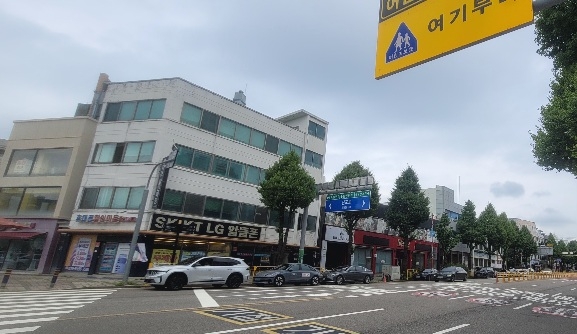
The Sinpo-dong area of Incheon, once so vibrant it was compared to Seoul's Myeong-dong, has long since become a symbol of urban decline — but the neighborhood is now approaching a new turning point.
Two major developments are converging to give the area fresh momentum. Late last year, authorities finalized a district unit plan for the area around Jayu Park, opening the door to private joint development in Sinpo-dong. Around the same time, the long-stalled redevelopment of Incheon Port's inner harbor Piers 1 and 8 — deadlocked for nearly two decades — received implementation plan approval, moving it into an active construction phase.
The inner harbor project envisions a 160,000-square-meter waterfront park, a K-pop performance venue with 20,000 seats, a shopping mall, mixed-use residential and commercial facilities, and a 2-kilometer ocean-view running course. Planners say it could reshape the old downtown's urban functions and tourism flows entirely, making it far more than a simple port upgrade.
The two projects, long treated as separate endeavors, are now moving in tandem, raising hopes that a new urban development corridor could take shape — one linking Sinpo Station, the open port district, Chinatown, Jayu Park and the inner harbor in a single continuous axis.
Deregulation opens the door to private development in Sinpo-dong
The starting point for development in Sinpo-dong is the district unit plan for the area around Jayu Park, officially announced in December last year.
The plan covers approximately 600,000 square meters, encompassing Sinpo-dong and the surrounding neighborhoods of Sinsaeng-dong, Bukseong-dong, Songwol-dong, Nae-dong, Jeon-dong and Inhyeon-dong.
Its core aim is to ease existing regulations and encourage joint development so that private capital can flow into an old downtown that has suffered from aging buildings and a stagnant commercial scene for years.
Under the plan, the residential ratio in mixed-use buildings can be raised to as high as 80 percent, officetel construction is now permitted, and floor-area-ratio incentives have been introduced for joint development and the adoption of recommended land uses.
Depending on the zone, floor-area ratios of up to 800 percent will be available, significantly improving the commercial viability of projects compared with the past.
Perhaps most significant is the institutional framework now in place for consolidating the many small, fragmented parcels of land and buildings that had long made large-scale development in Sinpo-dong impractical — multiple lots can now be bundled into a single project.
Among building owners within the district unit plan area, interest in joint development is already growing, and private developers are beginning to explore opportunities, particularly around Sinpo Station on the Suin Line.
If Sinpo-dong was long recognized as an area urgently in need of development, it has now moved a step closer to being one where private investors can seriously assess the numbers.
Nearly 20 years in the making, Piers 1 and 8 finally enter the execution phase
Into this picture comes the redevelopment of inner harbor Piers 1 and 8 as a new and significant variable.
The Ministry of Oceans and Fisheries approved the implementation plan for the Incheon Port inner harbor Piers 1 and 8 redevelopment project on Thursday. Implementation plan approval is the key administrative step required before infrastructure construction can begin.
Incheon city plans to break ground on infrastructure work in December.
The project site covers 436,690 square meters. The plan calls for approximately 630 billion won ($455 million) to be invested through 2029 to transform the declining port facilities at Piers 1 and 8 into a maritime cultural space with cultural, tourism and waterfront amenities.
About one-third of the total site — 160,000 square meters, equivalent to 22 soccer fields — will be developed as a waterfront park.
A 20,000-seat K-pop performance venue, a shopping mall and mixed-use residential and commercial facilities will also be built on the site, along with a 2-kilometer ocean-view running course.
To preserve sightlines from the top of Jayu Park out over the waters off Incheon, the city lowered the maximum height of the K-pop venue from the originally planned 120 meters to 60 meters.
The emphasis, in other words, is not on refurbishing port infrastructure but on creating a new urban space centered on the sea — one designed to draw both residents and tourists.
The inner harbor as 'ocean park' — generating new foot traffic for the old downtown
What makes the Piers 1 and 8 redevelopment particularly noteworthy is the scale and nature of the foot traffic it is expected to generate once complete.
Where the existing port facilities restricted public access, the redeveloped site — with its waterfront park, performance venue, shopping and cultural facilities — will become a destination for residents and tourists alike.
With the implementation plan now approved and the project moving into the construction phase, the dynamics have shifted.
The opportunity now exists to open a previously closed stretch of waterfront to the public and create conditions in which people drawn to the harbor flow naturally back into the old downtown.
Sinpo-dong takes the urban interior; the inner harbor anchors the waterfront
Viewed as a single urban space, the two projects take on clearly complementary roles.
The Sinpo-dong district unit plan creates the urban framework that makes private development possible; the Piers 1 and 8 redevelopment creates the large-scale destination that draws people into the old downtown in the first place.
Sinpo-dong gains the conditions for residential and commercial development; the inner harbor gains parks, cultural venues, tourism facilities, performance spaces and waterfront amenities.
If the two spaces are organically connected, Sinpo-dong and the inner harbor could become mutually reinforcing — each generating demand for the other.
In particular, linking the inner harbor waterfront to the existing tourism and commercial corridor running from Sinpo Station through the Sinpo-dong commercial district, Sinpo International Market, the open port district, Jayu Park and Chinatown could fundamentally alter the spatial structure of the old downtown itself.
In the past, Sinpo-dong and the inner harbor were physically close but functionally disconnected. Port security zones and a deteriorating old downtown combined to make everyday waterfront access difficult for residents.
As the inner harbor redevelopment moves forward in earnest, however, a pedestrian and tourism corridor linking Sinpo-dong to the harbor could take shape. Visitors arriving at the harbor would also have a clear path to the Sinpo-dong commercial district, the open port area, Chinatown and other nearby attractions.
Ultimately, a new old-downtown structure becomes possible — one in which Sinpo-dong handles residential and commercial functions in the urban interior while the inner harbor serves as the waterfront anchor for culture and tourism.
![A rendering of the redevelopment plan for Incheon Port's inner harbor Piers 1 and 8 [Provided by Incheon city]](https://wimg.heraldcorp.com/news/cms/2026/08/25/news-p.v1.20260825.80f27aafd28a48ce81e7e54d4389f6e5_P1.jpg)
Private investment and tourism linkages are the decisive variables
A development blueprint, of course, does not guarantee success.
For the inner harbor Piers 1 and 8 project in particular, the sites earmarked for the performance venue, shopping mall and mixed-use facilities are to be sold to private developers — meaning the project's success hinges on how many private operators can actually be attracted.
Even if hundreds of billions of won are spent on infrastructure, the project risks ending up only half-finished if the key private facilities fail to materialize as planned.
The same challenge applies to Sinpo-dong. Even with improved commercial viability under the district unit plan, joint development requires the consent of landowners and building owners alike.
Practical hurdles remain — selecting a developer, securing financing, agreeing on a project timeline and assessing pre-sale prospects.
What is needed, therefore, goes beyond simply pushing ahead with development projects. Authorities must also craft an urban strategy that offers developers sufficient commercial viability and ensures a steady flow of visitors and residents to the completed facilities over the long term.
Urban planning experts emphasize that the inner harbor cannot be developed in isolation.
They argue that commercial viability can only be secured by connecting the inner harbor to existing tourism assets — Chinatown, Wolmido, Sinpo International Market, the open port district and Jayu Park — into a single integrated tourism and cultural circuit.
Scattered dots of development must be joined into a single axis
Ultimately, what will determine the success or failure of the Sinpo-dong and inner harbor projects is not just the quality of each individual development, but whether the separate projects can be connected into a coherent urban strategy.
Linking transit-oriented residential development around Sinpo Station, the Sinpo-dong joint development, the tourism assets of Sinpo International Market and the open port district, Jayu Park and the inner harbor waterfront into a single lifestyle, tourism and commercial corridor is what will allow the old downtown to grow both its resident population and its visitor numbers simultaneously.
The inner harbor Piers 1 and 8 project — with its large waterfront park, K-pop venue and shopping facilities — is a major project capable of generating new consumer demand across the surrounding old downtown, well beyond simple port redevelopment, making its potential linkage with private development in Sinpo-dong all the more significant.
Incheon's old downtown has long seen urban regeneration and development projects pursued on a neighborhood-by-neighborhood basis, with each initiative criticized for failing to connect organically with the others.
That must change. Rather than treating the Sinpo-dong private development and the Piers 1 and 8 redevelopment as separate endeavors, what is needed is a strategy that designates the entire corridor — from Sinpo Station through Sinpo-dong, the open port district, Chinatown, Jayu Park and the inner harbor — as a single old-downtown development axis.
This is not simply about putting up new buildings. It is an urban reorganization aimed at creating a new flow of people — residents who live there, consumers who spend at commercial establishments, visitors who experience the history and culture of the open port district, people who rest by the sea and then return to the old downtown's commercial streets.
The harbor opens after 20 years — will Sinpo-dong seize the moment?
The Piers 1 and 8 redevelopment is scheduled to begin infrastructure construction in December, complete that work by 2029, and open private facilities in phases through 2033.
With inner harbor development — stalled for nearly two decades — finally set in motion, Sinpo-dong too is facing a new window of opportunity.
If Sinpo-dong, where deregulation has laid the groundwork for private investment, and the inner harbor, which will draw people through a K-pop venue and waterfront park, can be made to work in concert, Incheon's old downtown has a real chance to break free from the cycle of decline and regeneration. It could reinvent itself as a new urban axis combining residential, commercial, historical, cultural, tourism and waterfront functions.
However, the benefits of development must not remain confined to parts of Sinpo-dong and the inner harbor alone.
Incheon city must provide follow-up administrative support to accelerate private development in Sinpo-dong while proactively building the pedestrian, transport and tourism infrastructure linking the inner harbor to Sinpo-dong and the open port district.
The city must also take an active role in attracting private investors. In the end, the real measure of success for this development will not be how much gets built, but how many people come, stay, spend money and keep coming back.
With the inner harbor closed for 20 years now set to open and the door to private development in Sinpo-dong finally ajar, the question is whether Incheon's old downtown can reclaim its place at the heart of the city.
Connecting scattered dots of development into a single axis — that is the greatest challenge the Sinpo-dong and Piers 1 and 8 redevelopment projects have posed for Incheon's old downtown.
gilbert@heraldcorp.com