
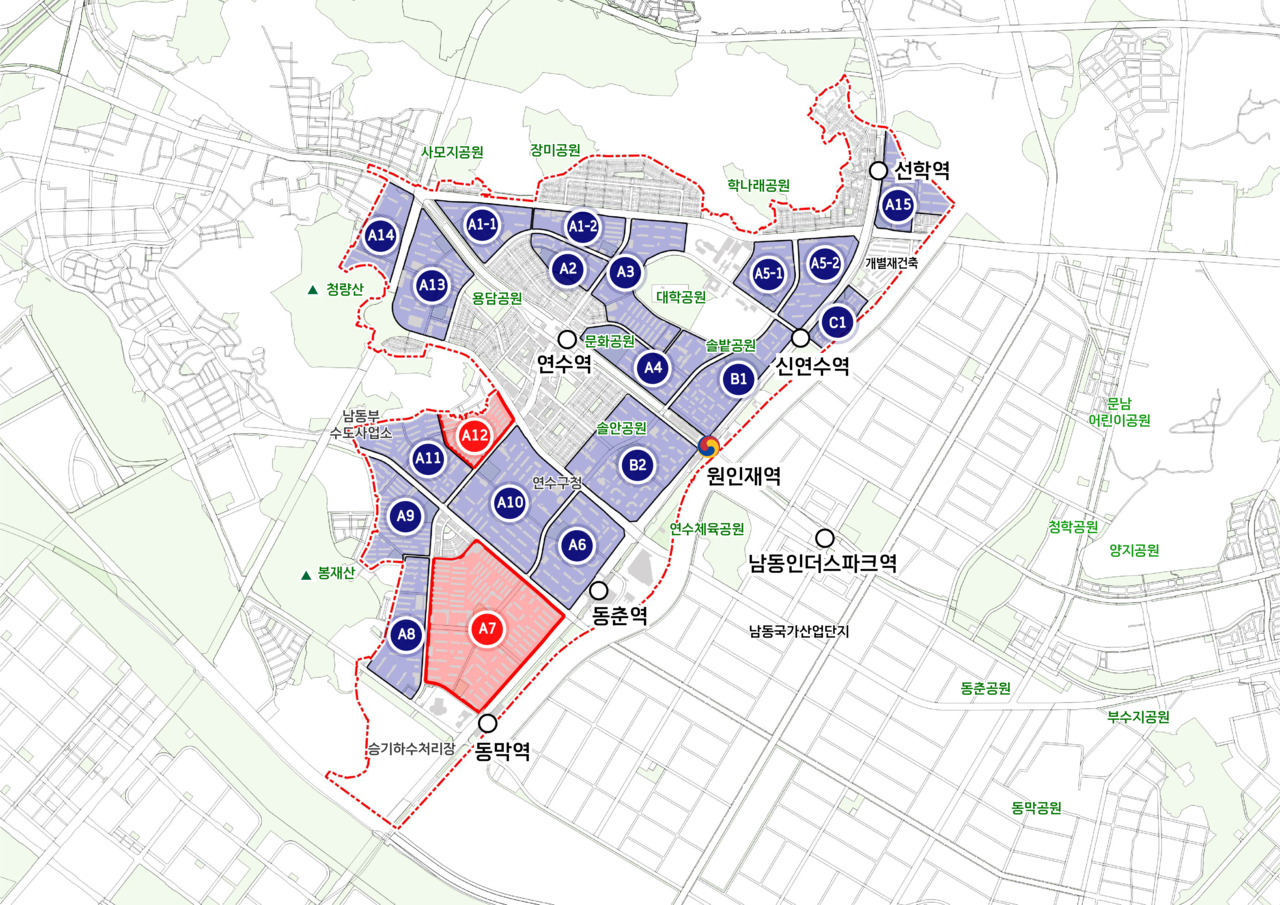
Five districts comprising 25 complexes have been selected as pilot zones for aging planned-city renewal in Incheon, covering a total of 16,267 units across the Yeonsu-Seonhak, Guwol and other districts.
The Ministry of Land, Infrastructure and Transport and the Incheon Metropolitan Government announced Tuesday that they had finalized the selection of five districts through a public application process for the city's aging planned-city renewal program.
The Yeonsu-Seonhak district is divided into two zones. Zone A7 covers 4,748 units across the Hyundai 1st, Yeonsu Punglim 2nd, Mujigae Maeul and Hanyang 2nd complexes, while Zone A12 covers 857 units across the Yeonsu Punglim 3rd, Joheung and Lotte complexes.
In the Guwol district, Zone B1 — encompassing the Dong-a, Samhwan 1st, Gwangyo KGM, Punglim, Seongji, Samhwan Gwangyo 2nd and Dongbu complexes — accounts for 2,756 units. The Galsan-Bupyeong-Bugae district's Zone A3, covering the Ukil, Daedong, Daejin, New Seoul and Dong-a complexes, includes 2,958 units. The Gyesan district's Zone A5, with the Kkachi Maeul Taehwa-Hanjin and Jakjeon Hyundai 2-1 and 2-2 complexes, covers 3,418 units. The Mansu 1·2·3 district's Zone A4, comprising the Samik, Mansu Hyundai, Geumho Town and Jinheung complexes, accounts for 1,530 units.
The Incheon pilot zone allocation is the largest ever designated under a single local government, including those in first-generation new towns. Previous designations include 12,055 units in Bundang, 9,174 in Ilsan, 7,797 in Daejeon, 7,318 in Busan, 5,957 in Jungdong, 5,460 in Pyeongchon and 4,620 in Sanbon.
Incheon launched its public application process in December last year, drawing applications for 21 zones totaling 46,105 units. Authorities evaluated submissions on resident consent rates, the degree of deterioration, the urgency of improving living conditions and the need to revitalize urban functions before finalizing the selections.
The Ministry of Land, Infrastructure and Transport and Incheon plan to jointly monitor housing market conditions — including prices and transaction volumes — in the designated pilot zones to maintain stability.
The broader aim is to generate new urban vitality and reshape Incheon's future city structure through sweeping improvements to residential environments, transportation, parks and other infrastructure.
The ministry plans to support the designated zones through every stage of the renewal process — from drafting special renewal plans to project implementation — working alongside support agencies including the Korea Research Institute for Human Settlements, the Korea Transport Institute, the Korea Land and Housing Corporation and the Korea Real Estate Board.
Through a mobile urban support center, officials will visit Incheon pilot zone residents directly to provide tailored one-on-one consultations and advisory services on topics including project procedures, estimated cost-sharing calculations and construction contract arrangements.
The ministry also plans to use a local government consultative body to continuously monitor progress and key issues in each of Incheon's pilot zones, and to swiftly coordinate matters requiring inter-agency discussion, such as relocation measures.
"The selection of Incheon's pilot zones marks a milestone as aging planned-city renewal spreads in earnest to major metropolitan cities nationwide, following Busan and Daejeon," said Yun Yeong-jung, the ministry's housing renewal policy director. "We will provide close support throughout the entire project process so that the newly designated pilot zones can establish themselves as successful models leading Incheon's aging planned-city renewal, and ensure the work proceeds with real momentum."
smh@heraldcorp.com





