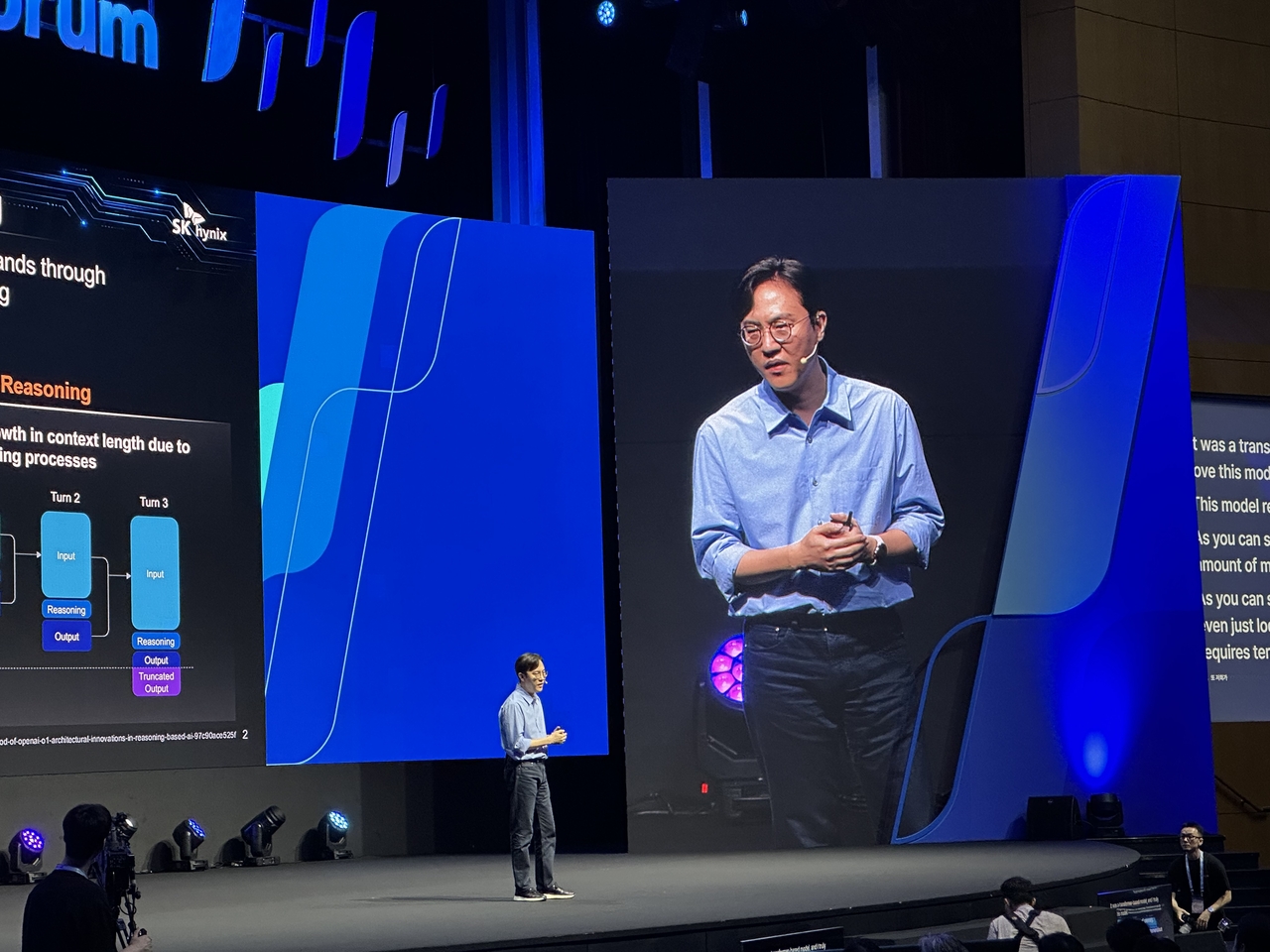
Joo Young-pyo, SK hynix's executive vice president for system architecture and a key figure in the company's next-generation memory development, struck a cautious tone on the timing of the CXL (Compute Express Link) market's takeoff. He also suggested that the growing importance of memory storage capacity driven by the spread of Agent AI could soon open new opportunities.
Speaking to reporters after the Dell Technologies Forum 2026 at COEX in Gangnam-gu, Seoul, on Tuesday, Joo said the CXL market outlook remains difficult to predict. "Market forecasting is hard, so I think it will take time," he said. "There are things that still need to be prepared — including on the CPU side and other components that go into a CXL system."
SK hynix recently unveiled a CXL memory module (CMM) for AI data centers based on the CXL 2.0 specification. The company developed it in collaboration with US chip design firm Marvell Technology, adding computing functions to the module.
CXL is a next-generation interconnect technology that enables CPUs, GPUs and memory chips to communicate seamlessly. By dramatically expanding memory capacity and allowing it to be shared like a common pool, CXL is seen as a solution to AI inference bottlenecks. It can handle explosive growth in KV cache (Key-Value Cache) — the storage LLMs use for previously computed information — without performance degradation.
Despite its memory pooling capabilities, questions remain about how quickly the CXL market will expand. With Nvidia at the center of the AI data center ecosystem, analysts say CXL — driven primarily by CPU vendors — will need more time to gain broader traction.
Joo said the CXL market could take off at any time. "With the recent shift toward Agent AI, it seems like more opportunities are being created," he said.
As the Agent AI era takes hold, the volume of information LLMs must store is growing exponentially. The need to process massive amounts of context is driving a corresponding surge in token usage, and analysts say data center demand for CXL could materialize at any point.
In his keynote address Tuesday, Joo said CXL predates the AI era. "No one anticipated it would be used for AI services, but we are evolving the technology on the basis of open interconnects," he said.
He added that while technical weaknesses remain, they are ultimately surmountable. "I believe these are problems we can overcome," he said. "The system will become widespread as we go through the process of deploying and optimizing it for customers."
Building out the CXL ecosystem — starting with CPUs — remains the top priority, as Joo noted. CXL requires collaboration among a wide range of participants, including memory makers, CPU and GPU vendors, and controller design firms that link the components together. That ecosystem work is considered urgent for the eventual spread of CXL 3.0-based platforms as well.
jeongwan@heraldcorp.com