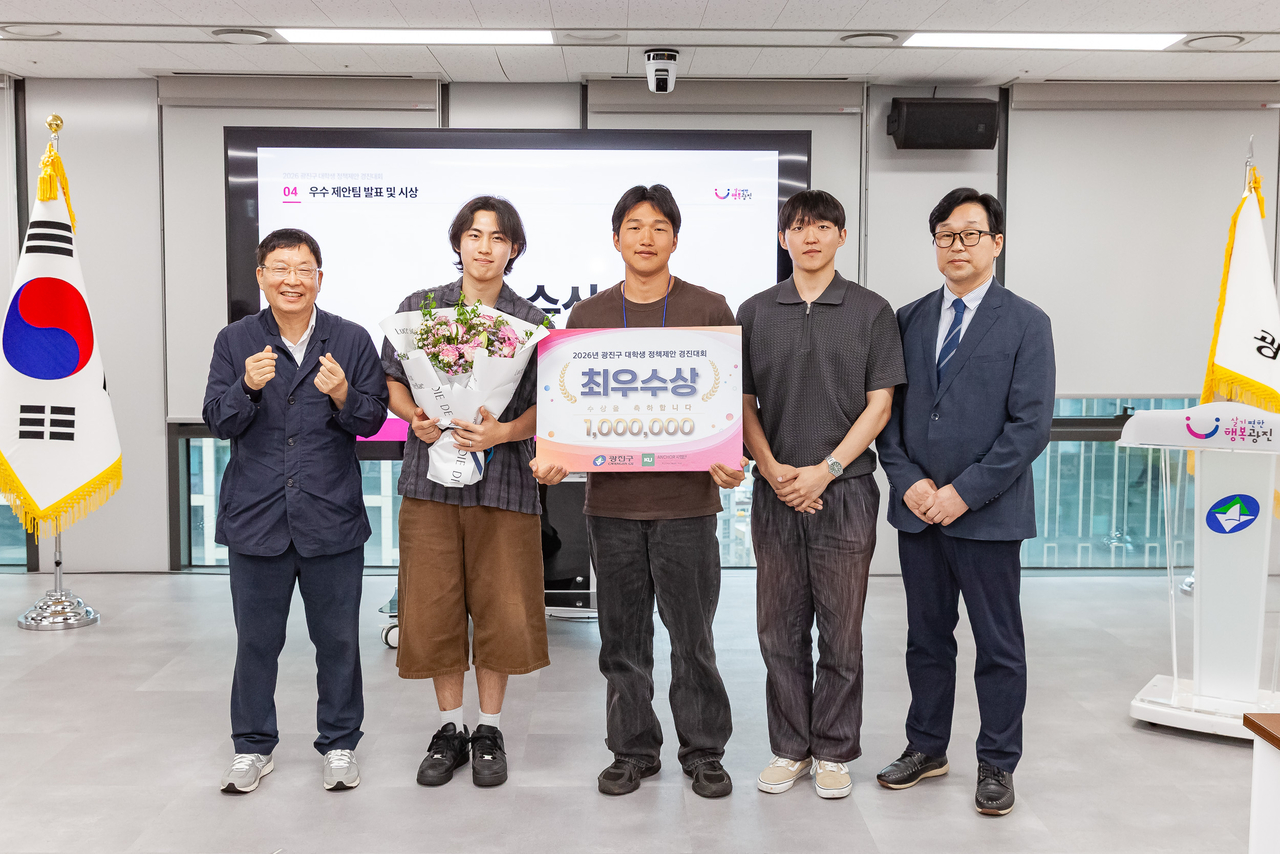
Gwangjin-gu co-hosted a student policy proposal competition with Konkuk University on Friday, selecting and honoring four outstanding policy ideas submitted by university students.
The competition was organized as part of the "Seoul ANCHOR Project," a university-cooperation initiative under the Ministry of Education, with the aim of identifying creative and practical student ideas that could be applied to actual district administration.
A total of eight teams competed — three from the Gwangjin-gu Student Policy Planning Group and five from the Konkuk University Living Lab Project — presenting a range of policy proposals aimed at resolving local issues and improving residents' quality of life.
Judging was conducted by a nine-member panel of internal and external experts chaired by the deputy district mayor, who evaluated entries on problem analysis, creativity, feasibility, presentation and effort. The panel selected one grand-prize winner, one excellence-award winner and two encouragement-award winners.
The grand prize — carrying a cash award of 1 million won ($724) — went to the "Zero Point" team for its proposal titled "Gwangjin 1.1.30. Itda." The team earned high marks for proposing ways to sustain strong existing district policies beyond one-off projects and to connect them with one another.
The excellence award went to the "Assembly" team for "Migaro Up," a proposal to convert vacant buildings in the Migaro area into youth hub spaces as a way to attract young residents and revitalize the local commercial district.
Two teams shared the encouragement award. The "Geonsamyi" team proposed creating an outdoor dining street in the Migaro commercial district along with an improved wayfinding system to draw more visitors, while the "Youth Welfare Division" team put forward a "Youth Housing Care Home-Clean Voucher" scheme to improve living conditions for young single-person households.
The district plans to have relevant operational departments actively review the ideas submitted through the competition before incorporating them into actual district administration.
"It is deeply meaningful that so many fresh and urgent solutions to local problems — seen through the eyes of young university students — have been brought to light," Gwangjin-gu District Mayor Kim Kyung-ho said. "We will continue to build on our collaborative framework with local universities, actively reflect the voices of young people in district governance, and work toward making Gwangjin a place that grows together with its youth."
seouldream01@heraldcorp.com