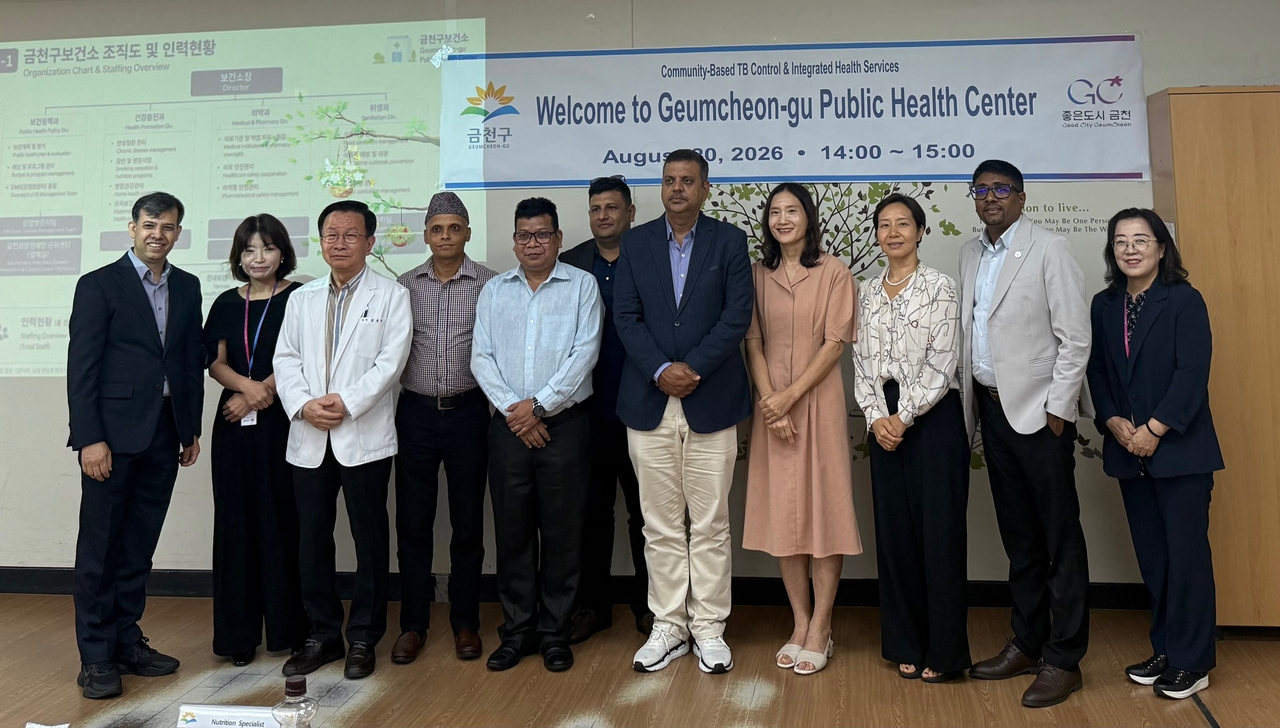
Geumcheon-gu announced that officials from Nepal's health authorities and international organizations visited the Geumcheon-gu Public Health Center on Thursday to observe the district's community-based tuberculosis management program and its on-site TB control system.
According to the district, 13 visitors — including representatives from Nepal's Ministry of Health and TB-related agencies, as well as officials from the World Health Organization (WHO) and the UN World Food Programme (WFP) — traveled to South Korea to benchmark the country's tuberculosis prevention, diagnosis, treatment and nutritional support programs, selecting Geumcheon-gu Public Health Center as a best-practice site. Nepal is classified as a high-risk country for tuberculosis, with an incidence rate exceeding 50 cases per 100,000 people.
The district held a briefing session presenting its full range of TB management activities, including prevention, screening, patient detection, treatment and medication management. Staff placed particular emphasis on the practical day-to-day work of continuously managing tuberculosis patients within the community through coordination with medical institutions.
The visiting delegation toured the health center's tuberculosis unit, observing firsthand the screening and detection process for TB patients. They also received explanations of real-world cases involving patient consultations and public inquiries, gaining a clearer picture of how the community-centered TB management system operates.
At the tuberculosis unit, staff screen patients for suspected TB through medical interviews and chest X-rays, then consult with a physician to determine whether additional testing is needed. When tuberculosis is suspected, sputum smear and culture tests are conducted. When no abnormal findings are present, patients are directed to follow-up testing or referred to a medical institution based on their symptoms.
The delegation also observed how the district screens contacts of confirmed TB patients and tests for latent tuberculosis infection to prevent further transmission, and how patients are continuously monitored through to the completion of treatment — a tightly coordinated approach designed to detect tuberculosis early and cut off community spread.
Officials from Nepal's health authorities and international organizations said the visit gave them an opportunity to see firsthand how a local public health center manages tuberculosis patients from early detection through treatment and medication compliance, and deepened their understanding of community-based TB control systems.
Geumcheon-gu District Mayor Choi Ki-chan said the visit was a meaningful occasion for Nepal's health officials and international organization representatives to see the district's TB management work up close. "We will continue to operate our tuberculosis management system with even greater care, so that patients in the community can be detected early and receive sustained treatment and follow-up," he said.
seouldream01@heraldcorp.com