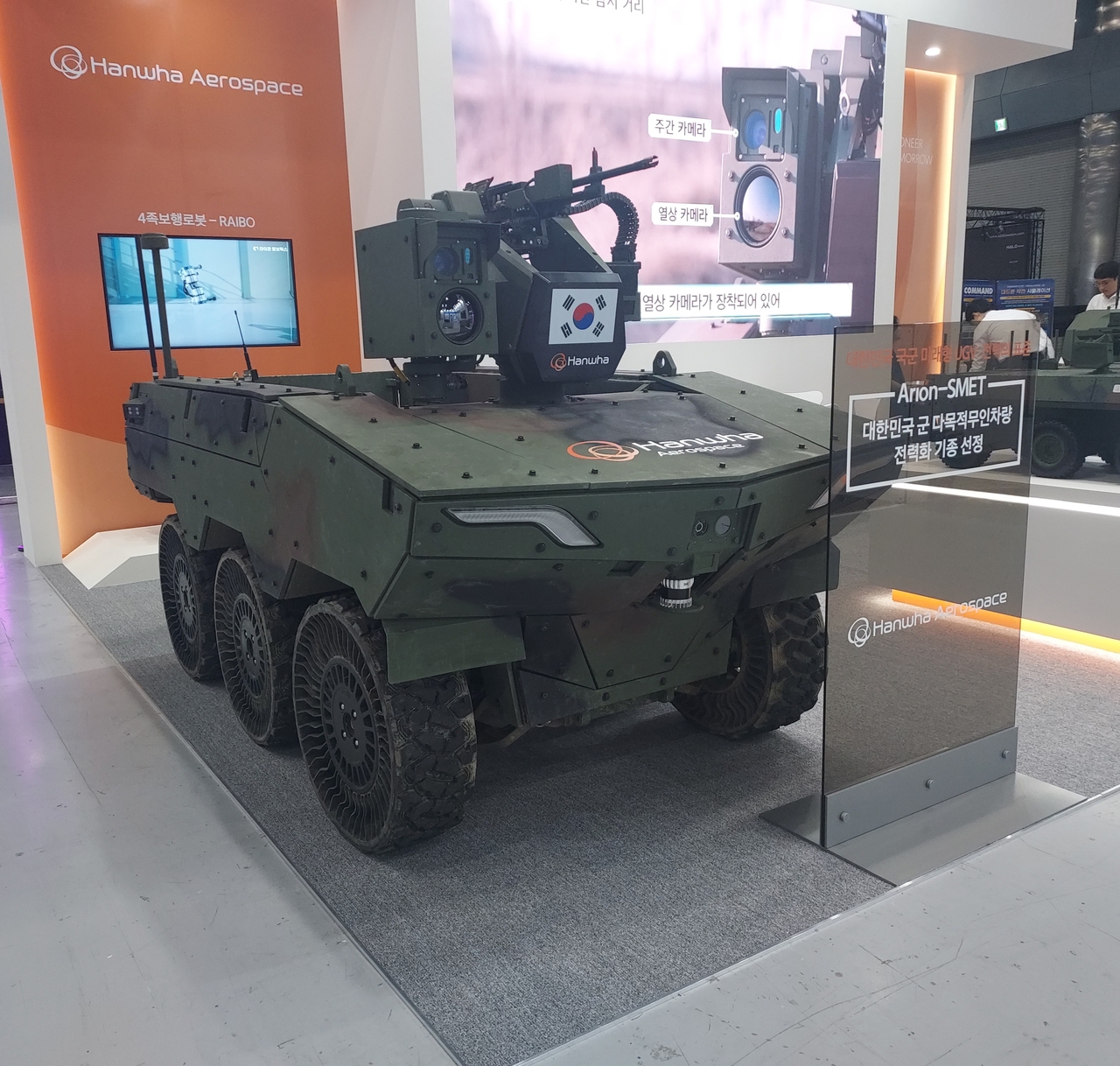
Hanwha Aerospace plans to unveil a fully autonomous mission-capable unmanned platform as early as 2035.
The company laid out the roadmap Wednesday at the Unmanned Vehicle X Civil-Military Cooperation Expo held at COEX in Gangnam-gu, Seoul — five years ahead of its previous schedule.
To meet that goal, Hanwha Aerospace plans to first secure a common platform for unmanned ground vehicles (UGVs) by 2030, building a system in which UGVs can independently carry out missions under a single platform architecture. The company said it will draw on physical AI technology based on vision, language and action (VLA) to develop the fully autonomous mission-execution capability.
"Achieving that goal will require smooth acquisition of battlefield data through combat robots and the establishment of hyper-connected, jamming-resistant communications to overcome connectivity constraints," said Park Mae-hun, head of the manned-unmanned teaming research center at Hanwha Aerospace's Land Systems research institute. "We also need to build a defense physical AI coalition — an R&D cooperation framework linking the military, government agencies, and academia and industry."
At the expo, Hanwha Aerospace displayed the Arion-SMET — recently selected by the government as the multipurpose unmanned vehicle to be deployed with Army and Marine Corps infantry units — and the fourth-generation multipurpose UGV GRUNT. The company also unveiled a scale model of an unmanned reconnaissance vehicle it is developing under a government-led program, as well as a multi-legged robot from partner company Lion Robotics.
The Arion-SMET boasts a domestic content rate of more than 98 percent, including its remote fire-control system and other key components. It can carry payloads of more than 450 kilograms and reach a top speed of 50 kilometers per hour on paved roads. Its greatest advantage is the ability to perform a wide range of missions — surveillance and reconnaissance, drone scouting, mine detection and fire support — through modular equipment. The GRUNT is a next-generation multipurpose UGV based on the Arion-SMET.
Park Byeong-ho, head of Hanwha Aerospace's LS4 project division, explained the rationale for expanding UGV mission roles. "The area of responsibility per unit has grown two to four times due to a shrinking troop pool," he said. "At the same time, the proliferation of threats on the battlefield — such as low-cost drones — makes it increasingly difficult for a single platform to handle the full range of operational environments."
Hanwha Aerospace announced at the expo that it plans to expand its multipurpose UGV lineup beyond existing small platforms such as the Arion-SMET to include medium and heavy variants: an unmanned reconnaissance vehicle (9-ton class), the latest tracked UGV T-RCV (15-ton class) and the unmanned combat vehicle H-UGV class (30-ton class).
Next year, the company plans to stage a domestic demonstration of its "Hanwha MUM-T Solution" featuring its UGVs. Hanwha Aerospace conducted an integrated MUM-T performance demonstration in Romania in May — the first time a domestically developed military UGV had demonstrated its capabilities on European soil.
That demonstration featured Hanwha Aerospace's wheeled armored vehicle TIGON, its UGV and the GRUNT, alongside the Themis developed by Estonia's Milrem Robotics. The GRUNT and Themis were deployed ahead of other units into hazardous areas to conduct drone-linked reconnaissance and surveillance missions, while the TIGON handled troop transport and fire support.
yeongdai@heraldcorp.com