Bill to be filed early next month as lawmaker-sponsored legislation by Financial Policy Committee chair
Compromise of 25–30% cap possible during Assembly deliberations
Traditional financial firms to be brought in to improve exchange governance
![South Korea's five major won-denominated exchanges — Upbit, Bithumb, Coinone, Korbit and Gopax [Each company]](https://wimg.heraldcorp.com/news/cms/2026/08/26/news-p.v1.20260826.f37052e617c647a7886c749960b9693c_P1.png)
South Korea's financial authorities plan to submit the government's draft Digital Asset Framework Act to the National Assembly as early as next week, through legislation sponsored by the chair of the Assembly's Financial Policy Committee. The bill's most contentious provision — a cap on major shareholders' stakes in virtual asset exchanges — is shaping up to apply a uniform 20 percent ceiling regardless of market share.
According to the National Assembly and other sources, the Financial Services Commission coordinated with the ruling party and will introduce the government's draft Digital Asset Framework Act early next month under the sponsorship of Rep. Yoo Dong-su of the Democratic Party of Korea, who chairs the Financial Policy Committee. The bill is understood to take a uniform approach — capping major shareholders' stakes across all virtual asset exchange operators rather than applying different rules based on exchange size or market share.
The Digital Asset Framework Act is a comprehensive bill covering the issuance and distribution of stablecoins as well as the regulation of virtual asset service providers. It is widely regarded as foundational legislation that must be enacted as a priority to raise the competitiveness of South Korea's digital asset market.
The legislative timeline has slipped from initial expectations as financial authorities and lawmakers worked to iron out the details, but momentum has picked up again with the Financial Policy Committee chair taking the lead in coordinating the process. The ruling party plans to move directly to bill review without forming a separate TF, aiming to pass the legislation before the end of the year.
A 20 percent ceiling on major shareholders' stakes is being discussed as the baseline for the bill's most contested provision. Authorities envision using the cap to bring traditional financial institutions such as banks into exchange governance structures. The rationale is that stablecoins introduced under the new framework could in effect influence the monetary and payments system, making it necessary to seat financially capable institutions on exchange boards to strengthen market resilience in the event of an incident. There is also a desire to prevent any single operator from exercising unchecked control.
The market had previously discussed a compromise that would exempt smaller exchanges below a certain market-share threshold from the shareholding restructuring requirement — with one widely cited proposal limiting major shareholders to 15–20 percent only at exchanges holding 50 percent or more of the market. Authorities, however, believe that applying different regulatory standards based on each exchange's market share would create confusion over how and when market share is measured, and could invite regulatory arbitrage.
If resistance to the cap grows during Assembly deliberations, a relaxed ceiling of 25–30 percent could be put on the negotiating table. Authorities are also considering prioritizing passage of the bill in plenary session and addressing finer regulatory details through follow-up legislation or subordinate rules. The Assembly is expected to first set the shareholding ceiling and then work out transitional provisions and a timeline for existing operators to restructure their stakes.
Industry pushback is anticipated over concerns that a uniform shareholding cap would excessively restrict property rights and management control. "Applying a blanket 20 percent cap would send shockwaves through the exchange industry," one exchange industry official said. "It could effectively force existing shareholders to sell at a discount the moment it takes effect, and could also affect the ability to attract new investment."
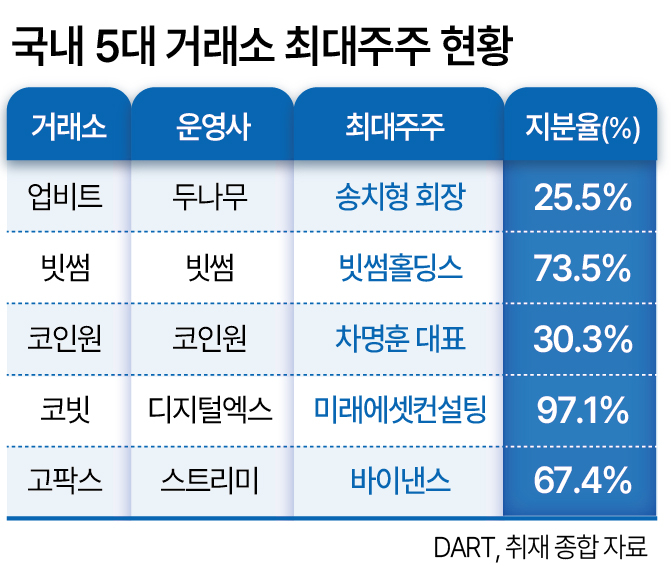
With a uniform shareholding cap — rather than one tied to market share — gaining traction, most domestic won-denominated exchanges are expected to face unavoidable governance restructuring. Discussions over stake sales and outside investment, which had quieted down, are likely to heat up again. The largest shareholders at the five major exchanges currently hold the following stakes: Dunamu (Upbit) Chairman Song Chi-hyung at 25.5 percent, Bithumb Holdings at 73.5 percent in Bithumb, Coinone CEO Cha Myung-hoon at 30.3 percent, Mirae Asset Consulting at 97.1 percent in Digital X, and Binance at 67.4 percent in Streami (Gopax).
Among these, authorities appear to view Coinone's recently restructured shareholder base — which welcomed Korea Investment Securities and OKX Ventures as new investors — as a model case. Coinone has been reorganized so that CEO Cha holds 30.36 percent, Com2uS holds 24.54 percent, and Korea Investment Securities and OKX Ventures each hold 20 percent. The structure distributes ownership among the founder, a traditional financial institution and a global digital asset firm. Cha's stake is also close to the 30 percent ceiling that authorities have floated as an acceptable upper limit during negotiations. The Korea Financial Intelligence Unit accepted Coinone's notification of a change in major shareholder on July 22.
Bithumb, by contrast, has seen little progress in stake sale talks. Its largest shareholder, Bithumb Holdings, controls nearly 80 percent of the exchange, and the web of cross-shareholdings among affiliates has made negotiations difficult to advance. "Untangling the complex shareholding structure is a prerequisite for Bithumb, but given its strong brand recognition and trading base, there will still be no shortage of financial firms interested," an official at a financial holding company said.
Digital X — formerly Korbit, with Mirae Asset Consulting holding a 97.15 percent stake — is no exception. There had been speculation that it might be relatively insulated if market-share-based regulation were introduced, but the prospect of a uniform cap applying to all exchanges has grown considerably more likely.
That backdrop is seen as one reason the market has recently been discussing the possibility of Mirae Asset Consulting selling part of its stake or bringing in outside investors. "There are assessments that Mirae Asset Consulting acquired its stake at a relatively low price, so there would be an incentive to sell a portion and realize a gain," one industry official said.
With the effective elimination of market-share-based regulatory exemptions, competition among smaller exchanges is expected to intensify further. That competition has already spilled over into a fee-cutting war. Digital X, now part of the Mirae Asset group, announced Monday that it would waive trading fees on all won-market pairs on the Korbit platform for one year. Coinone also announced that starting at 11 a.m. that day, it would issue vouchers to customers to make trading fees entirely free.

forest@heraldcorp.com
kyoung@heraldcorp.com