'Era of 1 million responsible members… support from 20s and 30s up,' Jang says
Leader focused on 24-hour filibuster, hunger strike in battles against ruling camp
Internal feuds, calls to resign persist as Jang pushes intraparty reform
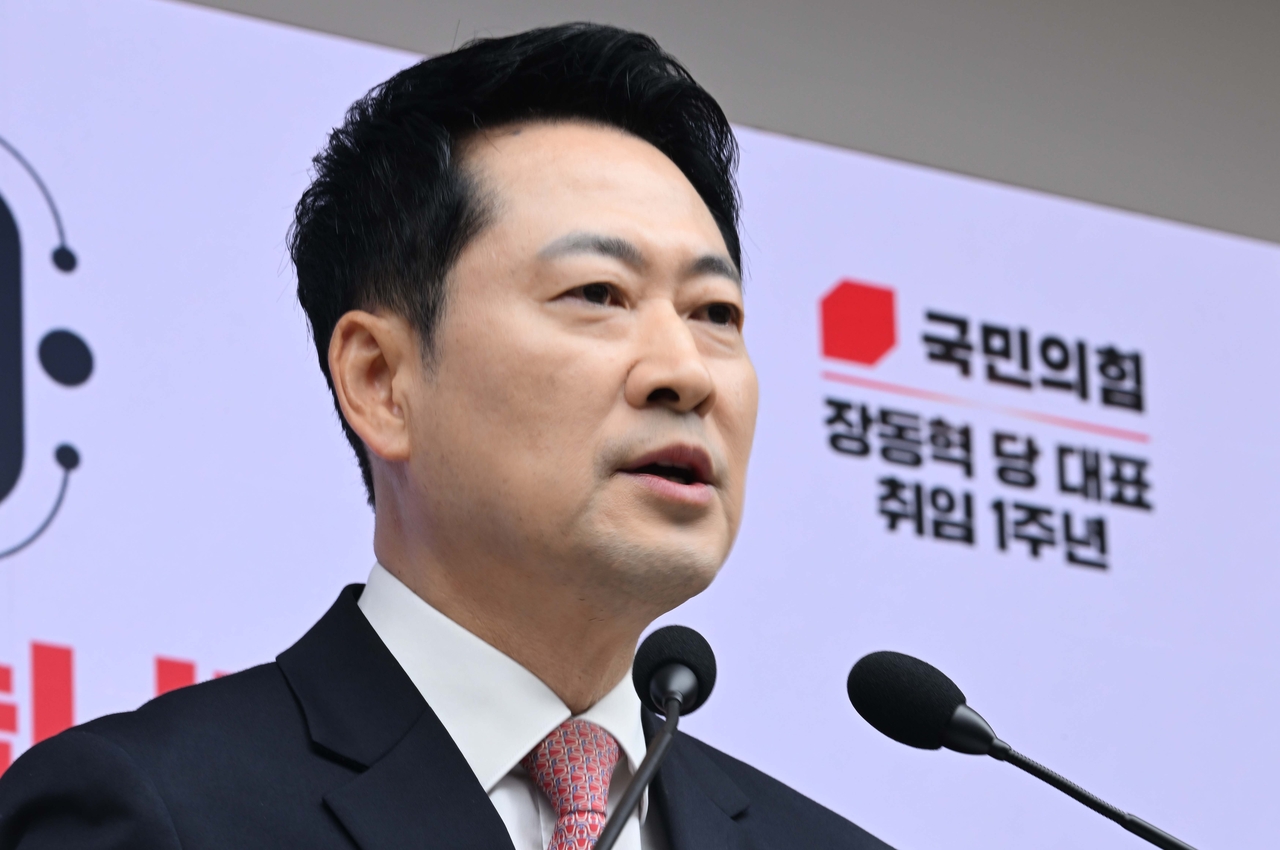
People Power Party leader Jang Dong-hyeok marked his first anniversary in office on Wednesday. Despite persistent calls for his resignation from inside and outside the party, Jang has held on by championing opposition to the ruling camp and pushing a member-centered vision for the PPP — and if he remains in the post through October, he will surpass the record for the longest-serving leader in the party's history.
Still, continued intraparty conflict and the constraints of being a minority opposition party mean that delivering tangible results in the fight against the ruling camp remains the defining challenge of his remaining term.
Jang held a press conference at the PPP's central headquarters in Yeouido, Seoul, on Wednesday to mark the anniversary. "Over the past year, I have devoted myself above all to strengthening the sovereignty of party members," he said. "I believe that a party without its members cannot exist, and that the strength of the members is the strength of the party."
He added that "despite the Lee Jae Myung administration's relentless insurrection-framing and political retaliation, the solidarity of our members has only grown stronger." "The era of 1 million responsible party members — once a dream — has arrived," he said. "Support for the PPP among people in their 20s and 30s is higher than ever."
Jang was elected PPP leader in August last year after vowing to "bring down the Lee Jae Myung administration." His two-year term runs through August next year. If he serves the full term, he will have led the party longer than anyone since its founding in September 2020.
All of his predecessors left office before completing their terms. Former leader Lee Jun-seok holds the current record at 424 days, and Jang will surpass that mark if he remains in the post through October. Former leaders Kim Ki-hyun and Han Dong-hoon served 280 days and 146 days, respectively.
Jang's first year has been widely characterized as one focused on confronting the ruling camp. A prominent example came late last year, when he led a 24-hour filibuster against legislation pushed by the Democratic Party of Korea that would have established a dedicated court division for insurrection trials.
Early this year, he staged an eight-day hunger strike to demand the introduction of two separate special prosecutor bills targeting allegations of Unification Church lobbying in ruling-camp political circles and illicit payments tied to candidate nominations. Outside the National Assembly, he held field supreme council meetings, visited industrial sites and met with young people. More recently, he attended a series of rallies at Olympic Park in Songpa-gu, Seoul, to defend voting rights after a ballot shortage marred the June 3 local elections.
"The past year for leader Jang moved on two axes — intraparty cohesion and the fight against the ruling camp," a party leadership official said. "Beyond the battles in the Assembly, he has consistently kept up a schedule of listening to people on the ground through field supreme council meetings, industrial site visits and youth forums. The Olympic Park visit is an extension of that same approach."
The path to staying in office has not been smooth. Calls for Jang's resignation have surfaced repeatedly from within and outside the party since he took office. Late last year, first- and second-term lawmakers demanded a public apology and a formal break with former President Yoon Suk Yeol on the first anniversary of the Dec. 3 emergency martial law declaration, but Jang's failure to take a clear position fueled intraparty tensions. In January, the expulsion of independent lawmaker Han Dong-hoon — triggered by a controversy over the party's member message board — sparked a backlash centered on pro-Han factions.
The June 3 local elections also generated friction over nomination outcomes. Criticism and calls for Jang's resignation mounted both inside and outside the party when he traveled to the United States for six nights and eight days during the campaign period. More recently, the party's central ethics committee drew accusations of "disciplinary politics" and "politics of subtraction" after handing down heavy sanctions against incumbent lawmakers outside the party leadership faction. Jang's repeated appearances at the Olympic Park rallies, tied to the ballot shortage controversy, also prompted concern within the party that the approach could hinder efforts to broaden appeal among centrist voters.
The party's approval rating swung sharply over the past year. According to Realmeter, the PPP's support stood at 36.1 percent just after Jang took office and edged up to 37.6 percent as of Monday. It hit a low of 28.1 percent in March, when intraparty conflict over nominations flared, marking the weakest reading of Jang's tenure. Conversely, the rating soared to 44.3 percent immediately after the June 3 local elections, buoyed by the ballot shortage controversy and a spillover benefit from public dissatisfaction with government and ruling-party policies. It has since given back those gains and returned to the 30-percent range. For full polling details, see the National Election Survey Deliberation Commission website.
As Jang enters his second year, the focus of his leadership appears to be shifting toward reorganizing the party structure. He outlined plans to create a virtuous cycle of "system, talent and environment — where the system attracts talent, talent builds a better environment, and that environment further develops the system." Specific measures include refining the party membership tier system, revising the party constitution and rules, establishing a livelihood-focused PLA (field inspection, legislation and follow-up management) committee, and operating standing committees centered on field activities.
The party leadership has already launched a TF on evaluating elected officials and a special committee on organizational strengthening, signaling the start of a structural overhaul. The plan calls for giving party members a significant say in evaluating elected officials and using those assessments in future candidate nominations, while also pursuing a reorganization of regional party chapters.
The supreme council is also reviewing Jang's proposal to introduce a direct member vote for local party chapter heads. Rather than routinely reappointing chapter heads whose terms expire at the end of this month, the plan would require them to stand for re-election by party member vote. Jang has said the party must replace chapter heads who are passive in opposing the ruling camp or underperforming in local activities, in preparation for the 2028 general election.
The re-election proposal has drawn pushback, particularly from senior lawmakers and those from the Yeongnam region, turning the reform drive itself into a new source of intraparty friction. Some incumbent lawmakers have raised concerns that a member-vote re-election process could deepen tensions between sitting lawmakers and local party organizations. With the central ethics committee's heavy sanctions against four incumbent lawmakers outside the leadership faction adding to the mix, critics within the party argue the effort risks consolidating leadership power rather than achieving genuine reform.
"On the foundation of tradition, I will build new values, go to the people on the basis of member sovereignty, and find a new path for conservatism that moves with public sentiment," Jang said Wednesday. "Firmly holding the hands of 1 million responsible party members, I will complete 'reform from within' and advance toward 'complete transformation.'"
mp1256@heraldcorp.com
raining@heraldcorp.com