Average kimbap price in Seoul hit 3,869 won in July, with some rolls reaching 5,000 won
One serving of samgyeopsal averages 21,321 won — nearly 3,000 won per 100 grams
Food companies raise prices across the board as consumers feel the squeeze
![A menu board outside a restaurant in Myeong-dong, Jung-gu, Seoul, on Thursday morning shows kimbap priced at 4,500 won — well above the 3,869-won Seoul average compiled by the Korea Consumer Agency's price-monitoring service. [Herald DB]](https://wimg.heraldcorp.com/news/cms/2026/08/27/news-p.v1.20260820.d60dd5a5685e4ac59ce8c8a64a09084b_P1.jpg)
Dining-out costs have continued to rise in the second half of the year, driven by soaring grocery prices during an extreme summer heat wave. The cost of cooking at home is climbing as well.
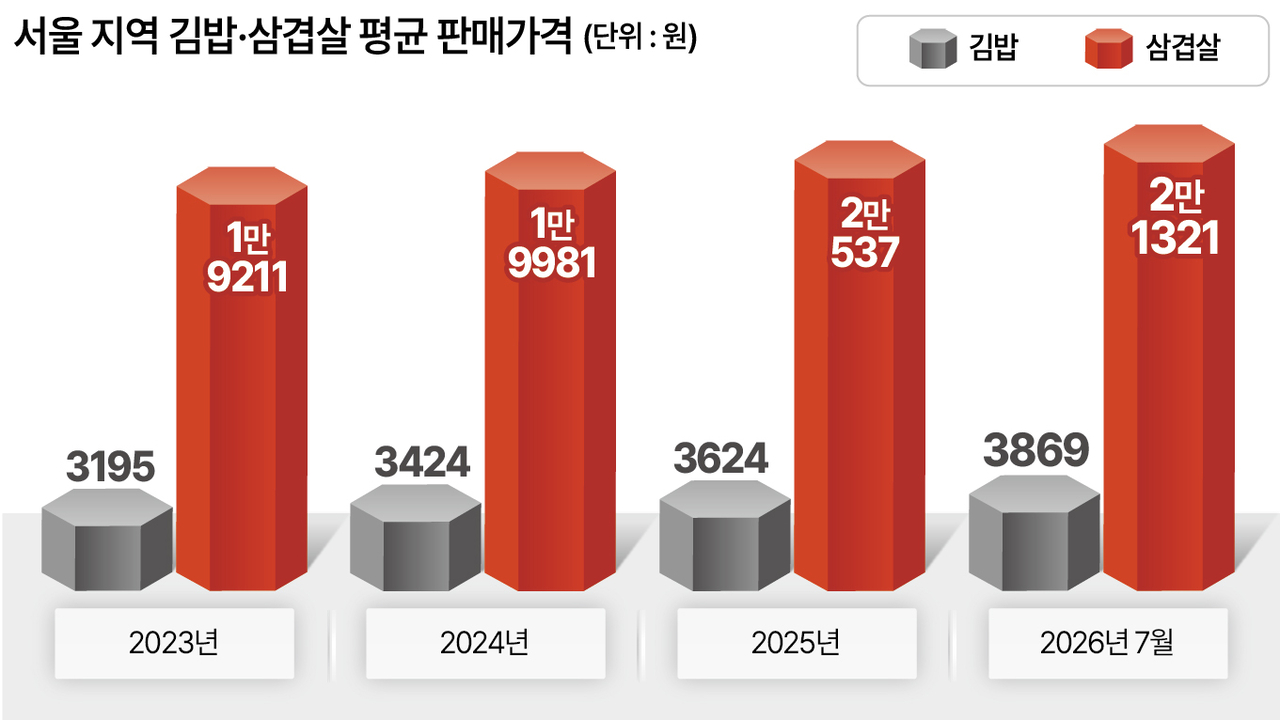
According to the Korea Consumer Agency's price-monitoring service, the average price of kimbap — long considered an affordable staple — reached 3,869 won in Seoul in July, just three months after hitting 3,800 won in April and now within striking distance of the 4,000-won mark. The figure reflects an average across major franchise brands and independent snack restaurants. At franchise chains, rolls priced between 4,000 and 5,000 won are now common: a basic roll at the well-known franchise Gimgane costs 5,000 won, while Gobongmin Kimbap sells its standard roll for 4,700 won.
Kimbap relies on a wide range of ingredients — vegetables, meat and eggs — making it directly vulnerable to broader price pressures. Leafy vegetables such as spinach and lettuce surged this summer as temperatures exceeded 40 degrees Celsius, and egg prices remained elevated throughout the first half of the year following a highly pathogenic avian influenza (AI) outbreak last winter.
Other popular menu items tell a similar story. Samgyeopsal, one of South Korea's most popular dining-out choices, averaged 21,321 won ($15) per serving (200 grams) in Seoul in July. The first-half average of 21,230 won marked a 4.3 percent increase from the same period last year, with rising import grain prices for animal feed and the spread of African swine fever cited as key drivers. Data from the Korea Agro-Fisheries and Food Trade Corporation show the average domestic price of samgyeopsal per 100 grams rose 3.5 percent year-on-year to 2,922 won.
Naengmyeon and samgyetang — dishes that see a sharp rise in demand during summer — also posted higher prices in Seoul in July compared with the previous month, averaging 12,692 won and 18,192 won, respectively.
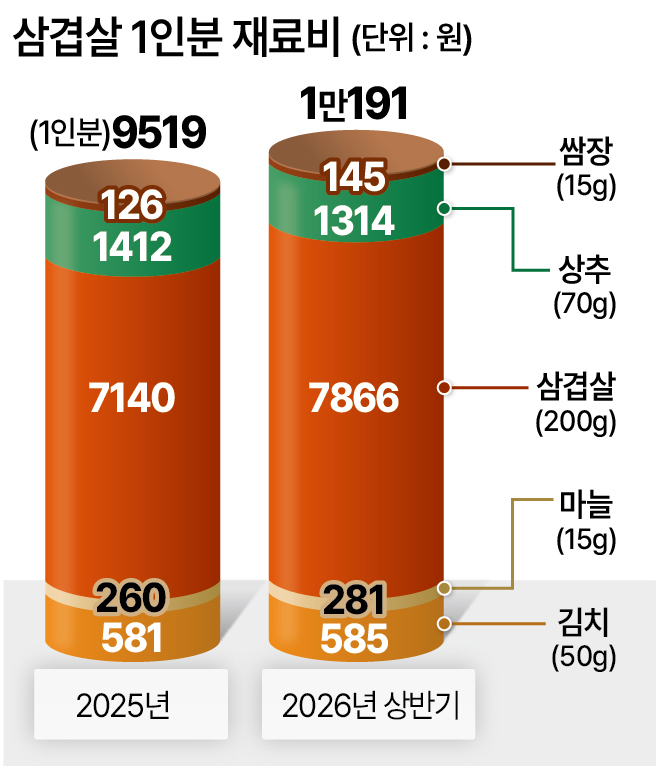
Cooking at home to save on dining costs offers little relief, as grocery prices have risen in tandem. The Korea Consumer Agency found that the ingredients needed for one serving of samgyeopsal averaged 10,191 won in the first half of this year, up 7.1 percent from 9,519 won a year earlier. For a family of four eating samgyeopsal at home, that translates to a cost increase from 38,076 won to 40,764 won over the same period.
Making kimbap at home is no bargain either. The agency found that buying the individual ingredients — including radish pickles (100 grams), eggs (10 pack) and dried seaweed sheets (10 sheets) — cost 11,822 won in the first quarter of this year. While that is 7.9 percent less than the 12,838 won recorded a year earlier, it is still three times the cost of a single serving of kimbap at a restaurant.
The Bank of Korea's statistics released this month show the preliminary producer price index for July fell 0.4 percent from the previous month to 129.39 (base year 2020 = 100), largely reflecting a drop in international oil prices. But experts say food prices remain unsettled even as manufactured goods ease. Major food companies — including Dongwon F&B, Ottogi, Paldo and Paris Baguette — have recently raised prices.
"We are seeing a polarization where overall prices are falling but food prices keep rising," said Lee Hong-ju, a professor of consumer economics at Sookmyung Women's University. "Unlike manufactured goods, which are directly affected by international oil prices and exchange rates, food is exposed to extreme weather such as heat waves and heavy rain, making it far more volatile." He added that because consumers buy food far more frequently than big-ticket items such as electronics or cars, the inflation they feel day-to-day is likely much higher than the headline figures suggest.
![A shopper browses the meat section at a hypermarket in Seoul. The Korea Consumer Agency found that the ingredients for one serving of samgyeopsal averaged 10,191 won in the first half of this year. [Yonhap]](https://wimg.heraldcorp.com/news/cms/2026/08/27/rcv.YNA.20260825.PYH2026082511460001300_P1.jpg)

soho0902@heraldcorp.com