Six Seoul Science High School students who won medals at international math and physics olympiads share their methods
'When I studied alone, I wanted to quit — but solving problems together was fun in itself'
Tears over missed team spots and silver medals — even prodigies face anxiety and setbacks
Teenagers who play games and watch short-form videos: 'Good grades don't mean you have to go to med school'
In the age of AI, they chose math and physics — and plan to 'find questions that matter'
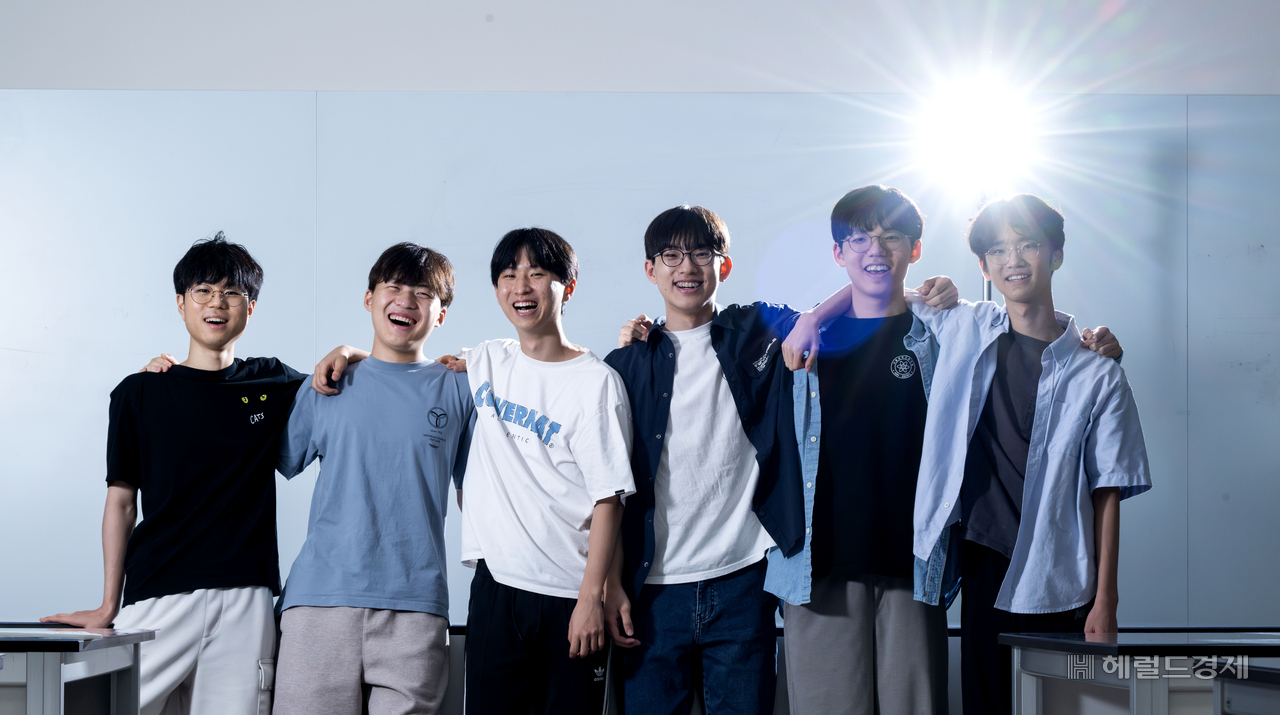
"At first, seeing a friend who was so much better than me made me feel competitive and even a little envious — like I had hit a 'talent wall.' But after we started solving problems together and got to know each other, that wariness faded and what grew instead was genuine admiration."
Kim Dong-hyeon, 18, a silver medalist at the International Mathematical Olympiad and a student at Seoul Science High School, could not help but measure himself against peers who outshone him. One of six Seoul Science High School students to win medals at this year's international math and physics olympiads, Kim was born with a natural gift for numbers — yet even he has tasted the frustration of hitting a talent ceiling. The wall he faced may have been a different kind, and a different height, from the one most people encounter.
On Monday, six young prodigies from Seoul Science High School sat down for an interview. Gathered with their friends, they were visibly energized and eager to talk — about winter breaks spent wrestling with math problems from morning to night, about the sting of missing a spot on the national team, about the anxiety of watching a classmate solve a problem faster, and about the tears quietly shed when results fell short of expectations. Yet the moment exams were over, they were back to reinstalling deleted games and losing themselves in short-form videos — teenagers like any other.
What excited them most, though, was the same for all six: the moment a problem they had been wrestling with finally yielded an answer. "I want to keep studying what I love," each of them said, in almost identical words.
How young prodigies study
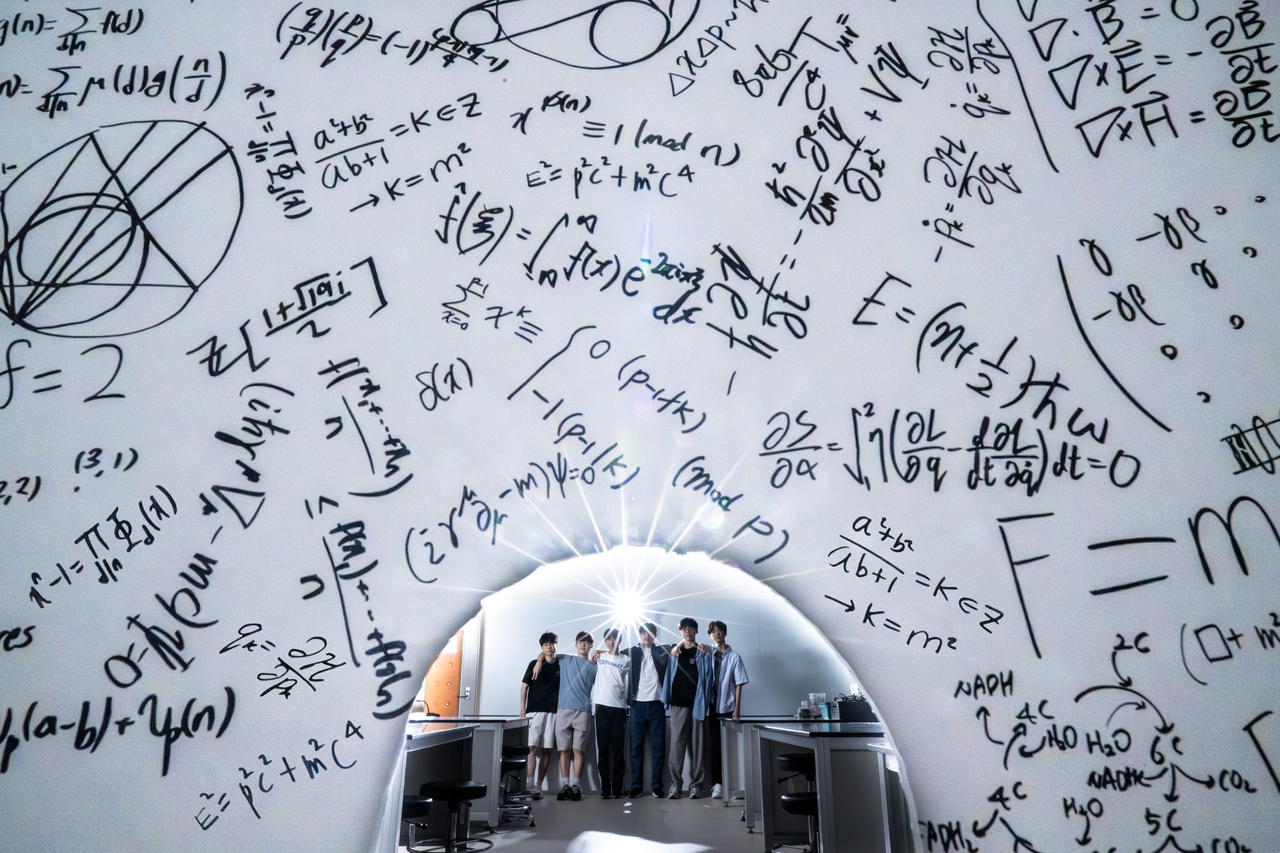
The core of their approach is immersion — not simply sitting at a desk for long hours, but staying aware of what they do not yet understand and thinking through every problem until the best solution emerges.
Lee Hyeon-jun, 19, a gold medalist at the Mathematical Olympiad, said he spent last winter break "doing nothing but math problems all day, except when eating." During the school term, there were days when exam preparation left no time at all for olympiad study, but whenever a free moment appeared, he sought out difficult problems and kept going.
Cutting sleep was not part of the formula. "I think the desire to get better is what matters," Lee said. "I spent a lot of time thinking about how I could solve this problem better, and how I could improve at what I was already doing."
Hong Seung-wook, 18, said that while juggling school grades and olympiad preparation at the same time, he made a point of identifying his weakest areas first and then directing more of his time there.
The physics students followed a broadly similar approach. Kim Mu-yeon, 19, Lee Kwon-hyeon, 19, and Jung Min-kwon, 18, built their foundations through school physics classes and then sharpened their competitive instincts by working through past International Olympiad problems repeatedly.
Studying together was equally important. The math olympiad winners took part in a voluntary club called the Mathematics Problem Research Group, where they shared problems they had each created and sat mock exams — three problems in four and a half hours, just like the real competition. The physics students gathered in dormitory rooms before competitions to work through past problems and compare their solutions.
Kim Dong-hyeon said the biggest change from studying alone was having friends around. "When I studied by myself, even a small roadblock made me want to give up and go play. But solving problems together was fun in itself," he said.
Some students attended hagwon for school grades or to get started with olympiad preparation. But the common thread was that as their level rose, the time spent finding problems on their own and exchanging solutions with friends became more valuable than being given answers in a classroom.
The students said the peer environment at their school had been a major asset in preparing for the olympiads. At the same time, they noted that students at regular high schools — where olympiad preparation sits entirely outside the university entrance system — would find it much harder to build the same kind of community. Hong said students preparing for olympiads outside specialized schools "need opportunities to meet, share problems and discuss them together."

Setbacks that shaped them
At this year's international olympiads, all 13 South Korean students who competed as national team members won medals. In mathematics, the team took three gold medals, two silver medals and one honorable mention; in physics, five gold medals, a clean sweep; and in biology, two gold medals, also a clean sweep.
Even for students regarded as among South Korea's most gifted, the road to those medals was far from smooth. Some missed selection for the national team. Others fell short of the results they had hoped for. There were moments when a more talented classmate made them feel small.
Lee Kwon-hyeon won a silver medal at last year's Asian Physics Olympiad. For a student who had been aiming for a spot at the international competition, it was a disappointing result. "I went as a representative of South Korea and came back with a silver — my pride was hurt and I cried," he said.
He spent the next year regrouping and earned a place at the International Olympiad. Then, just before the competition, he came down with chickenpox. Worried he might not be able to compete at all, he sat the exam in a separate isolation room and ultimately won a gold medal.
Kim Mu-yeon did not even make it to the interview stage on his first attempt to join the national team. He told himself he could make the interview next time, and then the team after that — and this year, he did.
The International Olympiads are academic competitions held for middle and high school students worldwide, covering subjects including mathematics, physics, informatics, chemistry and biology. Each country typically selects a team of four to six students through a domestic qualifying process. Depending on the subject, competitions may include not only theory and problem-solving but also experimental and practical assessments.
Jung Min-kwon said watching his sunbae solve problems far faster than he could left him haunted by the fear of not finishing in the top five. At the international competition itself, he felt his experimental exam had not gone as well as he had hoped and assumed he would not win a gold medal. When the results were announced, his first thought was: "What a relief."
Setbacks were just as common in mathematics. Hong Seung-wook missed out on the national team candidate pool after making an error on a functions problem he had considered straightforward. "I was really disappointed at the time, but it made me think I should never let my guard down again — and it pushed me to study harder," he said.
Kim Dong-hyeon said the anxiety he felt during the team selection process ultimately became fuel for growth. "Of course it hurts when you don't get the result you were aiming for. Still, the enjoyment I found in studying math and the friends I studied with — those don't disappear. I think that in itself is already a good enough experience."
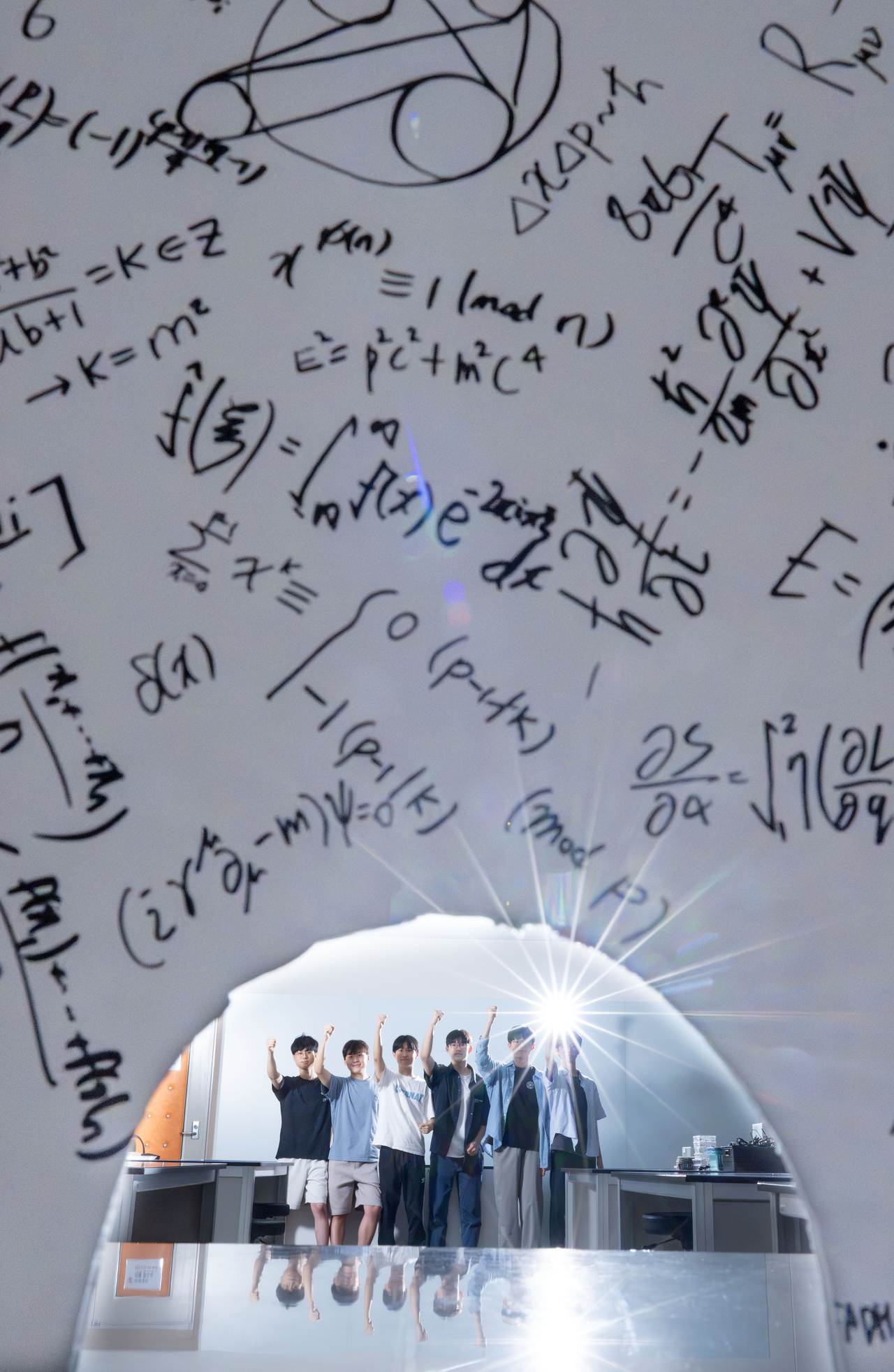
Med school? We could go — but we won't
Away from their books, they were indistinguishable from any other teenagers — playing games, catching sleep whenever they could, and sometimes losing track of study time after falling down a short-video rabbit hole.
Kim Mu-yeon installed League of Legends the moment his olympiad competition ended. Jung Min-kwon said he enjoyed Don't Starve and Minecraft, and has played chess since middle school.
Smartphones were a constant temptation. Lee Hyeon-jun said that once he started watching short-form videos, he could not stop, and that before major competitions he used an app to block his access to social media. "I'm still looking for a way to resist," he said.
Jung Min-kwon played chess with a student from the Mongolian team in the hotel lobby and joined Korean teammates for a card game. Lee Kwon-hyeon bonded with the Costa Rican delegation at a party over salsa dancing. On days without exams, the math students also spent time playing board games and taking part in cultural activities with delegations from other countries.
Asked about their plans after high school, the six students had different ideas — but all of them drew a line at medical school. They said they wanted to do meaningful work grounded in mathematics and physics.
"I could go, but I won't," Kim Mu-yeon said. "If I have to work anyway, I'd rather earn money doing something I love." He said he hopes to study physics at Seoul National University or KAIST and pursue research in areas such as quantum computing.
Jung Min-kwon, who ranks among the top students in his school, plans to study electrical engineering and computer science. "The reason I worked hard on my grades was to keep my options open," he said. "If I went to med school just because my grades were good enough, I'd actually be narrowing my options, not expanding them."
Lee Kwon-hyeon is considering studying electrical engineering and computer science at Seoul National University or pursuing graduate study in the United States. As a child, he said, he first grasped the meaning of technology when he saw a friend with Parkinson's disease use a motorized wheelchair to join other children in play. "I realized that technology can let people live alongside others," he said, adding that he wants to develop technology that protects people's lives and dignity.
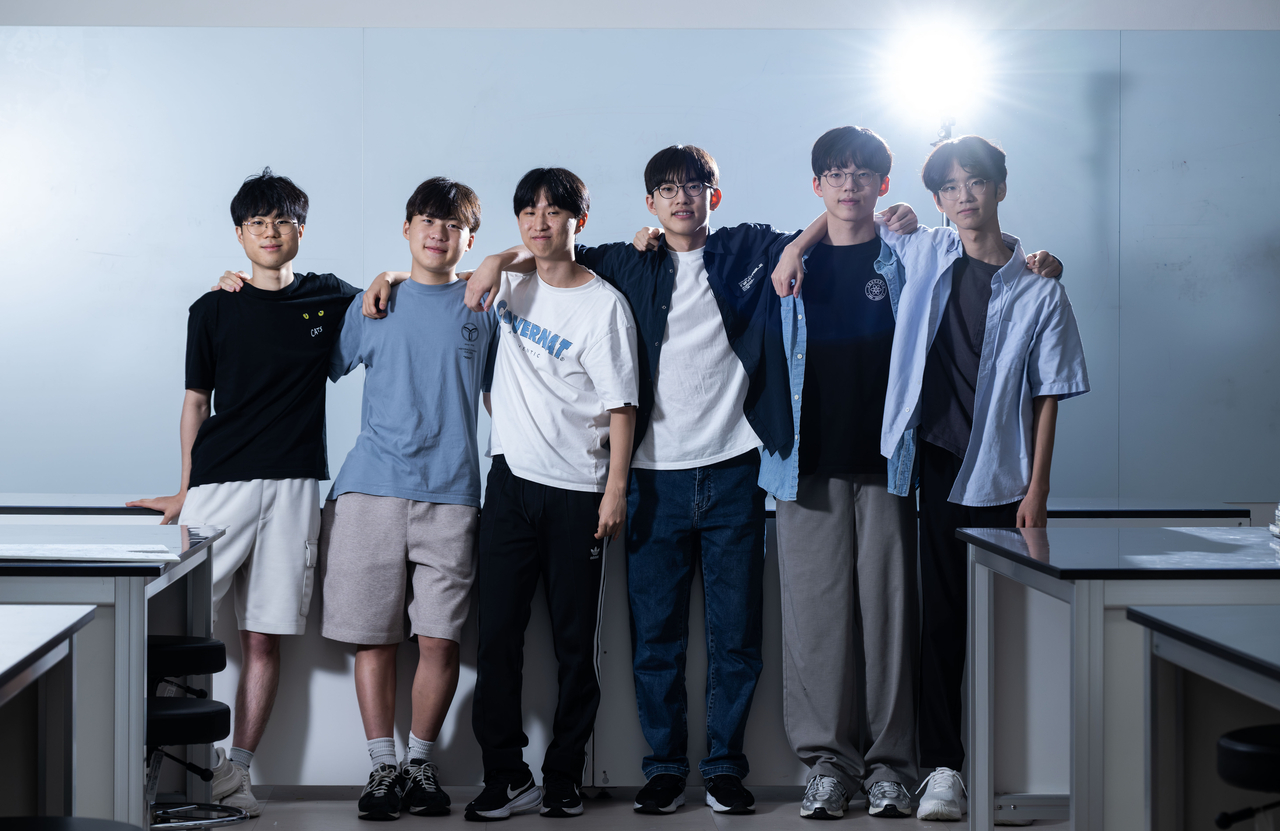
The future these prodigies envision
The olympiad winners said they believe there is still a meaningful role for humans even as AI advances rapidly.
Lee Hyeon-jun said that even if AI eventually solves far harder mathematical problems than it can today, the role of the human mathematician will not disappear. "Mathematicians don't just solve problems — they also create problems, deciding what needs to be solved and judging which questions are worth asking," he said.
Even as AI takes on a growing share of problem-solving, he argued, humans will still be needed to generate new questions and identify which problems are worth pursuing. Lee said he expects humans and AI to collaborate in mathematical research, each drawing on the other's strengths.
Asked what single question he would choose to answer if he could devote his entire scientific career to just one, Jung Min-kwon said he would want to solve the "theory of everything" — the long-standing challenge in modern physics of unifying the four fundamental forces of nature, including gravity and electromagnetism, within a single theoretical framework.
Even so, physics has not always been enjoyable for him. He said that grinding through similar problem types while preparing for school exams once made the subject feel less exciting than it had when he first enrolled. After the olympiad ended and the pressure of rankings and selection lifted, he returned to studying the physics he actually wanted to explore — and found the joy again.
Their study methods, their dreams and the problems they want to solve are all different. But when asked why they opened their books again after each failure, their answers converged on the same place: before the grades and the medals, there was simply the feeling that math and physics were fun.

brunch@heraldcorp.com
jookapooka@heraldcorp.com